The most successful executive capital allocators in history naturally get to a point in their careers when, after decades of rolling their snowball, they’ve deservedly earned their mark, immense wealth, and fawning adoration in the investment community: Warren Buffett, Henry Singleton, Mark Leonard, John Malone, Tom Murphy, the Rales brothers, among others.
The revered are invariably North American. Yet lurking in Sweden is a high-performance conglomerate with a track record spanning almost three decades so stellar you could frame it in the investment hall of fame next to Teledyne.
The company’s name is Lifco. It’s a classic investment saga and as pure a capital allocation tale you can get: From 1998 to 2019, under Fredrik Karlsson’s stewardship, the company ballooned earnings 100-fold through pure deal-making with just a handful of employees, preaching at the altar of decentralization. It pulled this off from a modest head office in the back of an industrial building in the quaint Swedish 25k-population town of Enköping.
Originally founded in 1946 as a central purchasing entity for medical equipment in Sweden, Lifco’s real history ignited in the 1990s. After a short stint as a division of the publicly traded Getinge Group, it was spun off to shareholders in 1998. Two years later, following a rocky stretch, Carl Bennet, Getinge’s majority owner, took Lifco private under Carl Bennet AB. The deal was a bargain. He paid EUR30mn for the business, divested its food remedy segment, and recouped his entire investment. More assets were sold off and subsidiary managers replaced, leaving Lifco with its dental products distribution business.
Fredrik Karlsson, a spry 30-year-old at the time, ascended to CEO of Lifco amid the spin-off from Getinge. Now under Bennet’s ownership, Karlsson became his apprentice.
Jan Wallander, who steered Handelsbanken through the 1970s and 1980s and wrote the book “Decentralization – Why and How to Make it Work”, pioneered the Swedish model of decentralization. He advocated for lean headquarters and pushing decision-making authority down to the front lines, close to the customer. Percy Barnevik, at the helm of ABB during the late 1980s and 1990s, was the first to earnestly adopt this blueprint, fracturing ABB into 65 business units, each led by 65 managers and individual P/L responsibility. This ignited the Swedish ethos of genuine delegation. Under his ownership, Carl Bennet craved the same for Lifco, transforming it into a capital allocation machine. Karlsson’s mandate shifted from turnaround specialist to serial acquirer and CEO appointer.
“From Carl [Bennet], I learned the power of simplicity. I was too academic when I was young. And when you are over-educated, you are inclined to do everything yourself because you think you are that good. But he emphasised that one should not go in and interfere after you have given people responsibility.” —Fredrik Karlsson, from this interview
Aside from merging with its sister company, Sorb Industrier, in 2006, Lifco’s strategy from the end of the 1990s can be boiled down to private market arbitrage, acquiring predictable niche companies on the cheap and never striving for home runs. Early on under Bennet’s wing, Karlsson realized it was probably a bad idea to stick to a smaller vertical like dental distribution since the roll-up path would eventually turn expensive and yield middling results. So Karlsson, flanked by his right-hand man, Per Waldemarson (Lifco’s current CEO), began buying industrials too. Today, Lifco’s +260 company portfolio splits like a jumble into sector-agonistic B2B businesses, encompassing everything from excavator attachments, specialist orthodontist supplies, ship compressors, electrical equipment, coffee machines, auto trailers, and beyond. Dental distribution has dwindled to under 25% of the mix.
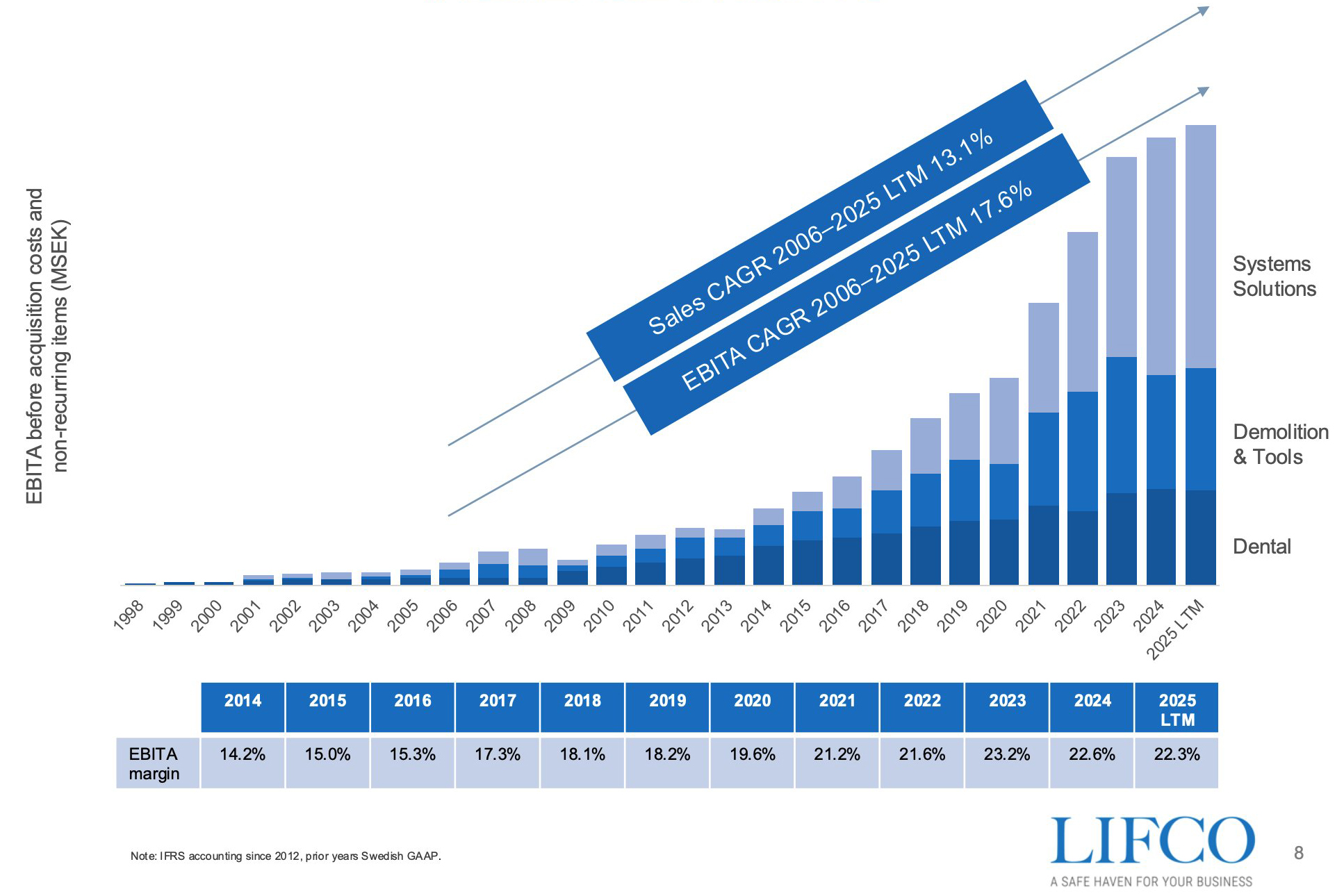
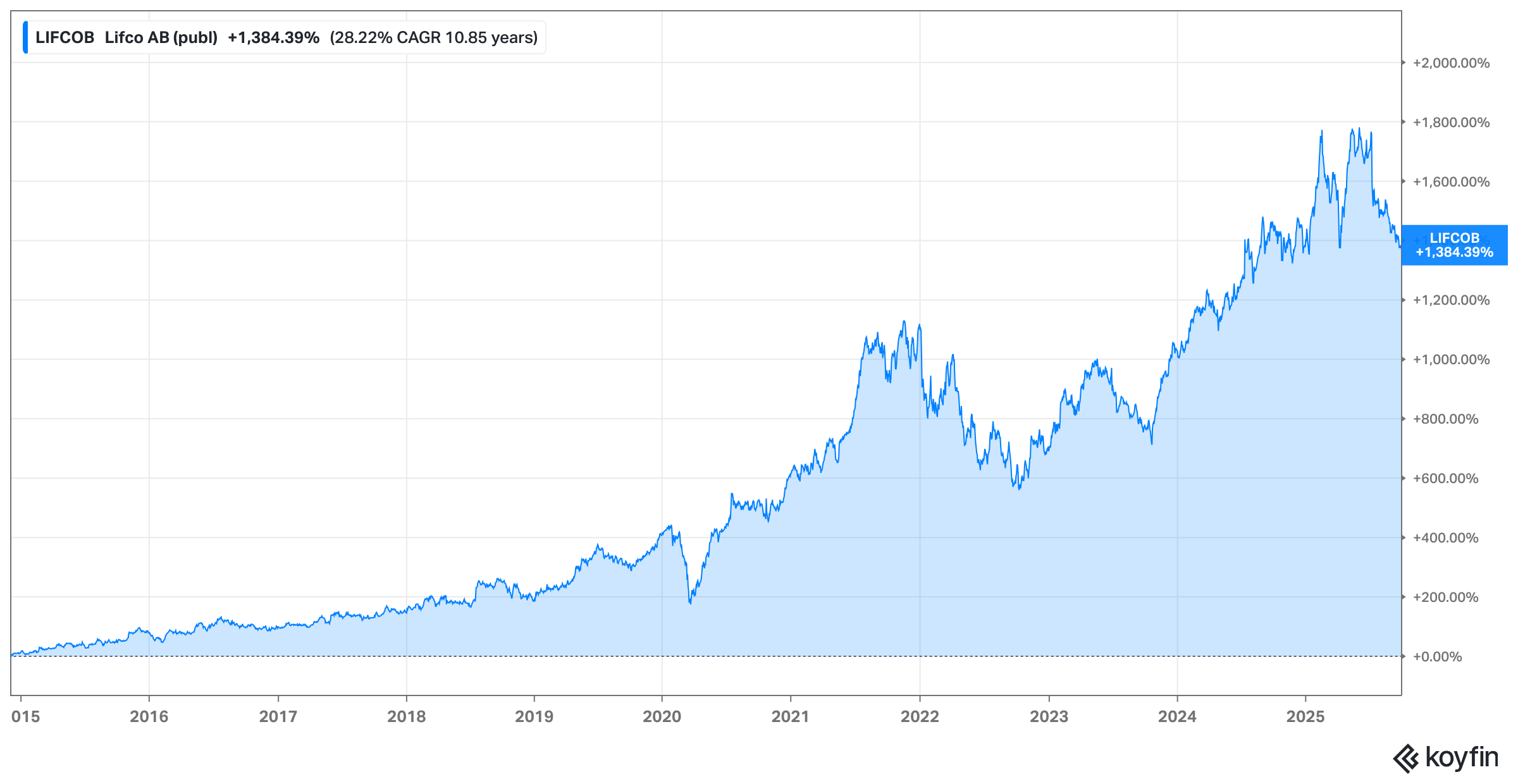
Karlsson’s move, multiplying the M&A runway many times over through diversified verticals, was a triumph. Between the spin from Getinge in 1998 till 2019, when Karlsson left Lifco, the company compounded operating earnings by a startling 18.4% per year while paying a dividend. From 2014, when Bennet took Lifco public for the second time, to 2019, the stock cranked out a 32% compounded annual return including dividends (paying out roughly one-third of earnings annually). And it has continued to be a home run under Waldemarson, delivering a full compounded total shareholder return from 2014 till today at 28% annualized on the back of a 20% EBITA CAGR, dividends, no change in share count, and a doubling of the multiple. Bennet’s stake (50.2%) is today worth a staggering SEK75bn ($8bn).
Today’s sprawling diversity of the Lifco constellation veils the fact that what Karlsson did at Lifco boils down to something as prosaic as buying predictable moats at cheap prices over and over again. Capital was relentlessly directed to acquire the cheapest, most predictable private companies in Lifco’s orbit. Lifco zeroed in on market-leading SMEs with enduring customer relationships in steady-growth industries, unburdened by customer or supplier concentration. Targets typically delivered mission-critical, proprietary offerings that claimed low wallet share with customers, breeding lock-in effects with pricing power. For manufacturers, Lifco required limited in-house production and flexible working capital. Project-based operations were almost taboo, ill-suited to a decentralized, trust-driven regime. Lifco never invested in turnarounds or companies in flux. Hot, fast-growing industries were screened out. This was a risk-averse cult, putting Buffett’s “catastrophe risk filter” above all, ruthlessly focusing on what little disruption could break the business.
The tiny headquarters had a handful of people, some telephones, and cost discipline. There was nothing fancy about Lifco’s M&A machine. Due diligence was quick, personal, and grounded in (un)common sense. Investment decisions rested centrally with the C-suite, supported by a small circle of acquisition managers. Bennet granted Karlsson and his team near-total autonomy, with board oversight kept to an absolute minimum.
Unlike other serial acquirers in deep verticals like vertical market software, Lifco didn’t keep a database. And unlike vertical acquirers with limited runways, such as AddLife (Karlsson resisted external pressure to spin off Lifco’s dental business when AddLife spun off from AddTech), Lifco was an accumulator that needed to be more paranoid about what it was buying the more heterogeneous the target. Lifco couldn’t draw on intelligence within the organization to appraise a target like an AddTech would do. Nothing was automated. Lifco had criteria but no written playbook to delegate down. And since Lifco was sector-agnostic, while the vast majority of deals were sourced from brokers and the remainder from group managers, there was little warming up to potential targets over years of coffee dates. Lifco never hired consultants to have them explain what it was buying.
Opportunity cost drove every decision. For each deal Lifco closed, it would think about what deal would slide along the desk the following week in another vertical and wouldn’t give a hoot about its market price. If a broker quoted an 11x EBITA offer, Lifco still countered at 7x because that was the opportunity cost. Year after year, it bought only companies meeting its bid. Like Berkshire, Lifco didn’t negotiate. Multiples paid stayed firmly in the 5-8x range.
The Lifco system (more details to follow) proved massively successful and remains so today. But by early 2019, a pay package dispute ended the partnership between Karlsson and Bennet. Karlsson’s right-hand man, Waldemarson, assumed the helm at Lifco. After a two-decade run, Karlsson was now a free and wealthy man.
He wasn’t unemployed for long, though. It should be no surprise that Karlsson went on to set up his own acquisition vehicle, partnering with Tomas Billing, then-CEO of Nordstjernan, a foundation-owned investment firm. Armed with a vision, reputation, and thick rolodex, the duo raised a full SEK2.7bn in just three weeks, overshooting their initial SEK1bn expectation, and set Röko in motion. Among the backers was Peter Sterky, CEO of Trift Capital, who joined Karlsson and Billing on the board.
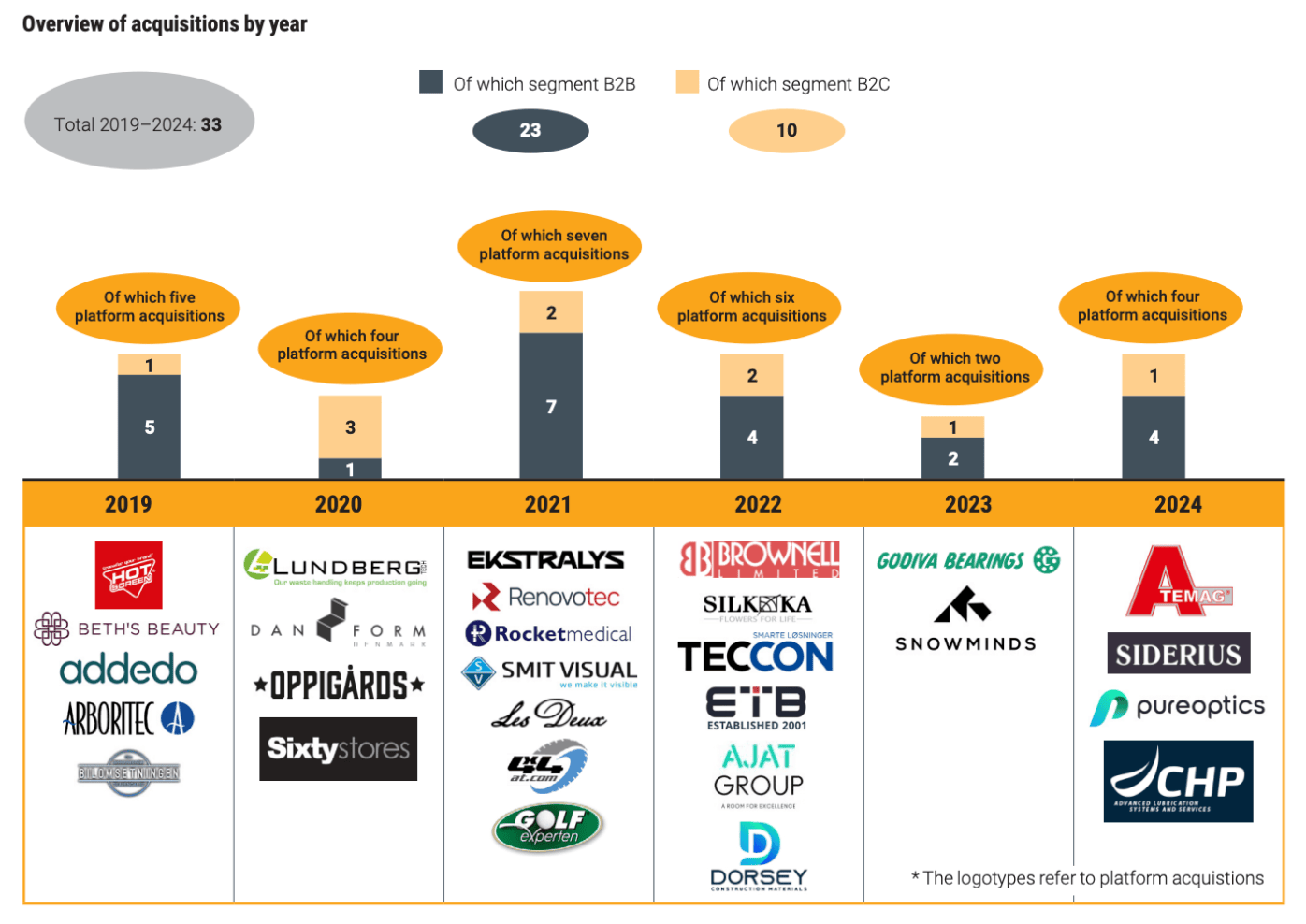
In its debut year, Röko sealed six acquisitions. The second year brought four more, pushing into Denmark and the UK. Then came nine acquisitions in 2021, moving into the Netherlands, alongside two new board additions bringing the total to five. By 2022, Karlsson and Billing geared up to accelerate the M&A engine, returning to original investors to ask for more money. Everyone increased their commitment pro rata, netting another SEK1.1bn. In the summer of 2023, Röko then raised another SEK700mn through a rights issue with 96% of shareholders participating and an oversubscription of 220%. Trust was plentiful. From 2019 to 2023, Röko amassed SEK4.5bn in total capital. Since inception through today, Röko has deployed >SEK8bn across 29 platform acquisitions (34 including add-ons), with 14 rooted in the Nordics and the balance scattered across the UK (8), Netherlands (4), Germany (1), Belgium (1), and France (1).
Röko went public in March of this year as a promised liquidity event for the initial investors at the offering price of SEK2,048 per share, or a SEK30bn market cap. Of the 144 initial shareholders, 69 sold portions of their holdings in the offering. The company received no proceeds. Karlsson and Billing, whose net worths each surged past SEK3bn, along with deputy CEO Johan Bladh (more on him later), sold no shares and locked up theirs for three years. Other directors and executives faced a one-year lockup, while remaining initial shareholders got 180 days, which just expired this September.
Röko mirrors Lifco’s decentralized structure and acquisition process but on a smaller scale. Yet its portfolio and incentive system diverge in two key ways, as Karlsson emphasizes, boldly dubbing Röko a “refinement of Lifco” with a more “structured mindset”:
- While Lifco targets moaty B2B businesses across diversified cycles, Röko earmarks roughly one-third of its capital to branded B2C businesses with higher growth potential and shorter track records, leveraging Billing’s experience working closely with founders and visionaries from Nordstjernan. Karlsson frames Röko as “70% Lifco, 30% Nordstjernan.” This VC-like tilt contrasts sharply with Lifco’s insistence on a decade of consistent financials before pulling the trigger, typically buying companies that are >30 years old. So far, Röko’s B2C bets include a Danish clothing brand, a golf equipment retailer, and a Norwegian beauty brand, among others. Time will tell if these belong in the durable camp or whether Röko will increasingly be burdened by impairments and distraction from 100% capital deployment. As the underlying returns on capital employed will show in a minute, it does seem like Röko has been slightly more trigger-happy to get the ball rolling.
- Röko’s focus on younger, growth-stage companies shapes its ownership approach too. While Lifco almost always acquires 100% of targets, sparingly keeping earnouts and frequently bringing in a headhunted, hardworking, and perhaps malleable youngster in the early-30s of age to replace the CEO to groom for group manager roles, Röko takes majority stakes and always keeps existing management on as non-controlling shareholders of the acquiree. Oftentimes, the acquiree’s second-tier managers also buy into the NCI stake. Non-controlling interests vary by acquiree — Röko owns 59% of Addedo, a software consultancy, and 85% of TECCON, an electrical product developer — but include call and put options on the NCI, meaning Röko has a right to buy the NCI and the seller has the right to sell the same NCI, typically with a five-year expiration and a deal consideration tied to trailing earnings multiples. (This contingent liability, btw, is recognized at fair value on the balance sheet and should be included in enterprise value calculations, which data providers do not pick up on.)
By first-level thinking, these models feel similar, with ample skin in the game and aligned incentives with the subsidiary managers. But it should not be underestimated how profoundly different these ownership models actually are, perhaps setting up very different incentives down the organization.
To clarify, let me first outline Lifco’s operating model and incentive structure once an acquiree enters the conglomerate:
Post-acquisition, Lifco swiftly integrates the acquired company: management and employees adopt its Code of Conduct, a monthly financial reporting system takes effect, and a new board, chaired by a Lifco veteran with at least a decade of group operational experience, is appointed. Beyond that, little changes. The acquired company retains autonomy to operate as usual.
But the most interesting bit is how Lifco optimizes capital employed and makes sure every dollop of excess cash gets sent to headquarters for M&A redeployment. Because Lifco’s distribution businesses are light on fixed assets, there’s a fierce focus on working capital and tightening the financing of growth opportunities.
In the spirit of Bergman & Beving’s EBITA/WC metric, pioneered in the early 1980s and a cornerstone for descendants like Lagercrantz and AddTech, Lifco’s incentive system down the organization hinges on working capital employed. Subsidiary managers earn cash bonuses above a certain absolute profit level but face penalties on capital increases. For illustrative purposes, if a subsidiary grows EBITA by a factor of 100, the CEO might secure a 10% bonus; yet, if capital tied also rises by 100, a 25% penalty reduces the bonus to 7.5%, effectively setting a 25% ROCE hurdle. Hurdles and penalties, of course, vary by company and gross margin. Lifco owns firms where volume growth is discouraged in favor of specialization, and others with 80-90% gross margins where doubling inventory barely dents the bonus calculus.
To nudge subsidiary managers further, Lifco enforces stringent inventory valuation rules. If the inventory doesn’t turn, strict formulas make sure to write down the inventory quickly. It’s the same for receivables: all overdue days are written off, regardless of promises made to customers. These impairments hit the subsidiary’s earnings and, consequently, the manager’s bonus, with profits restored only when customers settle. Managers typically learn this lesson once.
This incentive system works beautifully for the moaty niche businesses that Lifco acquires and strikes a balance of how responsible managers deploy capital. If they hold excess cash, they’re incentivized to send it to headquarters to shrink the capital employed. If they recklessly deploy FCF into bad initiatives to boost profit growth, their bonuses will suffer. The result is that subsidiary managers maximize their bonuses by maximizing margins, since topline growth demands heavier investment. This aligns with Lifco’s indifference to volume growth, instead throwing every excess krone into new bargain acquisitions. By prioritizing margins, subsidiary managers spend their energy building more barriers around the business as opposed to growth, making it more irrelevant for competitors to take market share.
Now compare this system to Röko’s ownership model where incentives are more likely to misalign with headquarters:
When Röko acquires a company, the integration is somewhat similar. A forward-looking growth plan is crafted to fund strategic opportunities, and the CEO undergoes training in Röko’s culture and philosophy. A monthly reporting system gets implemented. A senior rep from Röko is put on the board as a sounding board for management. Like Lifco, Röko also has strict rules on working capital.
Yet, the subsidiary manager’s behavior isn’t shaped by an incentive structure designed by headquarters, but dictated by the manager’s ownership stake in the subsidiary.
This can potentially clash (emphasize on “potentially”). Both Lifco and Röko obsess over margins, fear tying up capital, and prioritize discussing objectives with subsidiary managers post-acquisition. Their playbooks align: push more outsourcing (especially manufacturing) to maximize returns on tangible capital, implement swift price hikes to test pricing power, and cut risky customers (Röko’s operators, for instance, face pressure to ensure new products or new large clients deliver above-average margins). Lifco’s handpicked, younger CEOs rarely resist these mandates, molded to serve the conglomerate’s interests. A Röko operator, on the other hand, and I may be exaggerating here, is more incentivized to maximize trailing operating earnings for a banger exit price than an ongoing salary, so is unlikely to be fully aligned with some of these objectives. A tug-of-war can emerge where the operator fears Röko wants to minimize the operator’s capital employed, and Röko fears the operator wants to maximize it. Karlsson himself has noted that the few times Lifco used earnouts in acquisitions, they have proven costly. Though direct ownership fosters more alignment than earnouts, is an operator’s incentive with a put contract in hand really that dissimilar?
It might seem I’ve cast Röko’s model in a negative light. To be clear, I’m not telling you which model is better, as Röko’s approach may suit its focus on younger, growthier businesses. But the point of this rant is that I’ve been reading lots of arguments claiming Röko to be a smaller carbon copy of Lifco, which isn’t true. Both are fully decentralized serial acquirers of SMEs, yes, and both have had Karlsson in common, yes, but there are critical nuances. The risk is different, and the potential organic growth is different.
Röko is already aware of these ownership misalignments and tries to mitigate them by implementing finance manuals and internal control frameworks post-acquisition alongside basing the put/call contracts on three-year trailing earnings multiples rather than a single year. And sure, Röko’s ownership model could have been a form of early financing complement to raised capital to grow Röko as quickly as possible which may gradually shift to Lifco’s model over time for future acquisitions (the Offering Circular did talk about ownership percentages going up and mandatory put/call liabilities to go down over time) as Röko establishes a more continuous deal flow and cultivates a deeper cadre of group managers, each overseeing their own portfolio of subsidiaries.
In fact, group managers add another important layer to the Lifco system, one Röko (likely) lacks for now. As I noted earlier, Lifco group managers, who are appointed as chairs of subsidiary clusters, are exclusively former subsidiary CEOs steeped in Lifco’s culture for over a decade until finally being promoted to GM. Although this may elicit comparison with a Constellation Software portfolio manager, it shouldn’t, since a Lifco GM, as opposed to a Constellation PM, isn’t usually delegated M&A responsibility, only operational mentorship, guiding the next generation of operators. Becoming a Lifco GM can be as financially rewarding as getting the top job at the largest Nordic firms. Once promoted, the GM rakes in big paydays, with bonus packages that can run into the tens of millions SEK. These GMs are incentivized the same way as Lifco’s subsidiary managers, with cash bonuses tied to a percentage of profits from the subsidiaries they manage. Smaller subsidiaries grant a higher percentage and larger subsidiaries a smaller percentage. As GMs build their cluster, Lifco gradually reduces the percentage over time and eventually swaps all bonuses into a fixed salary, allowing the GM to get a swap of what they’ve built and take it home as a safety net. The idea is that GMs should oversee just enough subsidiaries (usually 10-20, though Martin Linder, who heads Lifco’s Systems Solutions segment, oversees 30) to resist getting too bored and steering from the top. This, btw, is more decentralized than Addtech’s 7-7-7 structure, where each business area with one manager generally holds seven companies.
This whole governance structure puts an intentional constraint on Lifco’s acquisition pace. If each GM needs at least ten years of operational experience as subsidiary manager, the M&A machine will be confined to how many trained GMs you have in the drawer. Lifco dealmakers (management + acquisition team) today count 7 people, with 16 group managers overseeing the operating clusters.
Perhaps for Röko shareholders, this is a question of patience. But considering how busy Röko has been growing so far, into assets at 1/4 that of Lifco, the people factor could add a serious restraint to its runway just few years out. Currently, Röko’s 6 dealmakers are enough to do this efficiently, but without a clear pipeline of apprentices (something we know nothing about but is likely absent given Röko’s ownership model), you could see how this might turn into a problem after some years of further acquisitive growth.
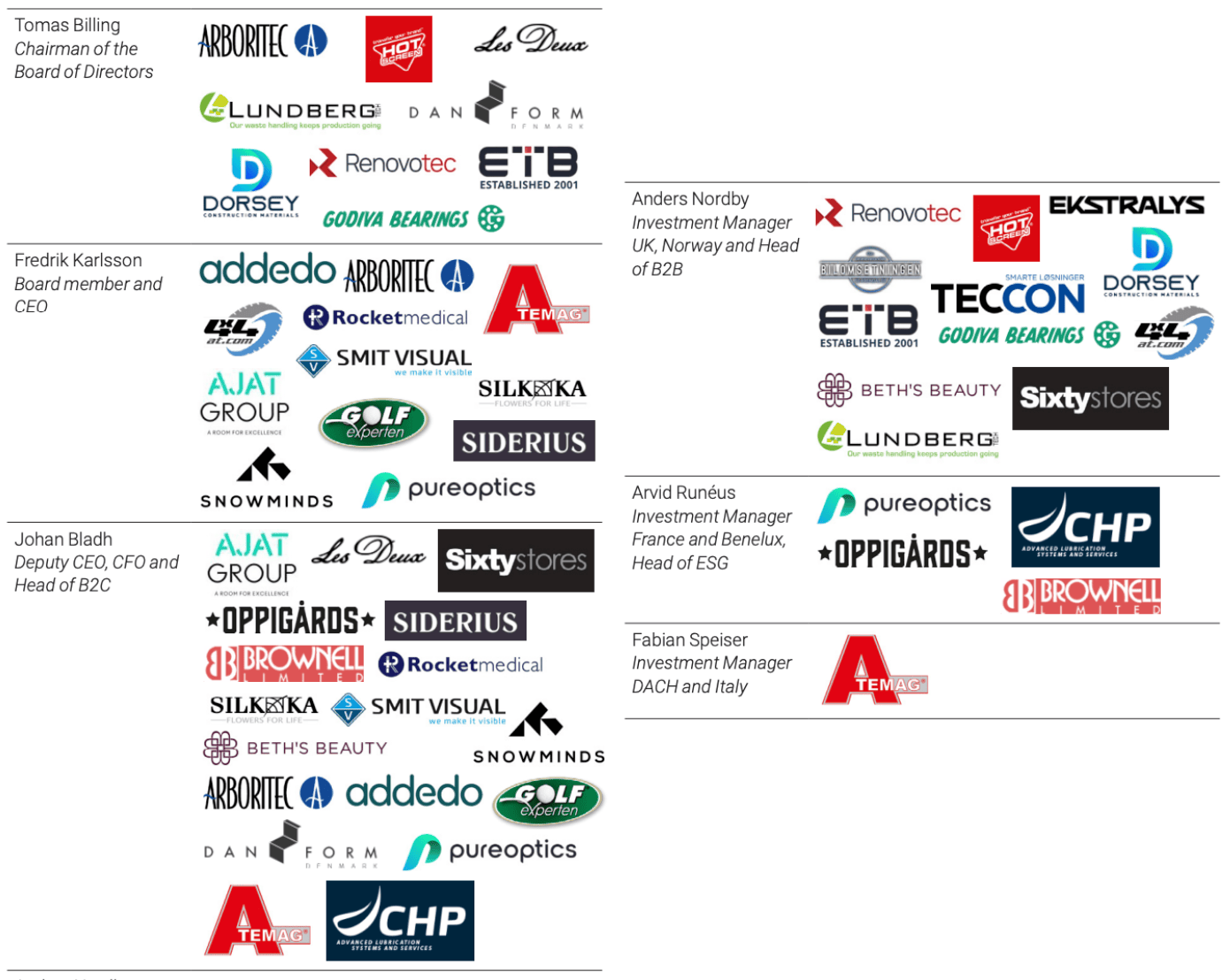
Time will reveal whether Röko’s hybrid of Lifco’s discipline and Nordstjernan’s founder-centric flair refines Lifco’s playbook or unravels its seams. The argument so far for picking Röko over Lifco, per my understanding, is that what you lose in durability, you gain in organic growth (like at Lifco, Röko’s group subsidiaries in aggregate make returns on tangible capital well over 100%, making any organic growth highly accretive to value). And sure, you gotta take Röko’s rapid growth and limited history into account, but may the potential organic growth difference really be overstated?
From 2015 to 2024, Lifco’s legacy Dental business posted flattish organic EBITA growth at a 1% CAGR. But the Demolition and Systems Solutions segments (a catch-all for everything else) have grown EBITA by 9% and 12% per year, respectively, boosted slightly by an SEK tailwind. Lifco believes its long-term organic EBITA growth to be GDP+, with Dental outperforming its past 1% growth number since the mix has changed. For Röko, organic growth since inception in 2019 has averaged 6% (unfortunately, Röko doesn’t break out organic EBITA growth but claims the number was 9% in FY24):

Of course, you gotta cut Röko slack on timing, having snapped up loads of B2C businesses at a time when some may have had a Covid boost, now retracing in recent years. But say over the long term, if you can expect something like mid-single-digit organic growth at stable margins, you can add that to Röko’s 2.9% FCF yield ex-acquisitions for FY24 (Röko doesn’t break out lease payments in the cash flow statement so I’ve used the depreciation of ROU assets as a proxy) and see that there’s obviously a lot of M&A optionality baked into Röko’s share price. (Lifco trades at a 2.5% FY24 FCF yield.)
Röko expects to pay out 0-20% of earnings in dividends, meaning all FCF will likely be spent on deals in the foreseeable future. This means that what you get as a shareholder over the long term is Röko’s FCF growth rate ± change in the multiple. This is a testament to the fact that Karlsson and co. see a lot of future M&A runway. I find it likely that Röko will introduce a symbolic dividend at some point in the near term to sharpen the scarcity of capital and discipline.
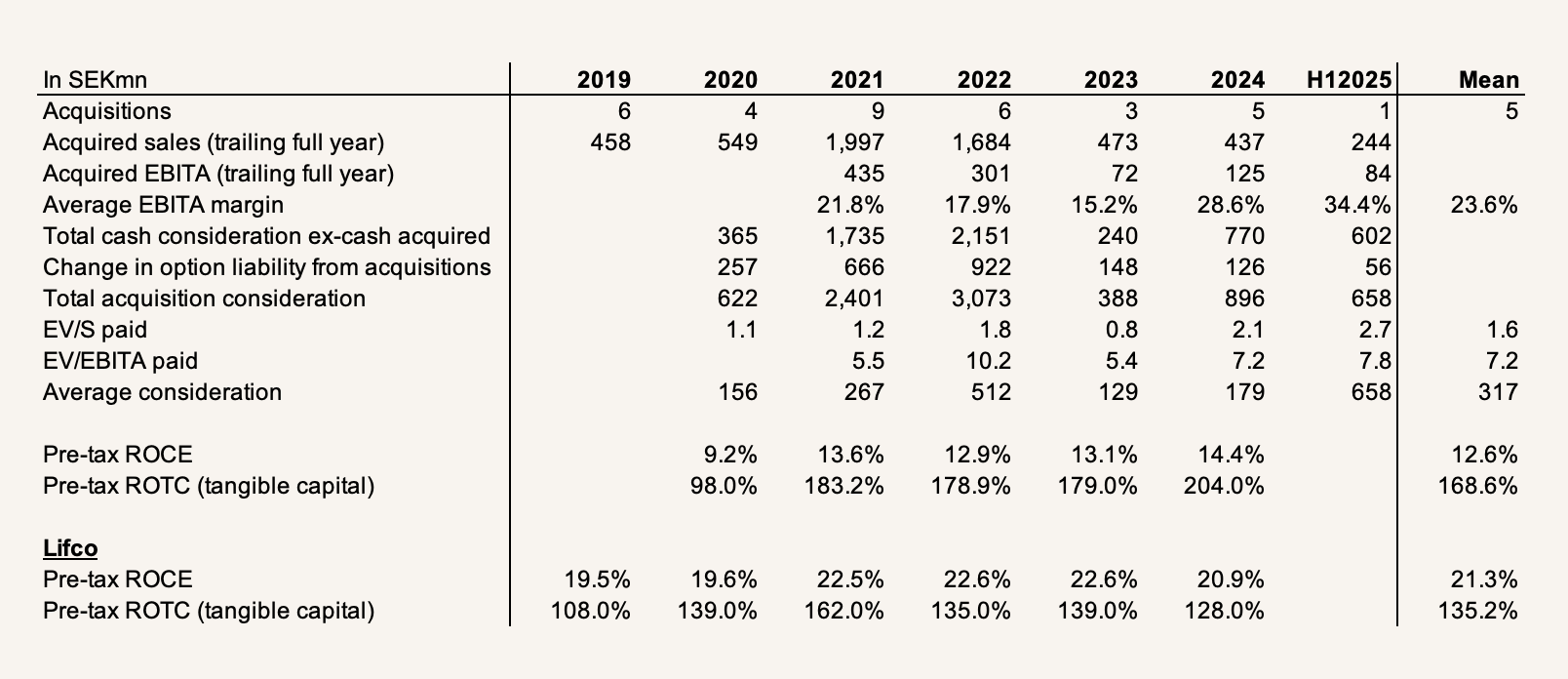
Since inception, Röko has acquired 5 companies per year at an average deal consideration of ~SEK300mn. This average is pulled up by the one large deal Röko did in H12025 of Topa Bathroom, a Dutch designer of bathroom products, as you’ll see below. Multiples paid have, by my calculation — taking the net cash spend and adding the fair value of the call/put liability at the time of acquisition — so far averaged 7.2x EBITA, ranging from 5-10x through Röko’s six-year lifetime. Add capital-light organic growth and you get to low- to mid-teens pre-tax returns on capital employed, with Lifco’s comparable returns provided for context:
Many investors have the wrong idea in their minds that Röko is constantly meeting companies and priming managements for the sale of their business. It does that to a small degree, but like at Lifco, the vast majority of Röko’s deal sourcing comes from its 600-odd broker relationships around Europe. Managing an accumulator is old-school marketing and sales work by picking up the phone, not blasting emails. In fact, broker relationships are, by Karlsson’s words, one of Röko’s (and Lifco’s) barriers to entry from serial acquiring copycats. Surfing Karlsson’s and Billing’s decades of network-nurturing, Röko continuously invests time in establishing broker relationships, educating them on the type of companies it’s looking for and how Röko treats them post-acquisition.
Because Röko never participates in bidding wars and never surprises sellers with discount negotiation tactics after the LOI phase, this differentiates Röko early in the sales process, ensuring it receives the right calls for the right offers first. Hence, the other barrier to entry is reputation. Brokers who call Röko with a suitable deal can count on high transaction certainty. And sellers can count on fast due diligence (typically six to eight weeks), where Röko meets the entrepreneur at eye level, unlike private equity firms wielding armies of consultants, complex share purchase agreements, and exhaustive probes to shield their leveraged bets. So although it may be tempting to question why lots of entrepreneurs would be willing to sell the majority of their business to a hands-off, low-ball bidder like Röko, beyond the oft-cited reason of not wanting to sell out to PEs while looking their employees in the eyes, the answer may in fact be that prosaic. Entrepreneurs who appreciate Röko’s approach and culture often grant Röko exclusivity in the negotiation process, even against competing bids. Like Lifco, Röko rarely wins when sellers entertain PE buyers. And in many cases, PEs often overlook Röko’s niche targets anyway. Because the mantra is continuity, Röko usually targets family-owned businesses with children involved at any level, poised for succession as parents plan to distribute their inheritance. Winning isn’t about bidding but about finding the right sellers.
“Of course, there are benefits to speaking with entrepreneurs directly. But we want the entrepreneur to look at the menu and see what buyers are out there to get a feel for who they trust and become comfortable that they’re getting a fair deal. A brokered process often creates great chemistry for us.”
Röko evaluates some-500 potential deals annually. The vast majority are discarded after short due diligence down to a couple of minutes, and others are sent quick offers just to test the ground. As evident, Röko ultimately acquires ~1% of the deals it looks at, filtering through seven specific criteria (no deal hits all seven, but most meet five). These criteria automatically slide 90-95% of acquisition opportunities into the “too-hard” pile:
- Continuous profit growth (preferably assessed over ten years)
- Normalized and stable EBITA margin >10%
- Management in place that’s willing to stay on post-acquisition
- Market leader in its niche
- (This means that even though targets are SMEs, Röko can sometimes bump against regulatory scrutiny, like when its subsidiary AJAT Group’s three Swedish business units were alleged to have abused their dominant positions last year — a case which was dismissed in November 2024.)
- Asset light (capex <5% of sales and with proven ability to control net working capital)
- EBITA between EUR2-10mn, or ~SEK20-100mn
- (Röko thinks anything below this range involves too much risk, often highly dependent on a single senior exec. This counts for platform acquisitions, not add-ons by subsidiaries.)
- The largest customer comprising <12% of net sales
If we take the helicopter perspective, any profitable SME within the size range and available for sale is, in theory, in Röko’s scope. Small, private, family-owned businesses form the backbone of Europe’s economy. In Europe, SMEs with fewer than 250 employees account for 99.8% of European companies, contributing to nearly 30% of GDP. This group amounts to ~24mn companies, 94% of which are independent from large corporations. Certainly Germany (which, btw, is Lifco’s largest single market by sales) and Italy, with their giant Mittelstands, are lucrative fishing ponds for an accumulator. Many Italian family businesses, born during the 1950-60s boom, thrive under regulations favoring small firms and a culture valuing personal business ties, nudging owners toward buyers offering a lasting home. In Germany, 95% of companies are family-owned, often with dispersed shareholder structures among relatives, posing both succession challenges and opportunities.
Röko itself estimates its latent catchment area to a fraction of that: ~50k qualitative European SMEs (qualitative means revenue between EUR10-50mn, growth >5%, and >15% EBITDA margins), with about half in Italy, Germany, and the UK alone. This is a large pond to fish in (and, of course, if your criterion is high-quality niche businesses and you’re not going after synergies, not just Europe but the whole world is your oyster). Forget worrying too much about a crowded fishing spot or bumping against competitive buyers for now. The most important factors for the investment case come down to M&A discipline and getting the right people trained to support the growth.
Despite my scepticism throughout this writeup of Röko’s model compared to Lifco’s, starting points do matter a whole lot for serial acquiring compounders:
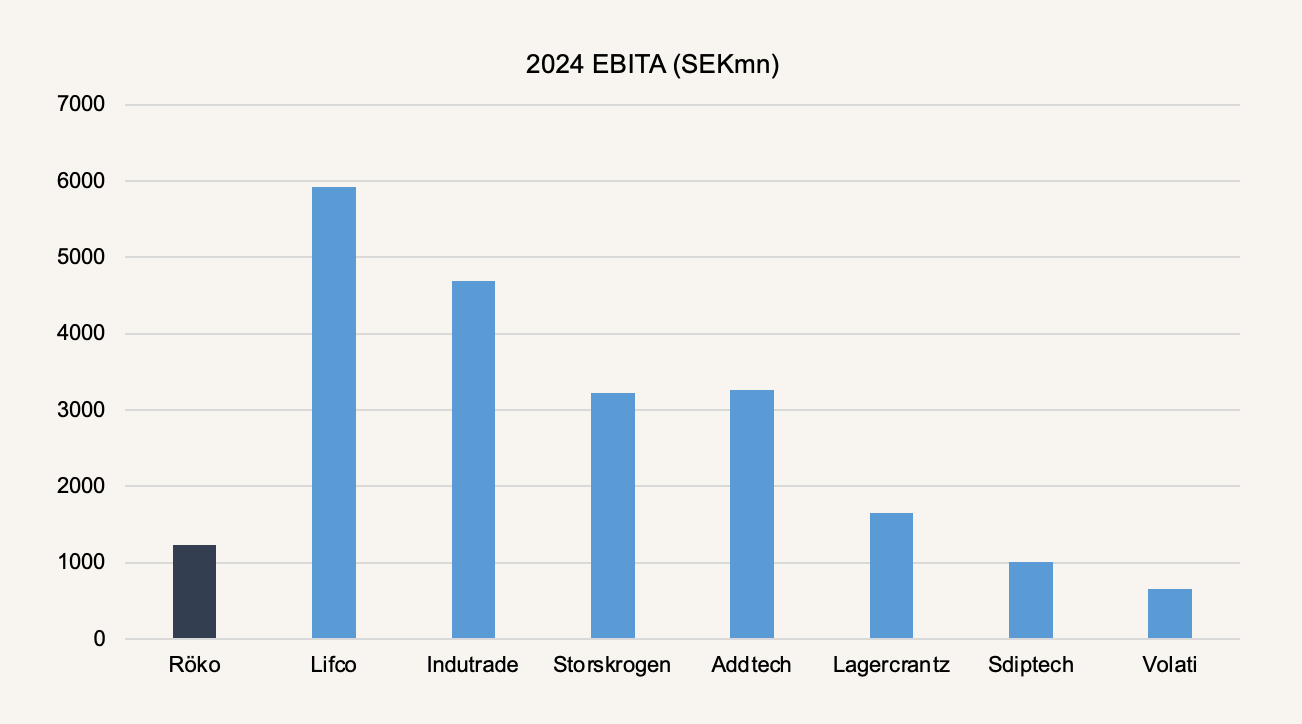
Over the past five years, Lifco, at 4x Röko’s current size in terms of assets, has averaged 14 acquisitions per year. By my calculation, if Lifco is to grow EBITA at 15% per year for the next decade, 5ppts of which organic, it would reach ~SEK25bn in EBITA a decade out and would need to grow EBITA by SEK2.1bn from acquisitions in year ten. At an average EBITA multiple paid of 7x and average deal consideration of SEK200mn, Lifco would need to do >70 deals annually a decade into the future, which is a tall ask for any non-programmatic acquirer (Constellation Software closes >130 deals per year today of smaller deal sizes). The same math for Röko would yield a more edible 15 acquisitions per year a decade out. If we take those assumptions for Röko and add a 4% terminal growth rate and 8% terminal cost of equity (7.9% WACC at the current capital structure), you could back into a fair EV/FCFF of 25x, or something like 18x EBITA in the terminal. So you’d get a 15% annual growth rate offset by a 4% derating headwind over the next decade for a low-teens annualized return as a shareholder. Of course, the runway and terminal period is finger-in-the-air. Röko could keep going for a long time, converging shareholder returns closer to its mid-teens ROCE, with any derating fading into the background.
That said, there’s the question of continuity as well. Early backers bought into Karlsson’s abilities and historical achievements, betting on business as usual. Today’s shareholders make the same wager. Karlsson is 63 years old and has already earned his billions (or hundreds of millions in $) in the IPO. The same for Billing, who’s 62. Their continued involvement hinges on personal enjoyment. They both own ~10% of the capital and collectively >50% of the votes through the A share. Deputy CEO, Johan Bladh, is in his mid-30s, who should probably be perceived as the main operator not that long into the future — similar to how Karlsson grew up under Bennet and Waldemarson in turn grew up under Karlsson — has likewise already made a killing with a stake worth >SEK600mn today. This of course equals huge skin in the game, trouncing each of their base salaries of SEK5mn per year, but you can’t help but wonder whether their drive will outlast their wealth now that they’ve made a killing in the IPO (although I give this thought little weight as this isn’t the first time you’ve heard this argument against ageing investors!). That neither Karlsson nor Billing sold shares in the IPO is sure comforting. And the three-year lockup is too.