
I’ve started an “All Korean net nets” series, and the first batch has arrived. This one contains five stocks, and the one I really like is behind the paywall.
A quick teaser on the one behind the paywall: Trades at half of NCAV, half of tangible book, negative EV, 3x earnings, almost 7% dividend yield, double-digit ROE, and a safe and simple balance sheet. It’s also the largest and most liquid stock in this batch.
You can expect more stocks in each batch going forward as I get more up to speed on the intricacies of Korean filings.
With that said, some of you have asked how the hell it’s possible to go through ~180 net nets in 3-4 months. The answer is that I expect a yuge chunk of the list to be quick “no”s. The purpose of this exercise is to write them up anyway and explain my reasoning to you.
I’ll emphasize once again that we’re dealing with imperfect information. As outside shareholders, that is always the case anywhere in the world you invest, but it’s even more the case in a place like Korea. And when you do an exercise like this, you try to solve a lot of puzzles in a limited amount of time.
In this series, we’re gonna try to answer a lot of questions which, admittedly, might not move the investment case in either direction as a net net. But we’re gonna do investigative work anyway to be able to sleep better at night and to gauge the situation with equanimity if things go wrong. But speed requires me to not dive into every nook and cranny of what the insiders have done over the company’s life. And net nets shouldn’t require weeks of research and expert calls. We’re never gonna lose sight of the fact that the financials and technicals will carry a lot of the weight here.
I’ve heard contentions that this exercise is a bit of a fool’s errand since most Korean net nets will be littered with bad governance, melting ice cubes, and even fraud. But that’s how net net investing works. Buying this stuff in baskets is doing the work that diligence would otherwise do. When Buffett bought a 20-name Korean net net basket in ‘05, he reportedly did so after “spending five to six hours on a Saturday”, meaning he spent ~15 mins on each name.
I plan on going through 3-5 net nets a day (writing them up takes time too, and I got other stuff in the pipeline), so in a 12-hour workday (Monday through Sunday), that’d mean I could spend 3 hours on each. But that’s on average. A lot of these names will take 10 mins, some a few hours, and if it’s really interesting, I can probably spend a day on one company. So don’t expect deep dives (which I can’t gather enough information for anyway), and that’s why I’m diving into net nets in the first place.
This is my process for any net net (and if you haven’t yet, I suggest you read my guide to net nets here):
- I start with the balance sheet, and I’ll show you my liquidation analysis to gauge the margin of safety or “escape value.”
- Then I move straight to really understanding the business, and if I can’t, that’s a quick no. I’ll focus on the stability of, or lack of, profitability.
- Then I move on to governance, and this is where I’ll try to spend the most time for many of these names. If I find something too fishy, it goes into the “no” pile as well. If I don’t, I focus on the main risks and what might be the kicker to a value crystallization.
It’s that simple.
A perfect net net for a basket looks something like this: cheap on liquid assets, cheap on earnings, earnings stable (or growing), returns of capital, and an open shareholder register.
I will not, however, need a 5-for-5 for it to be a potential candidate in the basket. Many of you will question why I try not to be too discriminating about the non-dividend payers, and that’s simply because some of these stocks are priced so low that any piece of news in that direction could act as a massive (but unpredictable) catalyst. Most of the stocks on my list have no Value-up plan announced, and none in today’s batch have announced a plan.
A quick note if you’re still thinking of subscribing to premium: I’m compiling a Google Sheet for each of these net nets and will rank them based on my assessment with a date and price at the time of writeup as we go along. I don’t push recommendations — nothing here is ever investment advice (see disclaimer) — and that list will simply act as a learning case of whether this exercise is worth the carry. The link to the Sheet will go out to all premium subscribers starting with the next batch, which will come out later in the week.
Without further ado, let’s get to it.
Moatech (033200.KQ)
Market cap KRW23bn (KRW2,535/share), 0.53x NCAV, 0.4x book, no Value-up plan.
In 2010, Moatech supplied its stepping motor to half the world’s computers. Those stepping motors steered the laser pickup in CD and DVD drives. At that time, Moatech had plants in Korea, China, and the Philippines with 5k employees, and revenue peaked at KRW170bn (~$120mn). Then, of course, the optical drive died. Today, Moatech employs 86 people, sells KRW46.5bn of motors and actuators a year, and the whole company is priced at KRW23bn on KOSDAQ.
Some numbers:
- KRW53.5bn of current assets against KRW10.3bn of total liabilities, so NCAV is KRW43.3bn, or 0.53x P/NCAV.
- ~KRW39bn of those current assets is cash and bank deposits. The company has no debt, so EV is negative.
- The company holds investment property too at KRW7.2bn on the books. Including that in NCAV brings the potential upside to NCAV to 119%.
- MinebeaMitsumi of Japan owns 79.17%, and it already tried to take the company private once.
- <2mn shares in free float. In a slow month, the stock trades ~KRW20mn/day (~$14k).
Now my rough liquidation analysis:
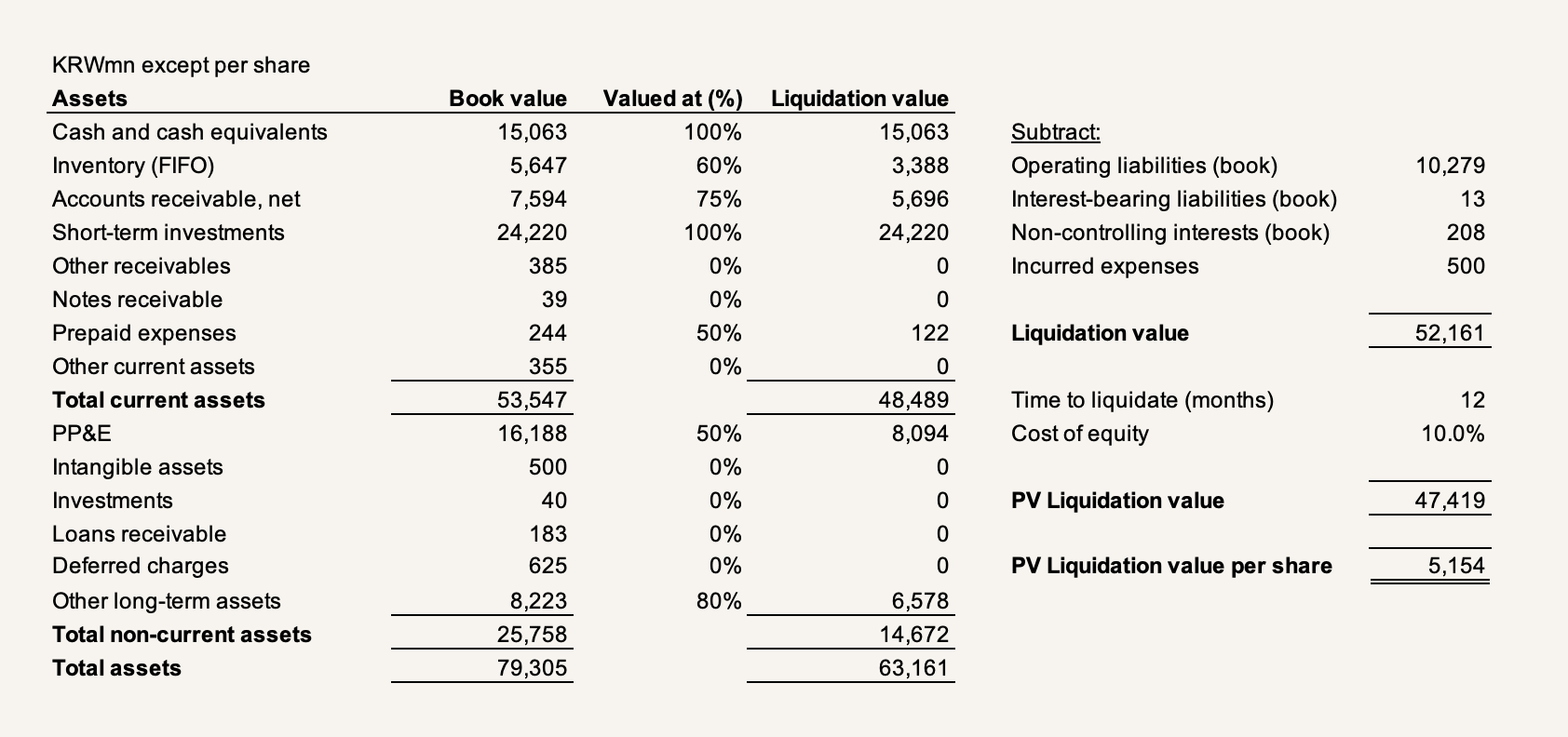
Moatech is the first name on my Korean net net list I’ve looked at in depth. I would usually write a business like this off immediately, since it has been a melting ice cube since its heyday, chronically losing a bit of money every year.
But there are two timely events worth mentioning.
First, in April this year, Korea’s new Commercial Act forced Moatech to retire 36% of its shares which were all in treasury that had sat inert since a failed take-private in 2018 (more on that in a minute). Meanwhile, you have KRX’s new market cap rule I talked about in the intro post. Both raise the odds, even if just a little bit, that something might happen.
Let’s roll back. Lim Jong-kwan started this company in 1985 as a five-man shop winding coils for Tokyo Electric of Japan. The coils went into stepping motors for floppy drives, which is the part that steps the read head across the disk, and Lim spent six years working his way up the chain, first assembling the whole motor for Tokyo Electric under its brand, then building it without their design. That left him with a product and nobody to sell it to. His customers arrived in the early 1990s, when Seoul picked 21 products that Korea was importing from Japan and paid to have them made at home. Samsung and Hyundai were assembling floppy drives and buying the motors from the Japanese, Moatech’s motor was on the list, and so Lim took the development funds and started supplying them directly.
When the floppy gave way to CD-ROM, the same motor did the same job against a laser pickup instead of a magnetic head. Samsung and LG then went to war over drive speeds, with every jump from 4x to 8x to 32x needing a faster motor, and Moatech shipped one for every generation while the Japanese incumbents moved slowly. And that’s basically how a coil shop ended up with more than half the world market, with 82%/revs riding on one product.
That concentration didn’t seem like a problem when drives got all the limelight and were in every computer. But then people stopped buying discs, and the market Moatech had built itself around disappeared. The technology still had uses, in cars and home appliances and telecom gear, and that’s the company you’re buying today.
In May 2012, Japanese Minebea (a components maker best known for miniature ball bearings) went to Korea and bought 50.8% of Moatech, near the top, paying KRW59.5bn. Minebea wanted the plants in Korea, China, and the Philippines, plus a route into stepping motors for EVs. But the new owner caught the decline, and sales fell 85% over the following nine years, to KRW24.6bn in the FY ending March 2021. Today, Moatech is priced at less than half what Minebea paid for half the shares.
What’s left of Moatech’s business splits in two. A little over half of revenue is resale. Since 2016, Minebea’s own Philippine plant makes Moatech’s office and appliance motors under a consignment contract, and Moatech buys the entire output and passes it on. The other half is the more interesting part, which is Moatech’s Incheon plant in Korea that makes actuators for cars. An actuator is that motor plus a gear train and control electronics, moving a particular part to a particular position and holding it there. Newer cars keep finding new use cases for them, like the flaps behind the grille that open and shut to cut drag, the mirror that tilts to throw a head-up display onto the windscreen, the drive that steers a LiDAR sensor, and the valves that route coolant around an EV battery. Moatech says it’s the third-largest domestic supplier of the grille-flap actuator, and its production was >1.6mn units last year vs <1mn units two years ago. It’s currently gearing up for a new production line for EV-thermal management in 2027.
Sales recovered quite a bit in FY26, up a whopping 35% due to that car business. The operations still lost money, though, a loss of KRW1.7bn, with interest income on the large cash pile clawing most of that back to a net loss of KRW600mn. Book value has gone from ~KRW76bn to ~KRW69bn in seven years, or down ~KRW1bn/year. In other words, with no earnings recovery, you’re buying the whole thing at roughly half of its liquidation value, and it shrinks a little >1%/year. It could be worse.
From December 2016, Minebea had Moatech buy a big chunk of its own shares, ~36%, so that Minebea could go for a delisting. A voluntary delisting in Korea requires 95% of the register. The company spent ~KRW25bn buying back 5.13mn shares on the open market at an average price of KRW4,900/share, and ran a tender alongside. That attempt stalled at close to 87% and got withdrawn in March 2018. Then KRX changed the rule so treasury shares no longer count toward the 95% threshold, and the treasury block sat on the balance sheet for eight years.
On April 9 this year, Korea’s new Commercial Act forced the board to retire the treasury stock. Minebea’s stake went from ~51% to ~79% in one swoop. The remaining float is 1.92mn shares. To reach 95%, Minebea needs 76% of that float.
There’s no other alignment. No director or executive owns a single share today. The CEO is a 28-year company man who came up through the sales office. Minebea’s seat on the board is a non-standing director from its motor division, and it seems he skipped every board meeting last FY until the two meetings that decided the treasury share cancellation. The parent also sits on both sides of half the business, since the resale motors are bought from Minebea’s plant at prices the group sets, which tells you a lot when Moatech earns a measly 10% gross margin.
There’s also a way for minorities to lose without Minebea lifting a finger. As I mentioned in the intro piece to this series, KRX is raising the minimum market cap for staying listed on KOSDAQ to KRW20bn from the second half of 2026, and Moatech’s cap is KRW23bn. This goes to KRW30bn on Jan 1 2027. The big risk is ending up with unlisted shell 79% owned by a parent that has already shown it wants the minorities out.
On the other hand, Moatech’s free float is small and illiquid enough that the stock moves on things that have little to do with the business. In October 2020 it tripled inside two weeks on no news, hit the daily limit four times, and got halted while the exchange launched an investigation. I think what set it off was a local shareholder called Kim Young-wook, who with four others had built 6.64% during that year as described here. Between them, Minebea and the treasury block, 93% of the register was spoken for. On the numbers at the time, if Kim’s group sided with Minebea, Minebea was ~500k shares away from the 95% a voluntary delisting needs. I believe that rumor and minuscule float created the squeeze.
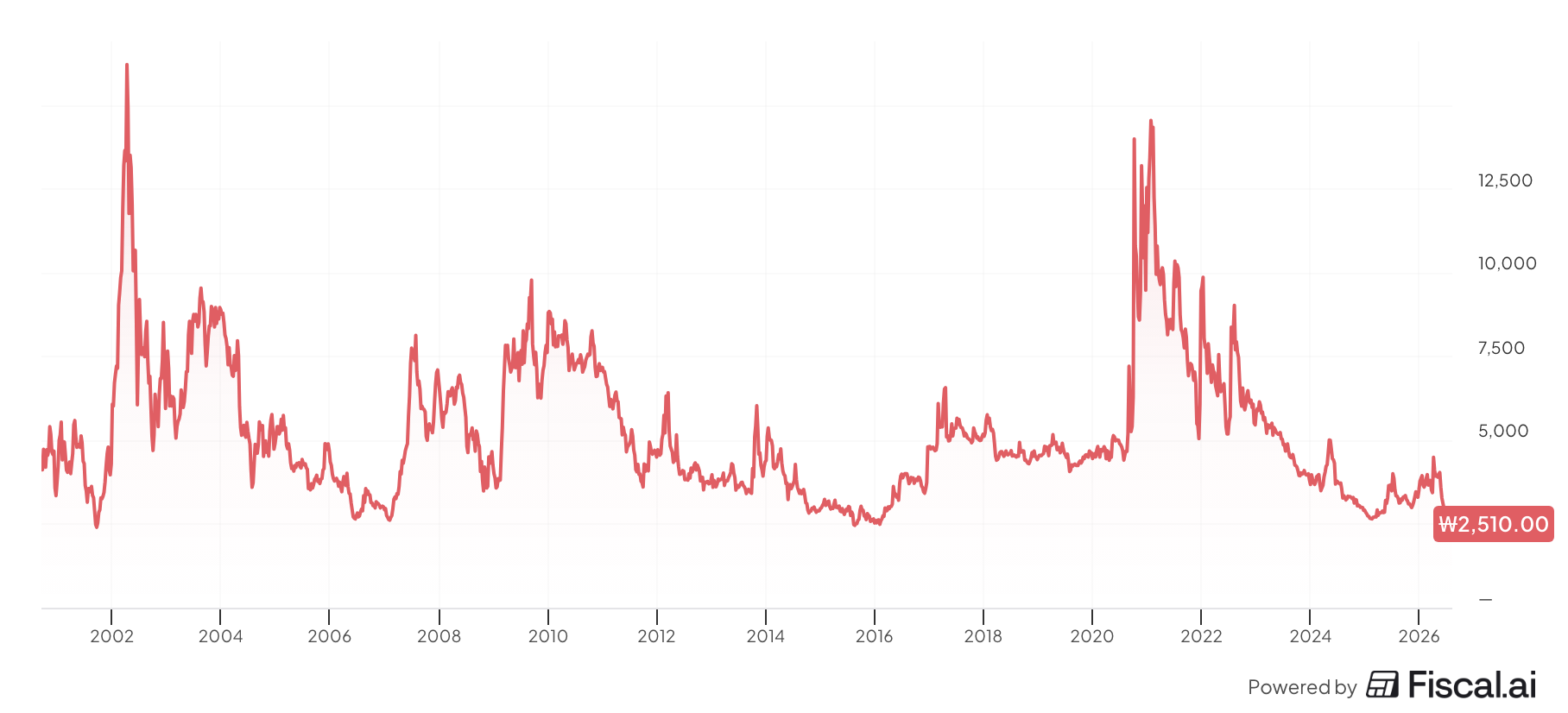
While Moatech returns no capital to shareholders, this is sort of a special sit that, the way I see it, could go one of three ways: 1) Minebea tenders for the float (remember, the last time it paid up for shares, it paid almost double today’s price). 2) The listing dies, through the market-cap rule or a squeeze-out at an appraised price Korean courts don’t care about setting low. 3) Nothing happens, the pile melts ~1%/year, and you collect no dividend while you wait. Not good enough for me.
Ocean In W (052300.KQ)
Market cap KRW21bn (KRW1,335/share), 0.29x NCAV, 0.1x book, no Value-up plan.
This one is a quick pass, because other than this one being at risk of the market cap threshold, the balance sheet is impossible to see through, and given the company history, this stock is uninvestable. It’s trading at 8% of book and has no debt for christ’s sake. One look at the long-term fundamentals chart should be enough to say that we’re dealing with a maze:
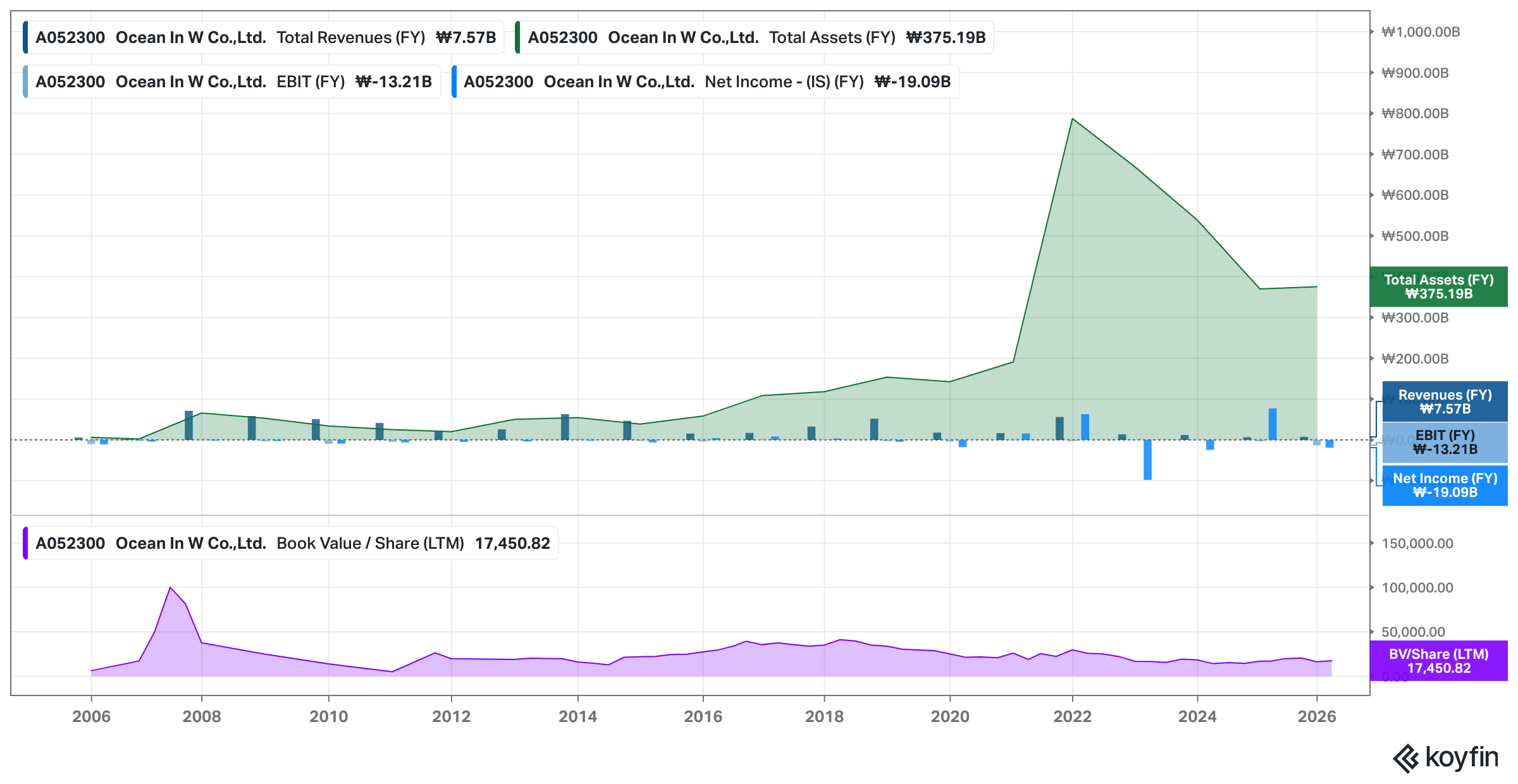
If you asked this company what it does, it’d tell you it’s a wholesale architectural glass distributor with some investment real estate. But in reality it’s an investment company, a complicated one with a complicated backstory. The glass business is only ~10% of revenue.
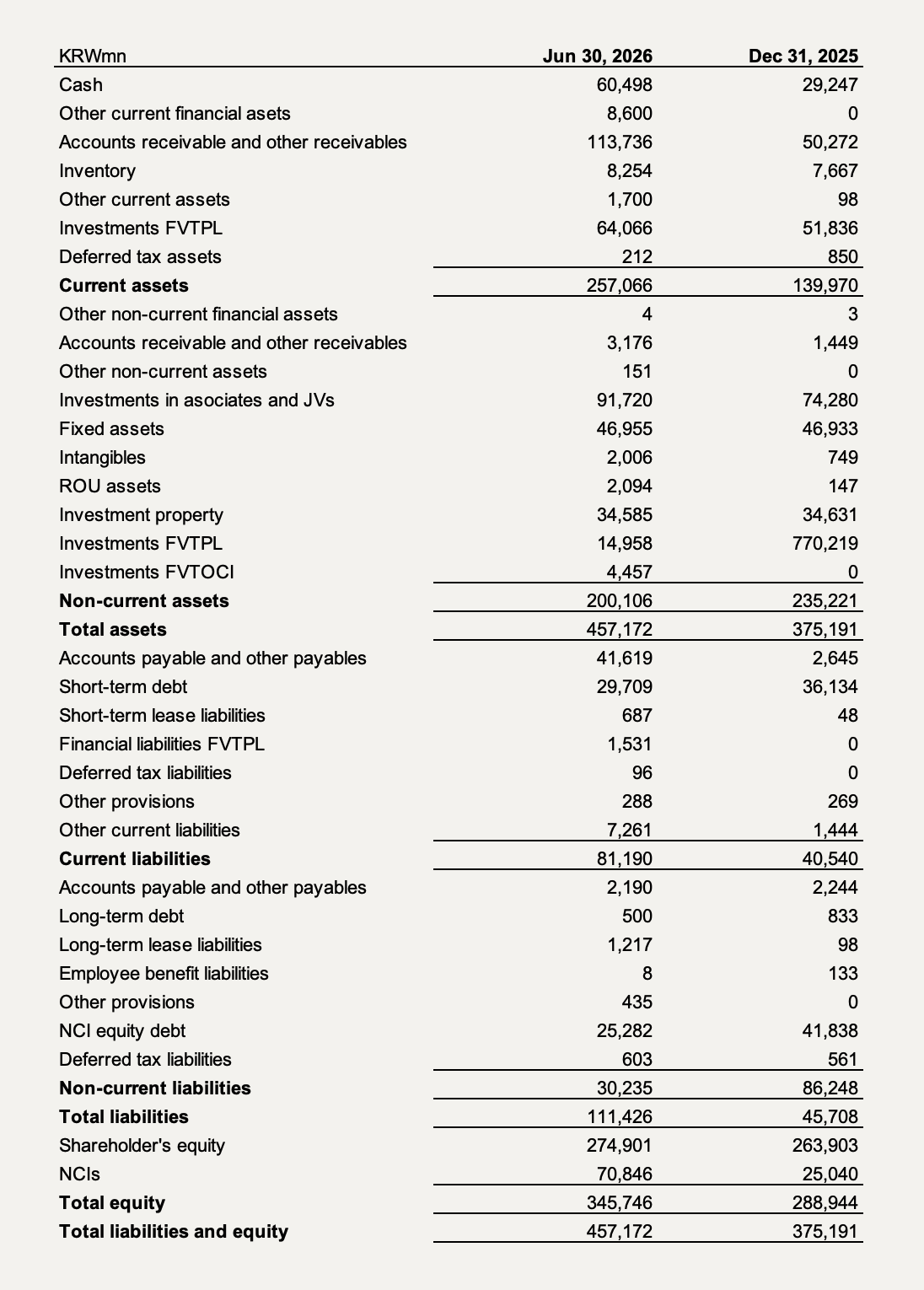
Here’s the balance sheet…
…and here’s the story behind it:
Ocean In W was founded in 1992 as a logistics company and listed on KOSDAQ in 2001. It has changed name five times since then.
In 2016, the company got a new controlling shareholder. A private company subscribed to a new issue of shares and took ~18%, enough to make it the largest holder. That private company was run by a man called Won Young-sik, who owned 37% of it, and his son owned 45%. Ocean In W later took its name.
Ocean In W got into wholesale glass distribution in 2017, when it absorbed a subsidiary called SH Glass. But just a year after that, it subscribed to a new share issue in a listed company named Chorokbaem Media, which was a drama producer, and ended up as its largest shareholder at ~40%. It financed the purchase through convertible preferred stock and convertible bonds, both sold privately. Since then, btw, these instruments have converted at steadily lower prices, because Ocean In W stock of course slid, and the convertibles kept resetting downward. (The company did massive reverse splits, 5:1 in 2021 and 10:1 in 2025, to bring the share count down.)
Anyway, so Won now controlled both Ocean In W and Chorokbaem Media.
Then Won got into trouble. A 2022 court judgment in the Lime fraud case named him as a moneylender to corporate raiders, with KRW580mn of that money going into convertible bonds Ocean In W had issued, and in July 2023 he was indicted on capital markets violations, breach of trust, and tax evasion, then released on bail that December. I couldn’t find a verdict in the case. But one of those counts was against Chorokbaem Media, where he was chairman. The company’s convertible bonds carried a call option, the right to buy bonds back from the holder and convert them into stock. Won assigned that right, for no consideration, to a company his children owned. Prosecutors put the cost to Chorokbaem Media at KRW1.5bn. Chorokbaem Media, of course, had to disclose that, which prompted an automatic KRX review of whether the company deserved to stay listed. Its shares were suspended in June 2023 and the exchange voted to delist it soon after, unless it found a new largest shareholder within 12 months.
So in November 2024, Ocean In W sold the whole 39% stake to a PE fund for KRW180bn. That’s ~3x Ocean In W’s own market cap at the time, and kudos to the company for offloading it at all with the asset facing delisting.
Ocean In W is controlled by a company owned entirely by Won’s son, Won has been its CEO since July 2024, and both of Ocean In W’s joint CEOs came from Chorokbaem Media. None of the proceeds from Chorokbaem Media went to shareholders. KRW64bn went into VC partnerships. KRW41.7bn was lent to two vehicles buying control of another listed company called INITECH, secured on INITECH’s own shares. The rest went into more partnerships and a chain of holdings that ended up consolidating a company called DMOA, which is, btw, also a Korean net net. Ocean In W’s own shareholders sued to inspect the share register and the accounting books, and to force management to pay the cash out. I’m sure I’ve only seen the top of this.
Which brings us back to the balance sheet. For the group, there’s KRW257bn of current assets against KRW111bn of total liabilities and KRW71bn of NCIs. Against a KRW22bn market cap, that’s a 0.29x P/NCAV. But most of that NCAV isn’t in Ocean In W. Because Ocean In W owns ~52% of DMOA, it’s consolidated on the books, and DMOA has KRW110bn of current assets and KRW49bn of liabilities. Of the remaining NCAV, KRW31bn is the INITECH loan, already 41% written off, with its repayment date rolled three times in nine months. The shares pledged against that loan are worth ~KRW30bn today, on KRW51.9bn lent. And one of Ocean In W’s two CEOs sits on the board of INITECH. It’s too messy, so I pass.
Sejoong (039310.KQ)
Market cap KRW27bn (KRW1,432/share), 0.6x NCAV, 0.2x book, no Value-up plan.
I like Sejoong much better. This company has three unrelated segments:
- A corporate travel agency (25% of revenue), running for 45 years. It books flights, hotels, and cars for ~500 corporate accounts, including overseas staff training trips, and takes a commission on bookings. Korean Air and Asiana are the two biggest sources of that commission.
- A BPO business (48%) focusing on marketing and cost reduction, but it’s mainly a printing business. Large companies hand it the printing work they don’t want in-house. For retailers like Lotte Mart, Lotte Himart, E-Mart, GS Retail, and Hyundai Department Store that means in-store promotional displays and direct mail. For Korea Investment & Securities it means producing customer statements and reports.
- A software distribution business (27%) for Siemens PLM that also offers consulting and technical support to larger corporations.
Although these businesses have very little of a moat, which you can see in operating income that has swung around zero for the past 8 years, they’re light on fixed assets (but working capital swings). So if we focus just on the balance sheet, this is a good, pretty liquid net net, especially since we can lump a big chunk of the long-term asset side into a liquidation analysis.
The balance sheet:
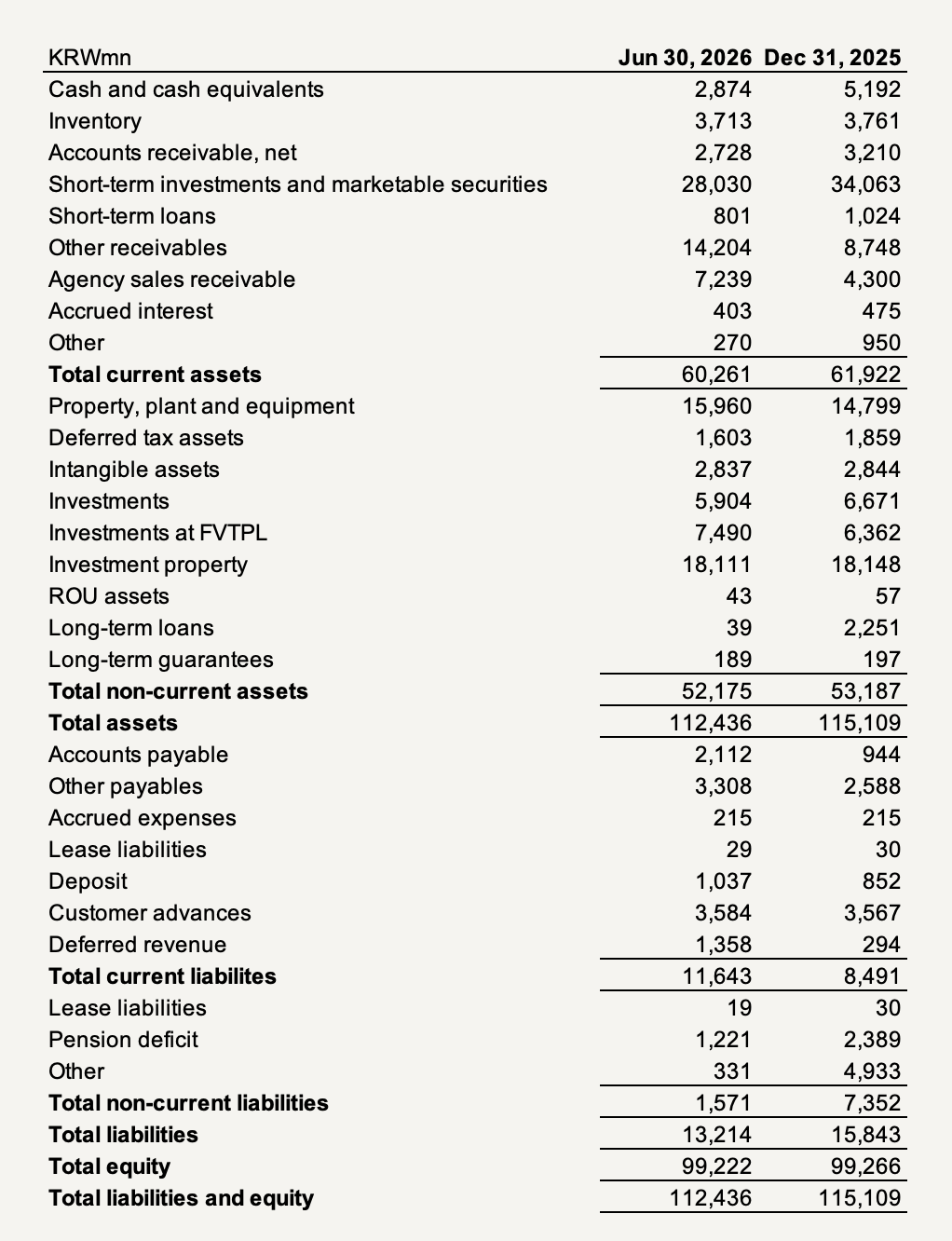
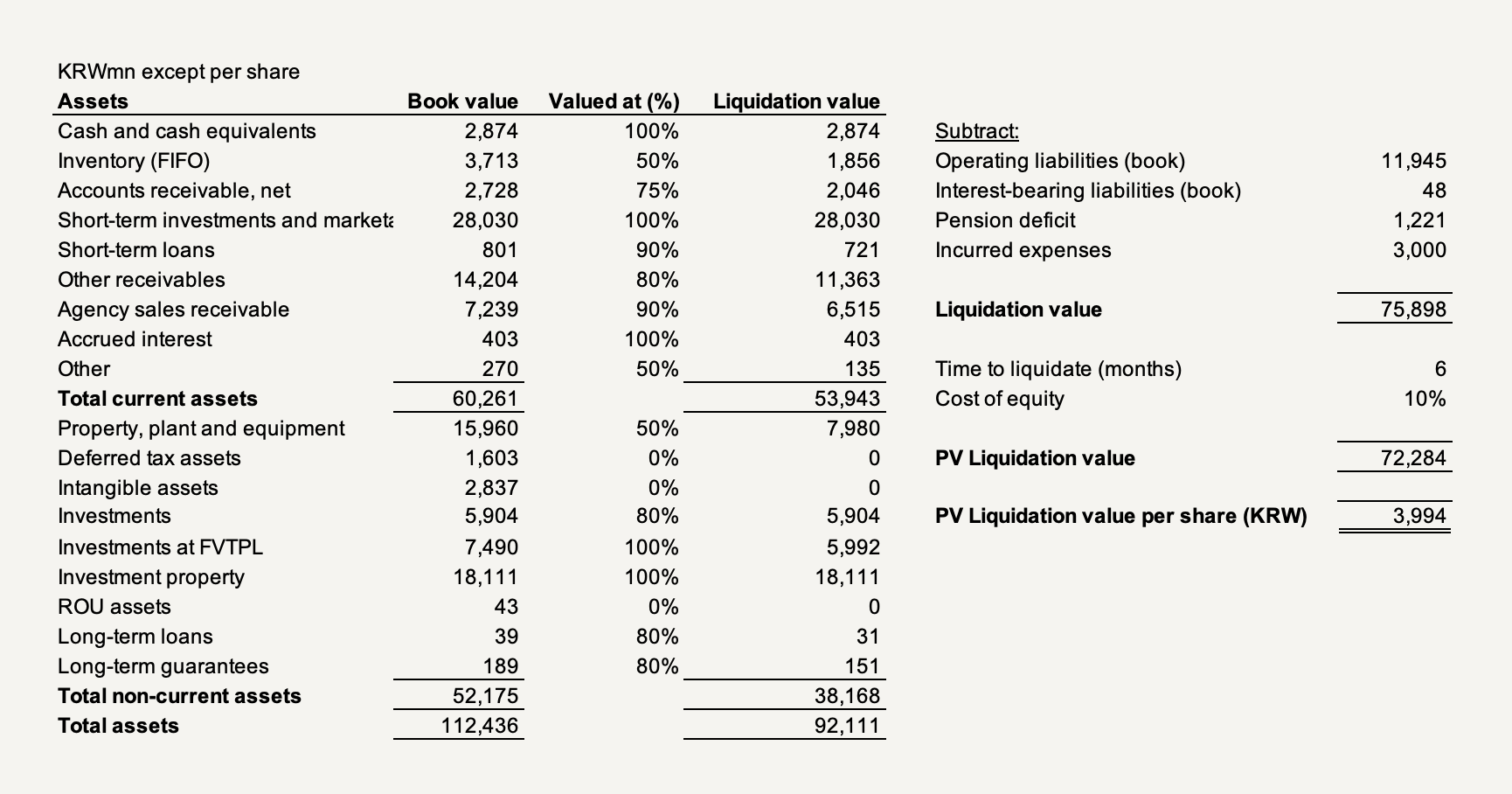
Fortunately, we don’t have to worry much about inventory. NCAV is KRW47bn vs a market cap of KRW28bn. That’s a 0.6x P/NCAV. But there are financial assets in non-current assets, specifically long-term investments (which are nothing more exotic than bank deposits), investments at FVTPL (equities of mostly Keumkang Industrial and Korea Zinc plus one convertible bond), and investment property (of which KRW15.4bn out of the KRW18.1bn is land booked at initial cost, which is very likely worth more today) which should be counted. Adding these items at face value gives you an additional KRW31.5bn of sort-of liquid assets. Therefore, all-in NCAV is closer to KRW79bn, and Sejoong is trading at 0.36x P/NCAV for a whopping 180% upside to NCAV.
By my rough estimates, a liquidation would fetch something close to our all-in NCAV too, almost 3x the share price:
However it’s hard to gauge anything beyond that. The company stopped paying a dividend around 2017 after some good years of profitability. It held treasury stock once, ~2% of issued shares, and in December 2021 it sold the lot to Keumkang Industrial. Sejoong in turn owns 1.3% of Keumkang Industrial. Besides that, there have been related party transactions but nothing major to flag. In February 2025, the board approved a KRW2.2bn loan to the founder, Cheon Shin-il, which was unsecured and ran for two years at a 4.6% rate. It was repaid in full this H1. Against that, as of the FY25 accounts, Cheon had personally guaranteed KRW6.2bn of the company’s BSP airline ticket settlement to Seoul Guarantee Insurance, so the favors go both ways.
So far this is actually encouraging (except for the lack of profitability and return of capital). Now I do wanna note what an interesting backstory this company has.
Sejoong started in the 1990s as a software company named Hancom Research. That was renamed to Namo Interactive in 1997 and floated on the KOSDAQ in 2000 during the dot-com boom. What Namo had was a website design program. Then in 2006, the company agreed to merge with Sejoong Travel, the Cheon family’s business (they’re sitting on 31% of the shares today, spread across family members of course), through a reverse merger. It later changed its name to Sejoong.
In 2007, it announced a shipbuilding-steel logistics business with Samsung Heavy Industries, and by the mid-2010s it had a steel materials division turning over KRW23bn. Those were also the years it paid its shareholders. In 2017, it sold it to KCTC, a Korean logistics group, for ~KRW16bn. That’s the first of the two disposals in this story.
Fast forward to 2020, and the KRX halted trading in Sejoong and opened a formal investigation into whether the company deserved to be listed. For five weeks the listing was in doubt, but then KRX decided not to take the potential delisting further. This is just a little flag that the company has been at risk of a delisting before.
Shortly after that, Sejoong sold the best part of its business. In its software distribution arm, it used to be a licensed reseller for Microsoft (at a thin markup), which produced essentially all of the group’s operating profit. Microsoft then changed its sales policy in Korea, the licensing arrangement couldn’t be kept, and in November 2023 the business went to a cloud company called Megazone for KRW17bn, which is a bit >2x earnings at the time. (This divestiture explains the first thing you notice on a long-term revenue chart, a 71% drop in FY21, when the business was first thrown into discontinued ops). The Siemens distribution business it retains today turns over just ~1/10 of what the Microsoft distribution business used to do, and the software distribution business is a shadow of its former self.
Cheon Shin-il was the founder (of the travel business that reverse merged into Hancom) and ran it until he died. He was also, for a long stretch, one of the better-connected men in Korea. He and Lee Myung-bak (Korea’s president from 2008-13) were classmates at Korea University and stayed friends, and through Lee’s presidency the press described Cheon as one of the powers behind the scenes.
In 2010 he was charged with taking KRW4.7bn in cash, gift certificates, and steel to lobby on behalf of a Daewoo Shipbuilding subcontractor, mostly for pressing a state bank to rescue it. He got two years on appeal, most of the cash was forfeited, and Lee Myung-bak pardoned him in 2013. The charge didn’t touch Sejoong.
Cheon Shin-il died back in March at the age of 83, and the stock immediately doubled. (It has since given the whole move back and then some.) I can’t explain why, other than a bit of the backstory above, but I could imagine it having something to do with the heirs needing to find cash for the inheritance tax, though at 4.7% his stake was never going to make much of a bill. It could (quite likely) be something else entirely.
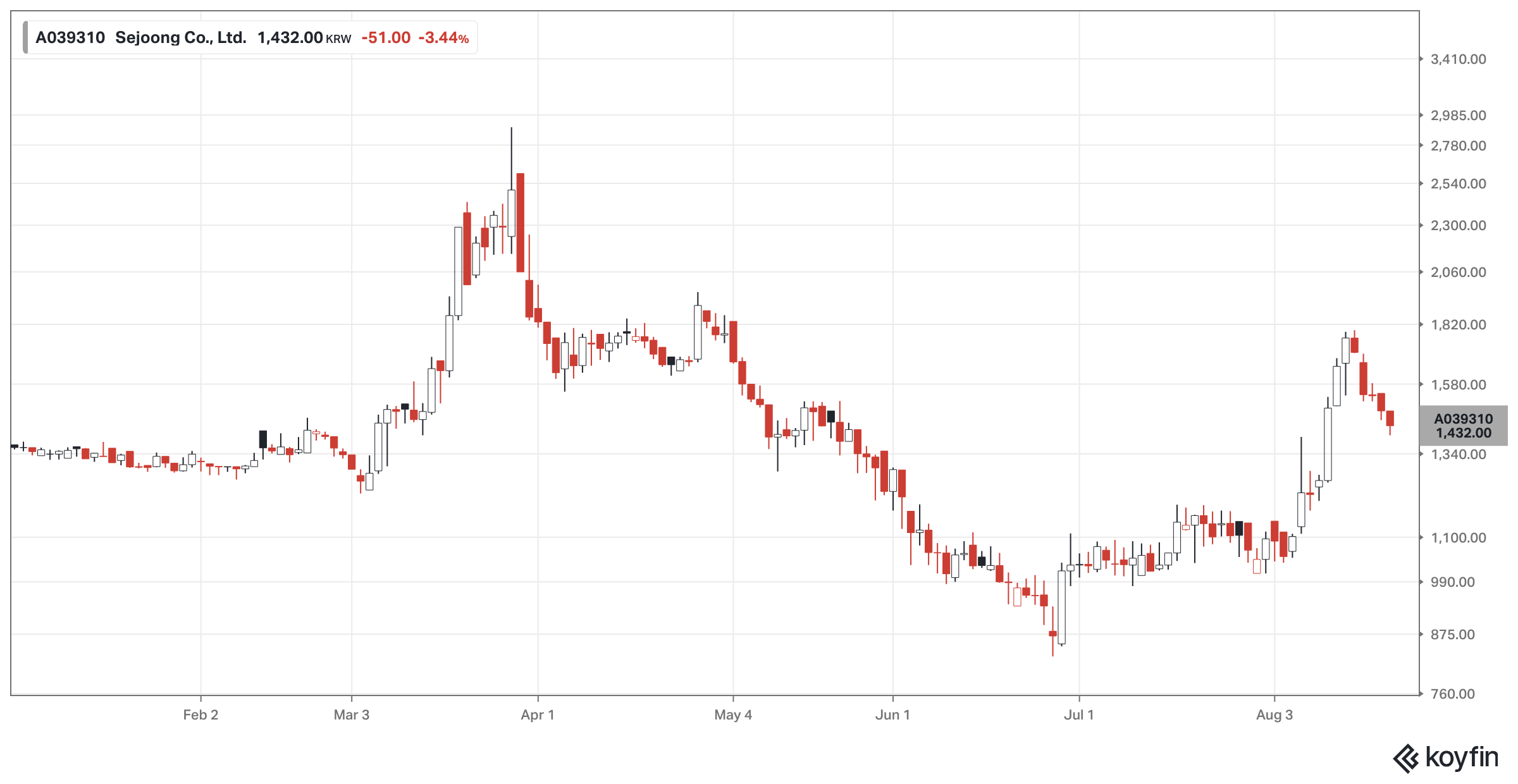
In 2020, Cheon Shin-il had already handed down 1.6mn shares to his two sons who are running the business (Cheon Se-jeon, the elder, as CEO, and Cheon Ho-jeon as managing director), taking himself from 13.7% down to 4.7% ownership. The brothers own 23% of the shares between them, and other related parties bring the controlling stake up to 31%, meaning compared to other family-owned businesses, this one’s got a pretty open shareholder register. What’s happened to the father’s remaining stake is still an open question as I think the estate is yet to be settled, and what really matters in this case is how the new generation will go forward in terms of governance.
I don’t know if I spent too much time on this one as I’m a bit on the fence. The fact is that this company is absolutely dirt-cheap on an attractive balance sheet, but it’s hard to see that being returned to shareholders unless someone swings by to force it, and you also got the market cap below the KRX’s coming threshold lingering over this stock (which I think in this case acts more as a catalyst if insiders want to stay listed, so that might be what’ll prompt a Value-up announcement). What you’re buying here is a pile of cash and investments, three small businesses that break even on average, and a family that could start fighting each other over control. It’s hard to see where this goes, it’s hard to gauge any upside, but you still got a huge margin of safety. Please reach out if you got further information, if I’m missing something, or if I got something badly wrong.
Shinwon Construction (017000.KQ)
Market cap KRW26bn (KRW2,355/share), 0.4x NCAV, 0.2x book, no value-up plan.
Shinwon Construction is a contractor that has been building roads, subways, airports, and apartments since 1983. Current assets are KRW190bn, total liabilities KRW120bn, and the market cap is KRW27bn. I won’t touch it, and not just because it’s a cyclical contractor (revenue has oscillated between KRW124bn and KRW310bn over the last nine years), an industry where net nets can very quickly turn fleeting.
Let’s do this quickly. I didn’t bother reconstructing the balance sheet. You can find it here.
Of the current assets, just KRW16bn is cash, and against that cash is KRW29bn of bank debt that falls due within a year. KRW117bn of current assets is money somebody else owes Shinwon, and another KRW38bn is land and finished apartments it hasn’t sold.
I don’t think you have to guess whether the receivables are fully collectable, because the report already gives an indication. Shinwon charged KRW17.5bn of bad debt expense in FY24 and another KRW7.1bn in FY25. That’s KRW24.6bn in two years, which, again, is pretty close to the market cap. It also wrote KRW6.5bn of loans off the books. Meanwhile, there’s a line in the FY25 accounts called “sundry loss” that went from KRW190mn to KRW4.3bn in a year. It’s 88% of all other expenses, in a note that separately itemizes a KRW3mn loss on scrapping fixed assets, and it’s nearly as large as the year’s earnings.
In January 2024, two related subcontractors from the same site went to the Suwon Bankruptcy Court on the same day and asked it to declare Shinwon bankrupt over unpaid construction sums, one of them for ~KRW500mn. Shinwon called the filings malicious, and the court threw them out sixteen days later, holding that failing to pay your bills isn’t the same as being unable to. Shinwon won that one. But still, subcontractors who are getting paid don’t file bankruptcy petitions.
Chairman Woo Jin-ho owns 16.51% of the shares and gave up the CEO title in 2022 to Kim Sung-min, who owns no shares. The full-time statutory auditor is simultaneously CEO of a film company, and turned up to just 3 out of 15 of last year’s audit meetings. There’s also a full-time inside director listed as technical adviser who is a former Mayor of Seoul. He had the job for eleven days in 1994, appointed the evening the Seongsu Bridge collapsed and lost the title as soon as it came out that he’d run Seoul’s construction bureau when the bridge was built. (I don’t know if this information is even relevant.)
There’s no dividend. The stock the company bought back in 2019 to “enhance shareholder value” is still sitting in treasury. And at a KRW27bn market cap, it’s running against the coming KRW30bn market cap rule. This stock is “cheap” because most of the assets might be shaky claims, and I don’t want to spend time getting to the bottom of it.
Out of the above four stocks, I sort of like Sejoong. But let’s now get to the best net net from this batch.