As promised in the first batch, the Google Sheet tracking every net net in this series is now live: the price and multiples on the day I wrote each one up, my score from 1 to 5, and the return since, updated live. Premium subscribers will find the link at the end of this post behind the paywall.
I gotta speed up my research if I am to keep this Korean net net series to 3-4 months. Like the first batch, this second one holds 5 stocks. I’ve put the… let’s just say most interesting one behind the paywall.
The more I look at these, the more I realize how hard it is to gauge insider incentives, and therefore how hard it is to avoid catching a value trap or two. (This is inevitable in net net investing, but the entire point of diving into stocks that are statistically, ridiculously cheap is to minimize the number of value traps.) My reaction to that is becoming increasingly “unreasonable” as to what goes into our net net basket.
Filings tell you what the controller did, but they never really tell you why. And “why” is the whole question in a net net, because the cash, securities, or whatever else you got in excess on the balance sheet is already sitting there. The only thing that decides whether you’ll ever see it is what the person holding the keys wants to do.
In this batch, one controller sold treasury stock to a friendly company instead of cancelling it. One keeps funding a listed subsidiary that has burned everything shareholders have put in. One bought land from a sister company while never having paid a dividend. One founder pays himself close to what the company pays all shareholders in dividends combined, and he answers to nobody. We also get our first Value-up plan in this batch, though it’s sort of uninspiring.
Btw, if you missed it, I sent the best net net I’ve seen so far in this exercise in its own writeup last week. Its market cap is entirely covered by cash and securities; it has no debt; it pays dividends and buys back stock; it has an unusually open shareholder register; it has a protected moat; it has compounded operating income and the cash pile at double-digit rates for 7 years straight on little invested capital. And I think it’ll continue to grow. You can find it here.
Let’s dig into today’s batch.
Samsung Climate Control (006660.KS)
Market cap KRW100bn (KRW12,320/share), 0.48x NCAV, 0.33x book, no Value-up plan.
Despite the name, this company isn’t part of the Samsung group. It’s based in Changwon, an industrial city in the south of the country.
Samsung Climate Control is a 56-year old auto parts manufacturer that makes the parts of a vehicle that move heat around, through three product groups: 1) the radiator that stops the engine from overheating (~half of revenue), 2) the oil cooler that does the same thing for oil (~1/3 of revenue), and 3) the HVAC system which is the heating and AC box in the cabin (the rest). Calling this a straight-up auto parts supplier would be misleading, though, because end markets split into cars (~half), agricultural machinery (~1/4), heavy equipment (~1/8), and motorcycles (~1/8), which is generally a wider spread than for most Tier 2 suppliers. Main customers are Hyundai/Kia at ~1/3rd of sales, then Astra Honda at ~13%, then Deere at 9%. Exports are 31%/revs.
Liquidation value is by far the load-bearing part of this stock. Cash and investments amount to KRW213bn, which is 2x the market cap. After deducting every liability (there’s no debt), the net is KRW169bn. You’re paid KRW1.6 of net financial assets for every KRW1 of market cap, and the operating business, the property, the plant, and the 50% JV the company has with Valeo come for free.
My liquidation analysis with 85% upside to liquidation value:
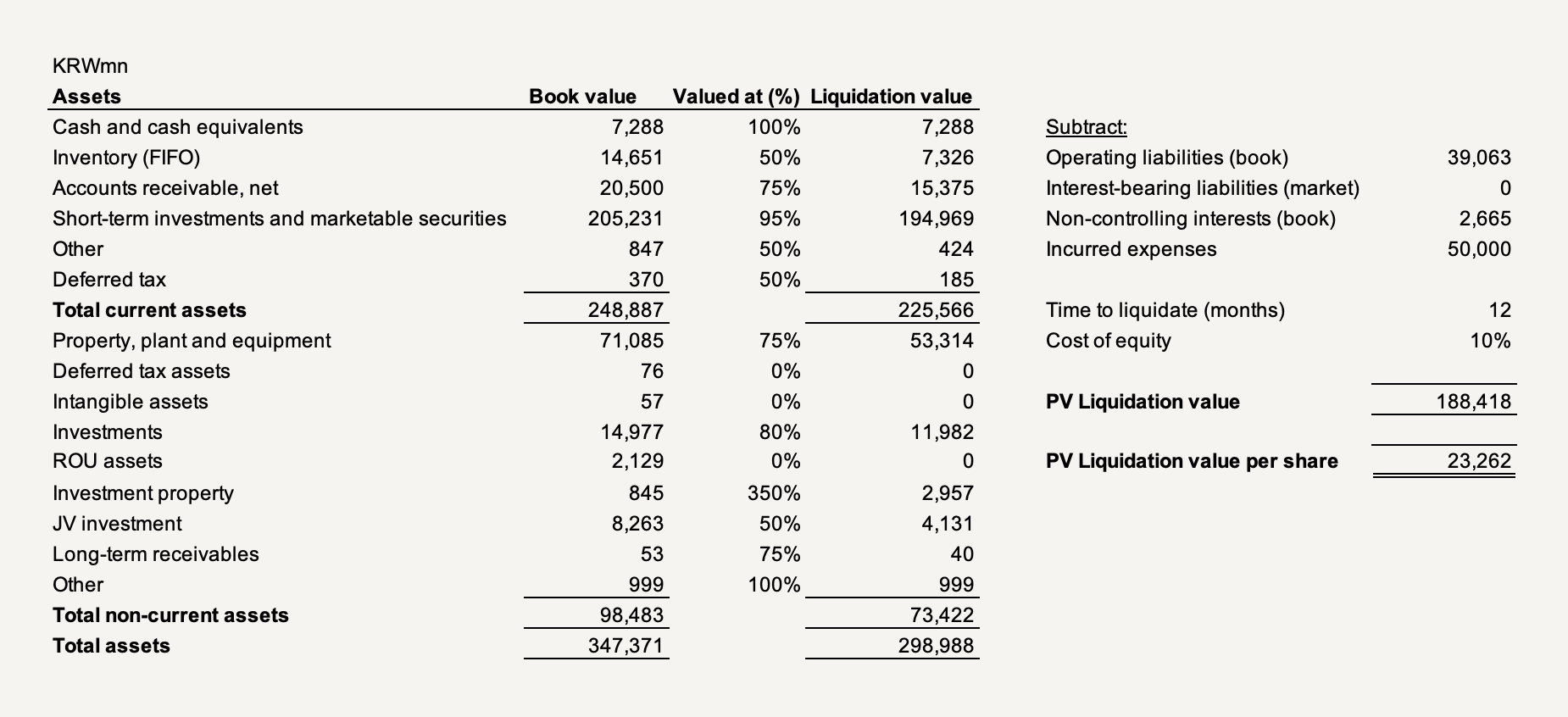
Liquidation value is the carry here precisely because you shouldn’t pay much for the business. As usual for Tier 2 suppliers, the business operates on razor-thin margins, subject to the whims of the cutthroat auto industry. Unlike the last company (behind the paywall) in the first Korean net net batch, this auto parts supplier has compounded BVPS at only mid-single-digit rates over the past couple of decades.
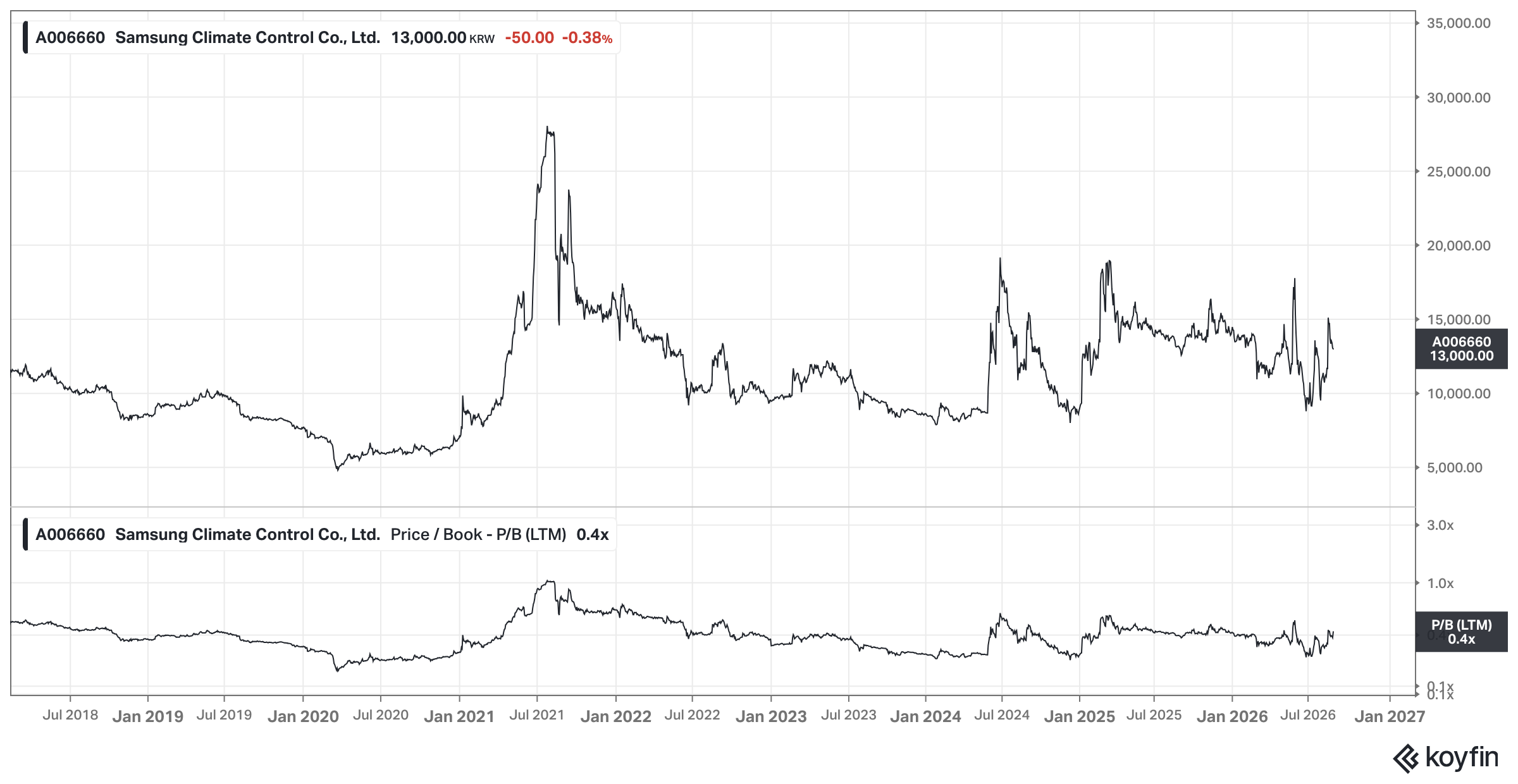
This stock has spiked before, most notably back in H12021, when the share price more than 3x’ed during the half-year, and briefly traded at book value. (Oddly, I haven’t been able to dig up a good enough explanation for what happened.) Fast forward to early 2024, the stock has oscillated quite rapidly between 0.3-0.6x book ever since.
The company began in 1954 as Samsung Industrial Works, a workshop in Masan, and became Samsung Radiator Industry when it incorporated in June 1970. The head office moved to the Changwon address it still occupies in 1977. In 1986, it set up a subsidiary called Three Star, and in November 1987 it listed on what is now the KOSPI. Ko Ho-gon became CEO in March 1990. Just a year later, he had become the largest shareholder, after having bought a bunch of stock in the open market. The family has controlled the company ever since.
The two decades after that read like a well-run Korean industrial. It won an industrial service medal in 1994, opened a research institute in 1995, took a ten-million-dollar export tower in 1999, renamed itself Samsung Climate Control in 2000, signed a labour-management cooperation declaration in 2001, and collected awards for it in 2009, 2010 and 2014. In 2001 and 2002, the family set up two foundations, a scholarship fund and a welfare body, both named Kosan. And in February 2006 the company sold half of Three Star, the subsidiary it had founded 20 years earlier, to Valeo. That still runs as a JV.
But from about 2004, the company started buying things that had nothing to do with radiators:
- 2004: Samsung Distribution, a highway rest stop and petrol station operator
- 2009: Kosan Electronics, touchscreen panels
- 2011: Kaiko (80%), aluminium wheels
- 2011: Taeil Tech (70%), LCD equipment
- 2011: Isong, transmission parts
- 2013: Kosan Maldives (93%), a tourism business
- 2014: A specified money trust, consolidated as a deemed subsidiary
- 2016: SCC Meters, electricity, gas, and water meters
- 2018: SCC Vietnam
Then, from 2017, the company started closing them down. Samsung Distribution and Kaiko were wound up in 2017. The money trust was deconsolidated in 2019. Kosan Electronics was liquidated in 2020. Isong shut its transmission business in December 2021. Taeil Tech and SCC Meters are carried at zero today, and SCC Vietnam is 70% written off. Of all those ventures, 74% ended up written off.
In 2022, the company spent ~KRW40bn buying a company it itself had spun off 42 years earlier out of bankruptcy. Donghwan Industries ran on its own for over four decades, won quality ratings from Hyundai and Kia in 1996, built four Chinese plants, and then filed for court rehabilitation in Changwon in April 2021.
Also worth mentioning, the KRW220bn of financial assets on the balance sheet are disclosed as three lines. KRW15bn is listed equities, which are in Samsung Electronics, Toyota, and Muhak (more on this in the next paragraph). KRW5bn is trust products. The remaining KRW200bn is “short-term financial instruments.” You’d assume those are term deposits, but there’s a bad debt allowance of ~KRW4bn sitting against it, a 2% provision rate, and no one provisions against a bank deposit.
Meanwhile, this company is tightly controlled, and I can’t see a mechanism by which minority holders make anything happen. There are three inside directors and one outside director, plus a standing auditor. The three insiders are Ko Ho-gon, his son Ko Tae-il, and Shim Ki-jong, who runs the finance department. This family holds ~52% of the shares, with Ko at ~35%, his son at ~14%, the wife and three relatives at another ~2%, and two family foundations named after the family at ~1%. It looks like the son has accumulated a few more shares this year. In December 2025, the company took its treasury stock holding of 3.3% of the issued shares and sold them off-market to Muhak, a soju maker in the same region. In exchange, it took Muhak’s treasury shares. So two family-controlled companies swapped blocks that now vote with the management that arranged the swap.
It goes in the “no” pile. There are much better net nets on my list.
Toptec (108230.KQ)
Market cap KRW126bn (KRW3,320/share), 0.55x NCAV, 0.32x book, no Value-up plan.
Toptec builds the production lines that go inside other people’s factories. You want to make batteries, or phone screens, or fabric, so you hand Toptec a spec, and it designs the line, builds it, ships it, installs it, and bills you in stages along the way. That business is called FA, or factory automation, and it’s ~90% of the company, with close to 2/3rds of it going abroad. What it builds now is mostly battery equipment, the machines that take finished cells and assemble them into the modules that go into a car, plus automated lines for EV motors and some warehouse robots. The rest is small. The “product sales” segment is a materials business selling nanofiber membrane for masks, filters, and outdoor jackets (apparently counting VF Group, owner of The North Face, as a customer).
This sort of contractor business is extremely volatile:
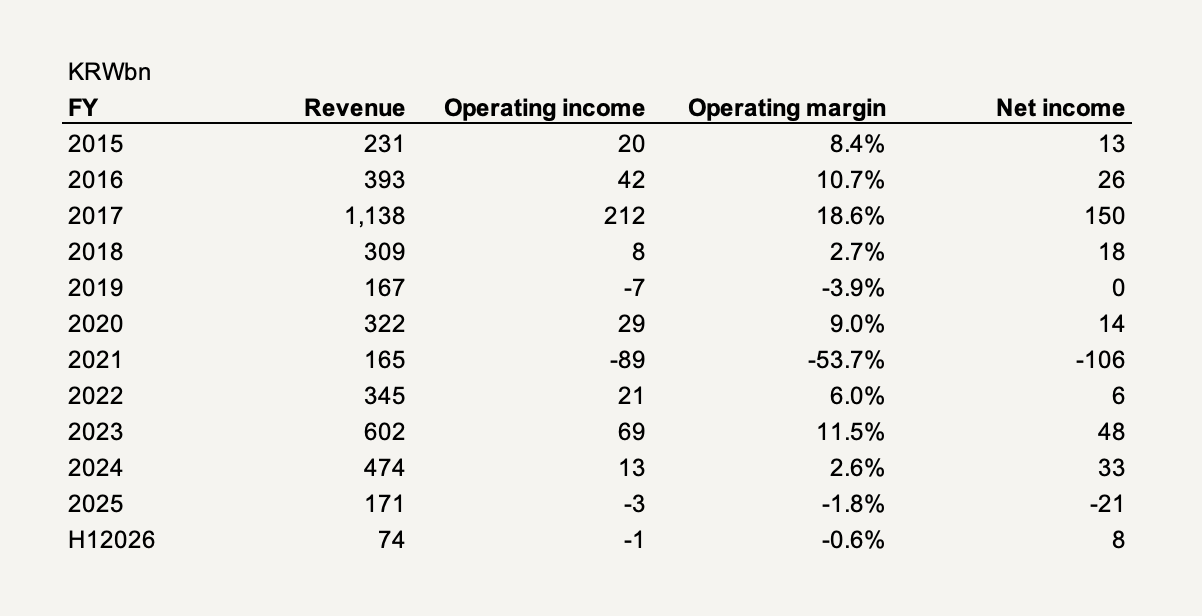
In 2017, Toptec did ~KRW1.14tn of revenue and KRW212bn of operating income. One customer was ~89% of that revenue. The report calls this customer “A”, but it’s of course Samsung’s display division. What Toptec sold it was the machine that bonds an OLED panel around the curved edge of a phone without trapping air bubbles. They developed it together. Samsung Display bought ~1k lamination units to set up its Apple OLED line in Vietnam, and Toptec was the biggest supplier of them. Then in November 2018, prosecutors indicted eleven Toptec executives for selling that technology on to China, KRX halted Toptec’s stock, and Samsung Display stopped buying. Revenue plummeted to KRW309bn the year after and KRW167bn the year after that.
The criminal case ended in July 2023 when the Supreme Court upheld the convictions and fined the company KRW100mn. Bang In-bok, who founded Toptec with chairman Lee Jae-hwan in 1992 (they were classmates at the same Busan technical high school and worked at the same engineering shop before starting it), got three years and served them. He’s back today as vice chairman and full-time head of the business, as an unregistered officer sitting outside the board, and he owns 7.9% of the stock.
I could stop writing here, but there’s more stuff worth mentioning that makes this uninvestable:
- The civil case is still running. Samsung Display sued in September 2019 for a contractual penalty and has since raised the claim to KRW73bn, though the FY25 accounts disclose the claim at ~KRW61bn. In October 2025, the Suwon District Court ordered Toptec to pay KRW11.6bn plus interest, or ~1/5th of the suit. Both sides appealed, and the first hearing at the Suwon High Court was in July this year. Samsung Display wants the damages recomputed on what the secret was worth in OLED sales rather than on what the equipment sold to BOE fetched. Toptec wants disclosure of what BOE already paid Samsung Display under a settlement nobody outside can see. Toptec’s auditor has provisioned nothing in the books, and the KRW61bn claim would eat half of the market cap.
- Toptec issued KRW27bn of converts in November 2023 at a conversion price that has since reset to KRW6,300, ~90% above today’s price. Holders can put from November 2026 and every quarter after. Nobody converts at half the strike, so ~KRW29bn of the cash pile walks out the door in nine weeks.
- In March 2025, Toptec signed KRW74bn with a North American battery maker it isn’t allowed to name. In April 2026, the two of them extended the delivery schedule, and 23 days later, the customer cancelled, with KRW54bn of it unperformed.
- The materials business is a separately listed company called Lemon (294140.KQ), with Toptec holding 53.56% of the shares. Shareholders have put KRW95bn into Lemon, and it has burned pretty much all of it. In March 2026, KOSDAQ designated it an administrative issue for running pre-tax losses >50% of equity in two of the last three years, which is the first step toward a delisting. Four months later, Toptec put another KRW7.6bn of working capital in at a 15% premium to the market price.
- Back in April 2018, Lee (the chairman) tried to sell 15.24% of the company in a block trade at KRW30,000, and 82% of it went unsold, three months after SK Telecom had walked away from buying the whole thing. The stock was at KRW34,000 then, or 10x today’s stock price.
The stock is trading at 0.32x book and 0.55x NCAV with KRW384bn of current assets against KRW155bn of total liabilities, meaning it’s already a relatively “levered” net net. If you add the KRW61bn claim as a contingent liability and knock off 25% of inventory, contract assets, and receivables, this is a net net no more. Easy pass for me.
Wonik Cube (014190.KQ)
Market cap KRW42bn (KRW1,195/share), 0.65x NCAV, 0.36x book, no Value-up plan.
Wonik Cube is a distributor with six segments, of which plastics and chemicals take up 70% of the business:
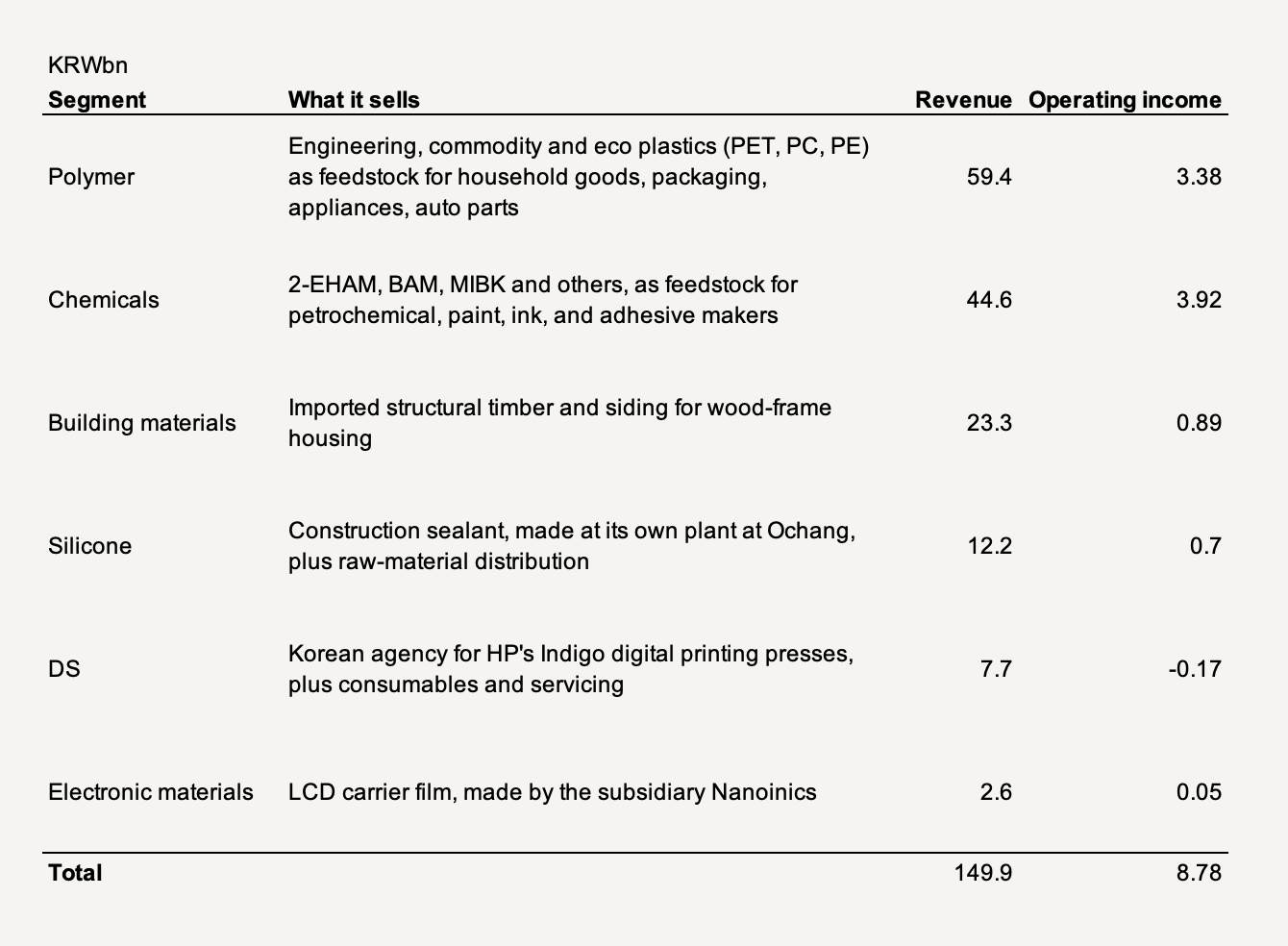
The company has existed since 1979, was listed in 1996, and although the business is lousy, it’s fairly stable. 97% of what it sells is domestic, and no single customer comprises >10%/revs.
Silicone is the only thing it manufactures itself. That plant is currently running at 69% utilization, down from 75%. The HP printer business is the one the company describes as producing stable income, but it lost money in H12026 because the KRW weakened and the presses are imported.
This is not a cash net net. Cash and securities amount to KRW20.6bn against KRW22.7bn of debt and lease liabilities, so the EV is KRW44.4bn. 79% of current assets consist of trade receivables and inventory, making the liquidation value largely a question of collection and resale. If you knock off just 20% of the receivables and 30% of inventory, the stock ceases to be a net net.
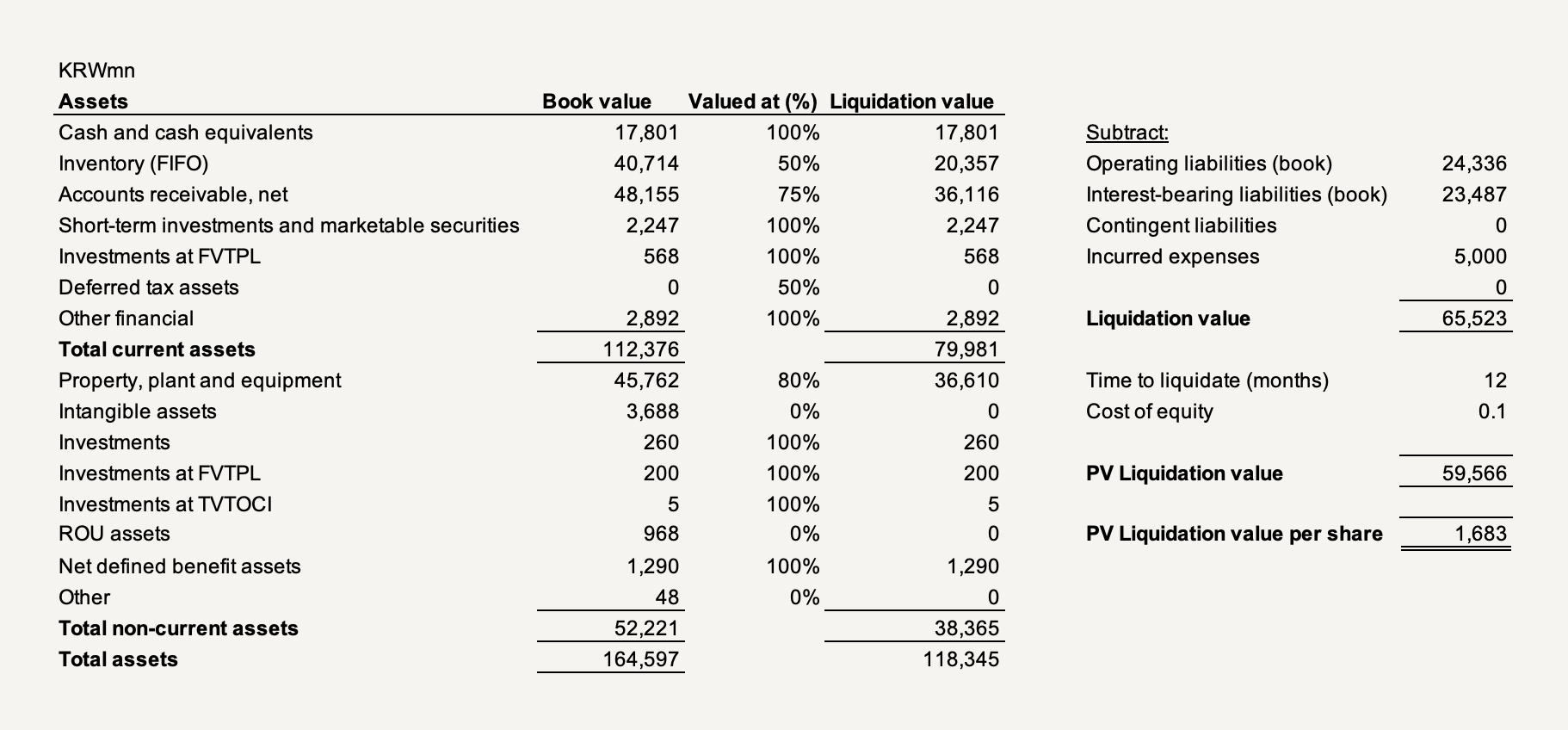
You’ll notice ~KRW46bn of PP&E in the model above, which adds some upside to liquidation value. The company owns two warehouses, one small factory, and an office in Bundang, and all of that together is maybe KRW20bn of it. Another KRW13bn is the land under those sites. The last KRW13bn is a plot in Gangnam that has nothing to do with the business, and that’s where this gets interesting. In September 2024, a company called Carelabs, in the same group as Wonik Cube (whose largest shareholder is Wonik Materials at ~32%), agreed to sell parts of two lots in Yeoksam for KRW75bn. That was 46% of everything Carelabs owned, and its own filing says the point was to repair its balance sheet. The buyers were three Wonik companies. Wonik Cube took 181 sqm for ~KRW13bn, claiming it was for a new head office. (It already has a head office.) Carelabs had been trying to sell that land since 2022, when a buyer agreed to KRW95bn, paid a deposit, deferred payment four times, and walked away. The Wonik group bought Carelabs in January 2023, and since January 2025, it has been run by the youngest daughter of Wonik’s chairman.
KRW13bn is 30% of Wonik Cube’s market cap and 4.5x last year’s earnings. It’s why capex went from KRW1.1bn in 2023 to KRW14.7bn in 2025. What I can’t tell you is whether KRW69mn/sqm was a fair price, because I haven’t gathered comparable Gangnam sales, or what is going to be built on 181 square metres. But the sequence of events is a bit sketchy considering that the company hasn’t paid out a dime to shareholders.
Meanwhile, I believe the business is overearning. The gross margin has sat between 8-11% for the past 12 years, but jumped to 12.5% in H12026. That has happened before, in FY21, when operating income more than quadrupled, only to retrench the following year.
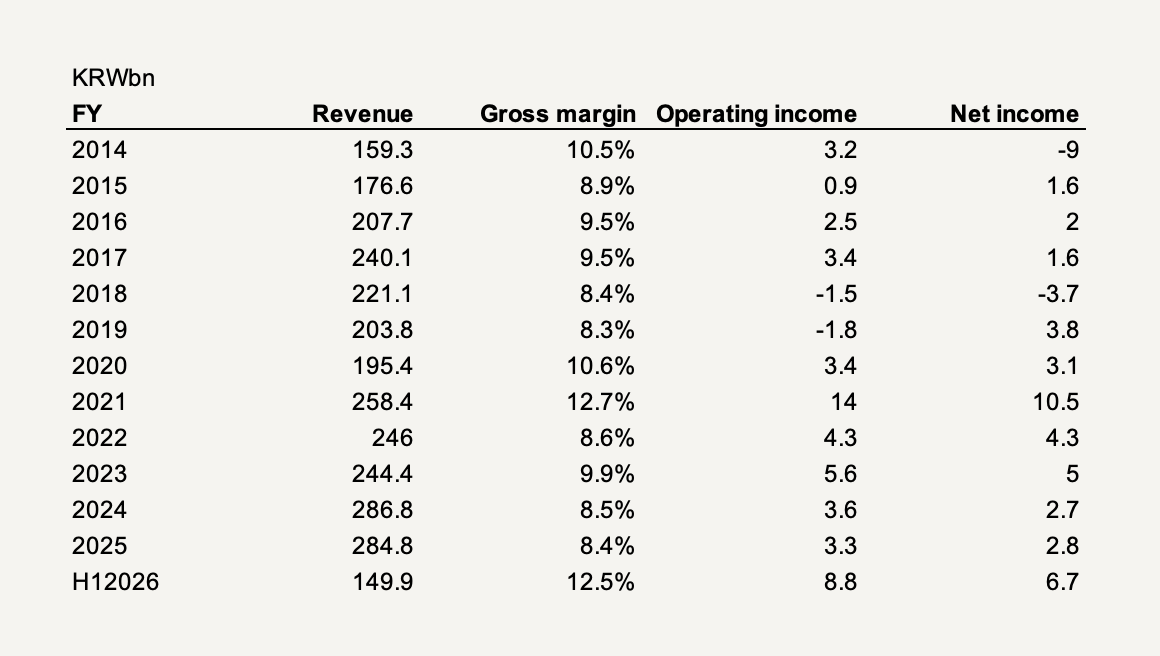
So it looks like the ordinary distributor’s windfall. When input prices rise and you’re sitting on stock you bought cheaper, your selling price moves faster than your COGS, and you earn that spread for as long as it takes the market to reset. That’s what the post-Covid period in 2021 was, and that’s what’s happening to raw material prices now due to an unstable Middle East. The real tell here is that inventory jumped >50% from the end of last FY to the end of H12026, a period in which sales fell 1.4%. Cash fell from KRW29bn to KRW18bn over H12026, while the company part-funded the increase in inventory and receivables with KRW8bn more short-term debt. So you’re likely to see a boomerang effect in both the gross margin and operating profits. And this isn’t the first time the company has reached for external funding to fund working capital. In 2017, it sold 8mn new shares at a 25% discount to market, raising close to KRW10bn.
Average net earnings from 2014-2025 are ~KRW2bn/year. Against a KRW42bn market cap, that’s 20x. ROE over that period has averaged 2-3%. The balance sheet is not nearly attractive enough to make this worthwhile.
Handsome (020000.KS)
Market cap KRW342bn (KRW15,900/share), 0.65x NCAV, 0.24x book, Value-up plan filed November 2024.
This is the largest, most liquid net net of the list in this series so far. It’s also the first with a disclosed Value-up plan.
The only issue is that I usually have a rule about fashion companies: don’t. Fashion is a business where inventory turns into garbage every 6-12 months, customers are fickle, and the guy who founded and ran it for decades eventually sells to a conglomerate that runs the business in a spreadsheet. Handsome, to some degree, fits all of these characteristics.
The company makes pricey clothes. It owns the brands Time, System, Mine, and SJSJ, which seems to be about as close as Korea gets to household names in womenswear, and alongside them it holds the Korean rights to foreign brands such as Lanvin, Tommy Hilfiger, and DKNY. It’s been listed since 1996, and since 2012 it’s been 42% owned by Hyundai Home Shopping, within the Hyundai Department Store group. By the end of FY25, it had >1.3k offline POS in Korea, but the apparel is mostly sold through department stores, some of which are owned by the parent. Outside Korea, its brands sit in 110 department stores, outlets, select shops, and online marketplaces. It also runs three online stores of its own.
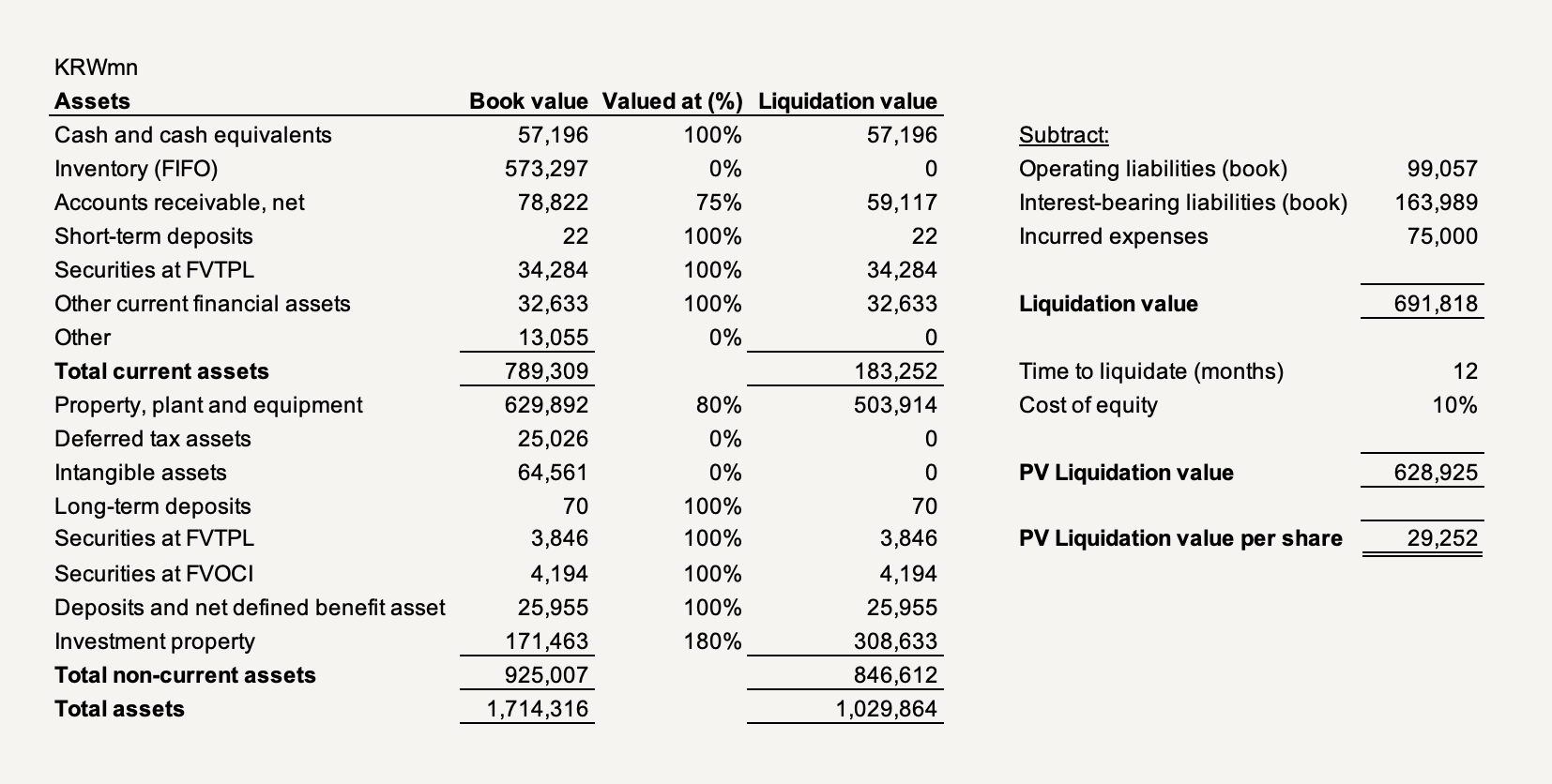
The company has KRW789bn of current assets against KRW263bn of liabilities, so NCAV is KRW526bn, or 0.65x P/NCAV. It holds ~KRW32bn net cash ex-leases, so the headline EV you’ll see at data providers puts EV at ~KRW310bn. But that’s incorrect. The company also holds ~KRW42bn of investments split between FVTPL and FVOCI, and investment property. That investment property has a book value of KRW172bn but an appraised value of KRW386bn. If you take out an (indicative) 25% tax on the gain and include KRW53bn of leases, you get an EV that is just about zero.
So you’re essentially being paid to own the fashion business.
And that’s just the investment property. Sitting in operating PP&E, there’s another KRW344bn of land, also at cost, with no fair value disclosed. If it carries anything like the same gap to appraisal value, the numbers could get silly. I’m haircutting both property items and completely disregarding the big chunk of apparel inventory to land at liquidation value:
That said, the market isn’t asleep either. This isn’t a company nobody’s heard of. The stock trades ~$1.4mn/day on average, and Korea’s National Pension Service holds ~10% of the shares. Baring Asset Management filed >5% back in 2023.
The reason the stock has traded down is answered by taking the long view of the business. Over eleven years, revenue tripled and operating income went nowhere. If you go back further to the early 2000s, when Handsome had its golden years, it earned a 27% operating margin. Last year, it earned 3.5%, and it doesn’t look like a cyclical dip.
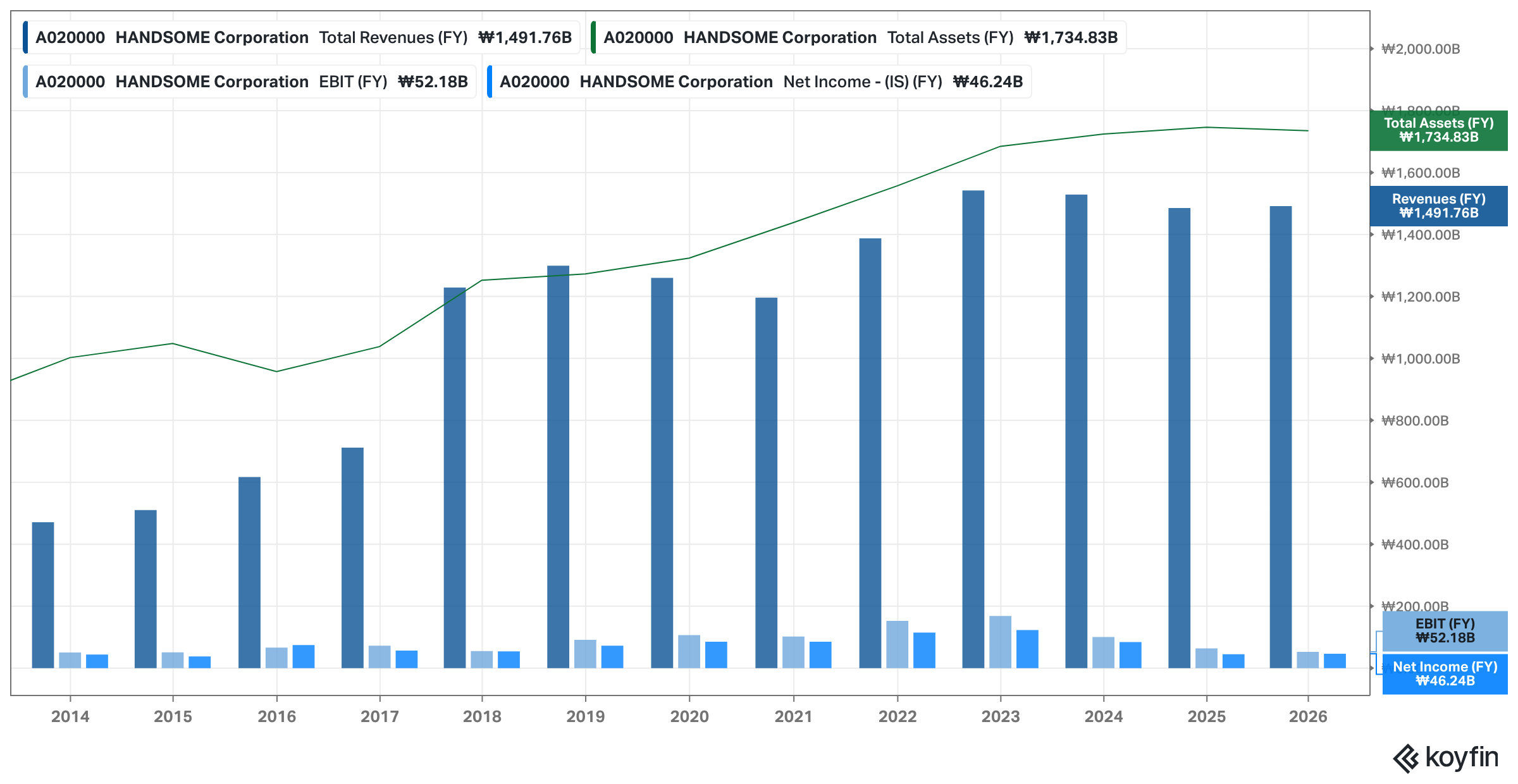
Korean fashion through the retail channel is usually sold on concession. This means Handsome doesn’t rent space in the department store, but hands the store a cut of every sale, which is ~1/3 of revs. In principle, that should cushion a downturn, because the store shares the markdown. However, the operating margin is what’s left after the store’s cut and after design, staff, and head office, and at Handsome that residual is thin, 5-7% in a normal year. So a few ppts of gross margin lost to markdowns or to a shift toward lower-margin imported apparel wipe out most of it. Between FY22 and FY25, revenue dropped 3%, but gross profit fell KRW105bn, and the concession bill rose KRW40bn, from 29% of revenue to 32%. The reports don’t tell you why, but had it stayed at 29%, operating income last FY would have been twice what the company earned.
The founder understood this, both from a financial and a brand value perspective. Jung Jae-bong built Handsome on a strict no-discount policy. That’s why the business used to earn a 27% operating margin.
In 2012, he sold control to Hyundai for KRW420bn. Hyundai immediately installed a CEO from the parent’s planning office rather than from fashion, and you sort of see the discipline going out the window. More outlets opened, markdowns crept in, and imported brands got pushed into the mix, starting five months after the deal closed with two labels Hyundai already owned. The margin dropped to 10% within just two years.
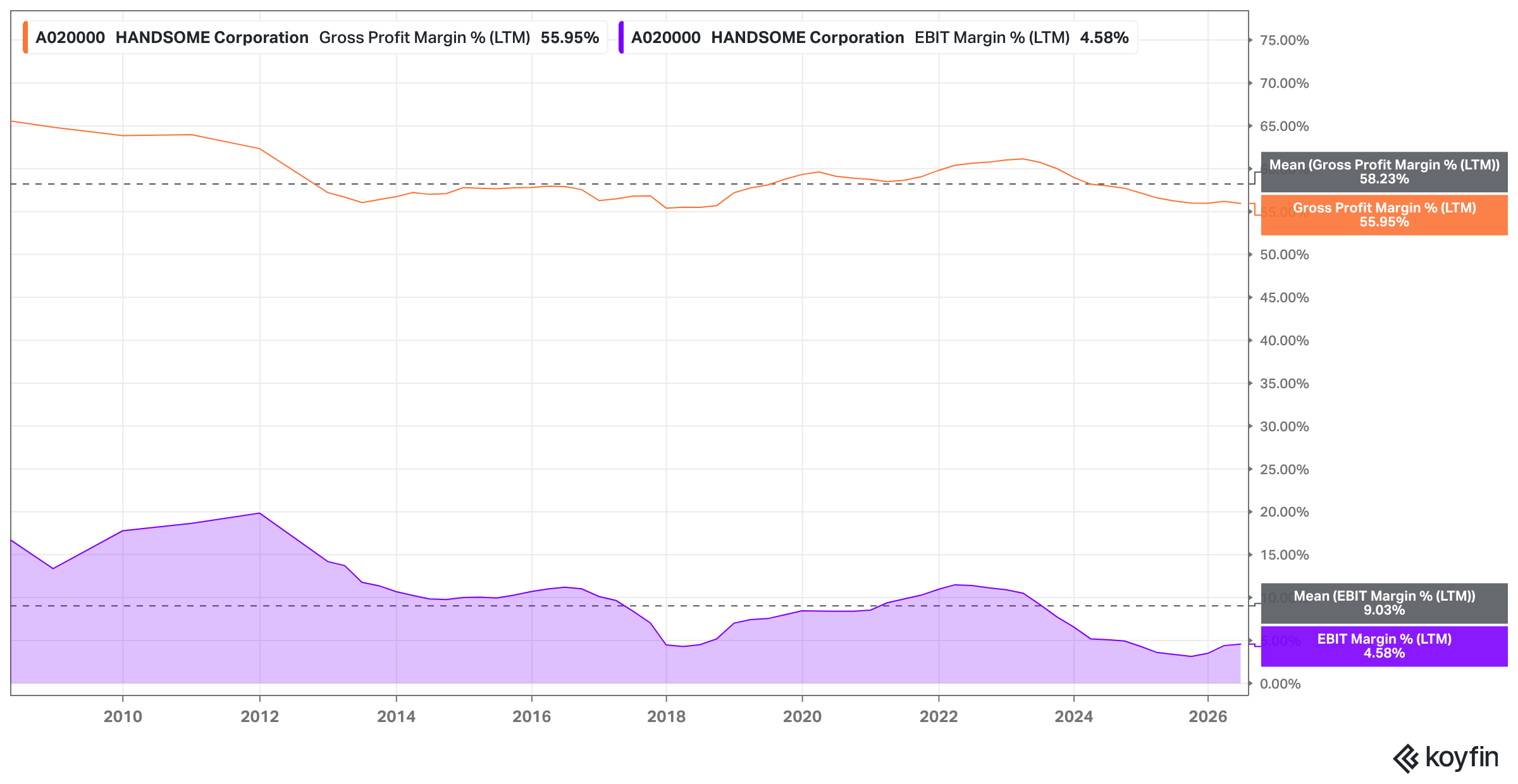
Then in 2017, Handsome bought SK Networks’ fashion division for KRW326bn. The deal included 12 brands, mostly licensed. As seen on the chart above, revenue doubled overnight and the margin halved again. I dug into this because I figured it was the smoking gun behind Handsome’s recent troubles, but it seems like it’s not. SK’s division was losing money before the deal, and Handsome bought it below book value, took KRW33bn of write-downs in year one, shut what didn’t sell, and had it earning KRW14bn by FY18. So the deal wasn’t a disaster per se.
Then came 2021-22. Post-Covid money flooded Korean retail, and the margin bounced back to 11%. Handsome made a record KRW168bn in operating income.
But then it gave most of it back in recent years. If you skim Korean press on Handsome, the story is that the company launched six imported brands in FY23 (Moose Knuckles, Veronica Beard, and a few others) which flopped. They did flop, but my impression is that it isn’t the only issue. Imported brands added KRW45bn of sales between FY22 and FY25 and then gave back almost exactly that in lost margin through markdowns. But the KRW116bn that disappeared in operating income during that period came almost entirely from the company’s own brands and at a lower margin as the post-Covid boom unwound.
So the investment case comes down to betting whether the business rebounds, or whether there are too many cockroaches still in the company’s massive KRW573bn inventory (73% of current assets). That’s close to a year of inventory. (Its closest Korean peer, Shinsegae International, holds 247 days of inventory.) Fashion inventory is the worst kind of inventory there is.
It’s coming down a bit, though. Handsome’s inventory fell 7.5% in H12026 with sales up 7.7%, and write-downs on bought-in stock are at 11.8% and climbing, the highest since 2021. Falling inventory with rising write-downs is what a cleanup looks like, while rising inventory with flat write-downs is what hiding looks like. Handsome is doing some washing right now to get out of the mess, but if that inventory suddenly needs another KRW100bn of write-downs, it’ll eat a couple of years of earnings.
If you take the positive view, Handsome averaged KRW90bn of operating income in the past 12 years. That’s about a 7.6% margin. And if you throw out the boom years, it still averaged 6.7%. If the margin gets back to 6% on current revenue, the business would earn KRW90bn on a KRW340bn market cap where you get what amounts to the whole market cap in cash, investments, and investment property thrown in as a cushion.
Against that, I’ll repeat that more than a decade of brand erosion is more of a trend than an accident. Hyundai has proven it can buy brands but not necessarily build one, and Korea’s premium fashion market may have moved mid-market for good.
The company pays out 35% of earnings in dividends, currently yielding 4.7%. It also bought back and cancelled 4% of the shares last year. It has a disclosed Value-up plan but it’s sort of meh, targeting a 0.5x P/B in the near term, which, to be fair, is a double from here. However, it all depends on the same variable as above, whether profitability gets back on track. The Value-up plan doesn’t mention the investment property. And this board likes real estate. In 2013, it bought its own head office for KRW100bn. In 2023, it bought a second site in Chengdam-dong for KRW240bn, paying for it by liquidating the company’s securities portfolio. It tells you what this board reaches for when it has cash, and it probably isn’t a special dividend or a major buyback.
Let’s now look at the most interesting net net from this batch.