
Today’s batch contains 6 new net nets, with the better one behind the paywall. With this batch, I’ve now written up 32 stocks on the list and ranked them all in the Google Sheet tracker for premium subscribers. 8 of the 32 have a 1 (out of 5, with 1 being the most attractive). Again, a 1 just means I’d consider it for a net net basket. It isn’t a recommendation to buy, and nothing here is investment advice. The link to the tracker is at the end of the post.
My next writeup will be of another dirt-cheap Korean stock that I like. This one will be no net net, but an excellent, moaty growth business earning >30% operating margins, has compounded revenue and operating profit by 18%/year and 25%/year respectively for the past 5 years, and trades at just 2x EBIT and 6x earnings. You don’t want to miss this one, so make sure you’re on premium before it lands later this week.
Enjoy this batch.
AztechWB (032080.KQ)
Market cap KRW22bn (KRW2,020/share after 2:1 reverse split), 0.32x NCAV, 0.20x book, no Value-up plan.
Well, if there’s a company that reminds me of the original Berkshire Hathaway, it’s this one.
In 1962, Buffett started buying a New England textile mill that was shrinking a little more every year, trading below NCAV, with management that kept closing plants and using the cash to buy back stock. He took control in 1965, stopped reinvesting in textiles, and moved the cash into better businesses, starting with National Indemnity in 1967.
I probably don’t have to tell you that the one difference that matters here is that of control. The Berkshire textile business kept losing money for another 20 years until he shut it in 1985, and what made Berkshire was never the mill, but the proceeds from liquidating the textile mill and where Buffett put that cash to work.
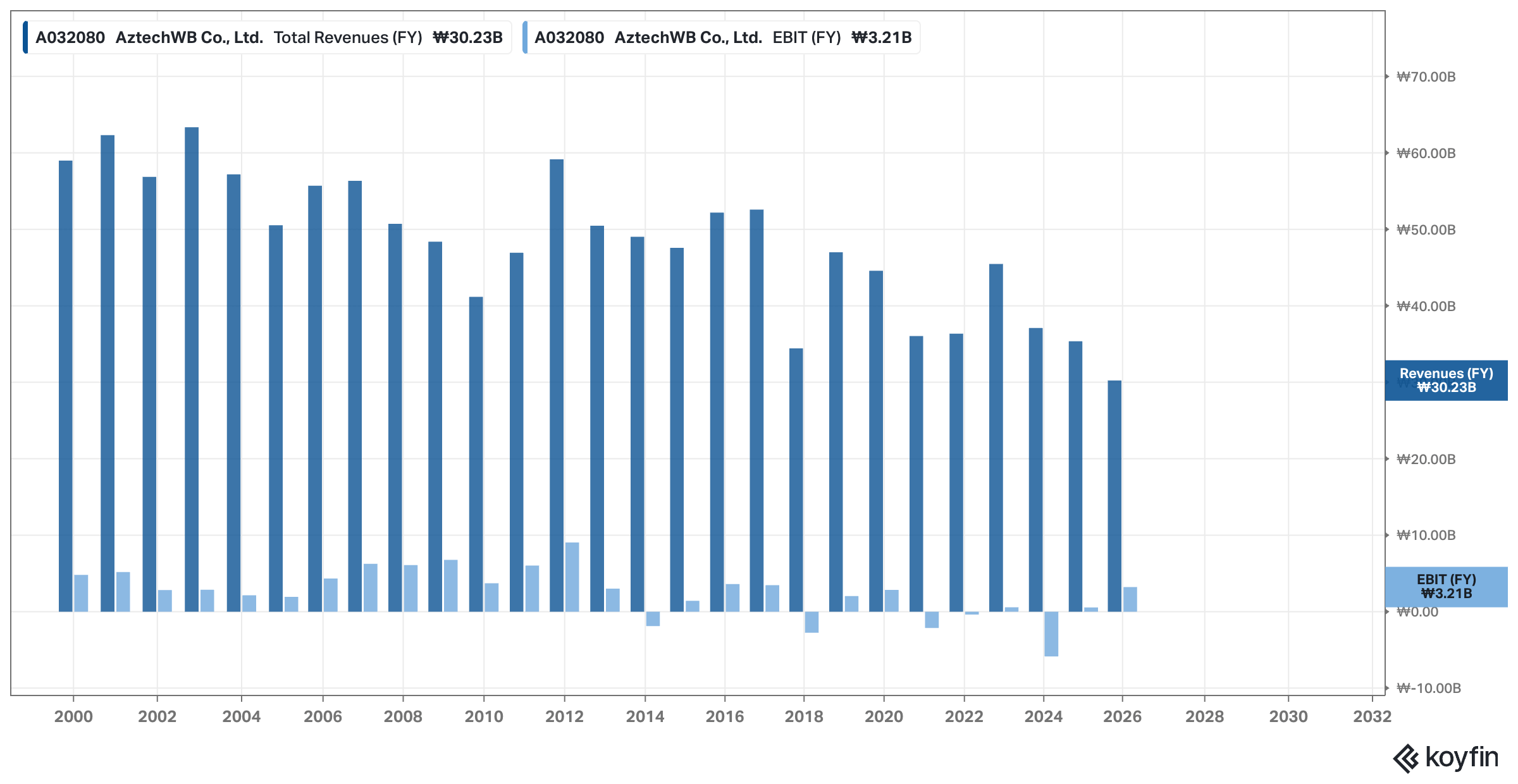
AztechWB is a money-losing Korean wool mill. It was founded in 1969 by the Huh family, and it’s a long way from its heyday. Korea had 180 wool fabric makers in 1999. Samsung’s fashion arm closed its last fabric plant in 2022, and Taekwang shut its spinning division the year after. AztechWB is now one of two or three of any size left in the country, and it’s facing trouble both domestically and overseas. In today’s wool market, Italy leads the top of the market and China the bottom. Korean exports of wool fabric are down 59% since 2017, and the government has decided that formal school uniforms, an important business for this company, should be phased out from 2027. AztechWB’s mill runs at 1/3 of capacity, and revenue has fallen from KRW53bn to KRW30bn in the last 10 years, while operations have shown a loss, or something close to it, in every year since 2017.
As of June 2026, AztechWB had KRW20.8bn of cash, KRW4bn of bonds, and KRW55bn of securities at “fair” value. Subtract KRW11.4bn in borrowings, and you’re left with ~KRW68bn, >3x the market cap.
But we cannot treat that KRW68bn as cash.
Of the securities, KRW9.2bn is listed shares and funds at quoted prices, and KRW21.7bn is funds valued using market inputs. Another KRW23.3bn is VC and PE fund interests, valued using the funds’ NAV figures.
So you’re buying a fund run by a textile family, and trusting the marks of holdings you have little to no insight into. My liquidation model takes the private fund interests at 60% of carrying value, the market funds at 90%, and inventory at 30-50% of its already written-down book value. I’m also taking the Busan site at its conservative 1998 revaluation. After liabilities, wind-down costs, and a year’s discount, I get KRW5,933 per post-split share.
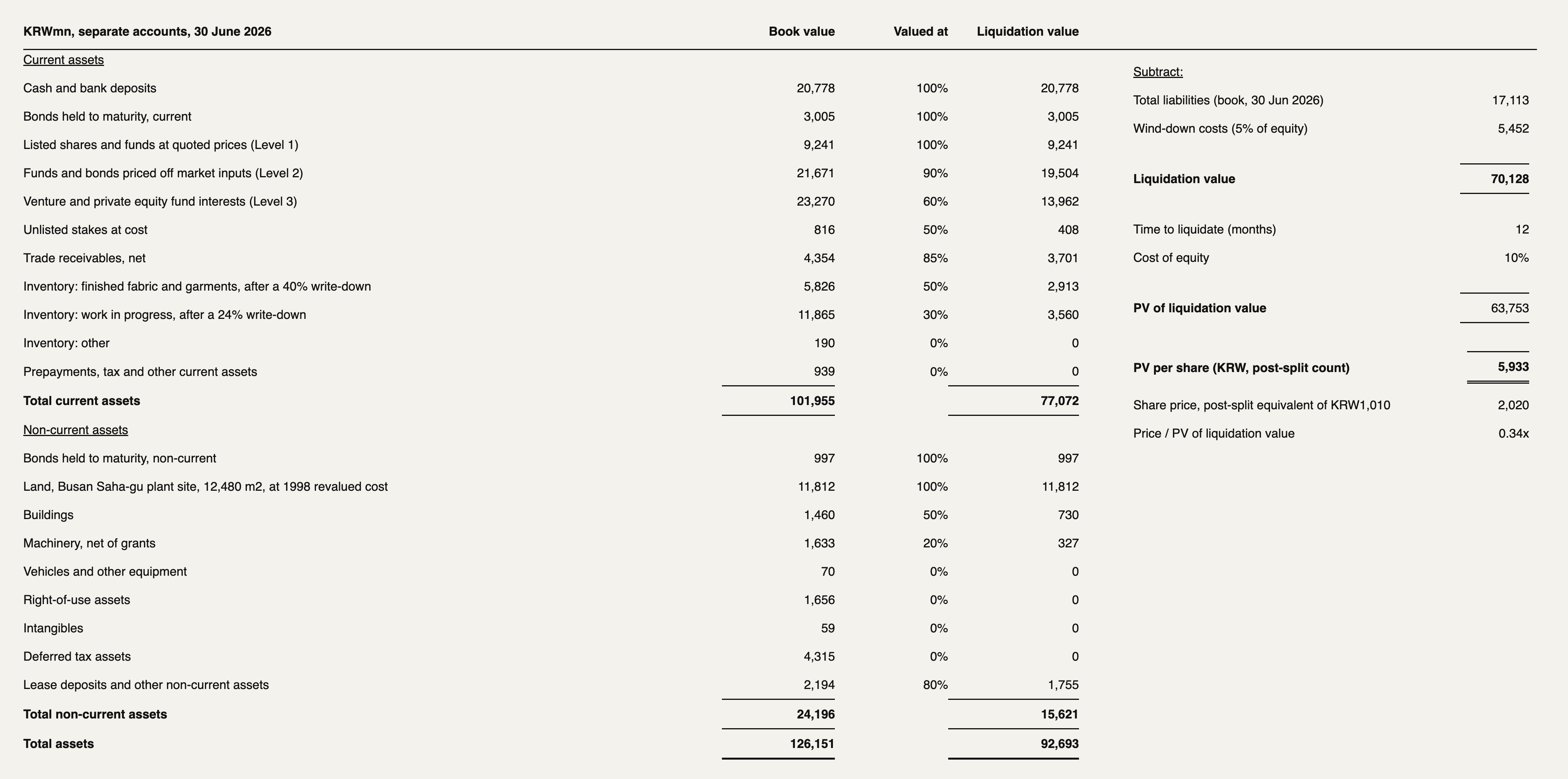
The stock is currently undergoing a 2:1 reverse split, and trading reopens on October 13. So the reference point to the liquidation value above is KRW2,020/share.
On that figure alone, the margin of safety is wide, but we’ve got no insight whatsoever as to what those funds consist of. And the real issue with this stock is that the family is far from shutting down the money-burning mill because the mill is a customer of the family’s other company.
Hyorim Seul is a worsted spinner in Eumseong, owned by the CEO and his two children and run by his wife. It sells AztechWB 2/3 of its yarn, KRW10.5bn last FY. AztechWB guaranteed KRW5bn of its bank debt in 2013, lent it KRW5.8bn in 2024, and in February sold it the treasury shares, so it now owns 15.6% of the listed company.
The family’s record doesn’t help either. There have been disputes among the Huhs over control, including a court case in 2018, and the CEO and his children have sold shares into past spikes. Not my favourite kind of partner.
Meanwhile, nothing comes back to shareholders beyond KRW50/share in good years, and nothing since FY22.
The discount to NAV is very wide, but that’s the only thing this stock has going for it. It’s a pass.
INITECH (053350.KQ)
Market cap KRW96bn (KRW4,815/share), 0.71x NCAV, 0.67x book, no Value-up plan.
This stock has two things going for it. First, it has a clean balance sheet, basically all cash and some convertible bonds, because it sold off its larger business, a card-terminal business named Smartro, 5 years ago. The remaining business is a bank-software business that doesn’t require much capital. The stock is trading at 0.67x book value. Second, while pretty much all of the stocks I’ve written up in this series sell below their most liquid assets because a family with incentives other than yours has tight control over those assets, that ain’t the case with INITECH.
The history of INITECH’s ownership is a jumble. If you’ve read my batch 1 in this series, you’ll remember that we first encountered this name when I worked on Ocean in W, which I passed on because it had sold a media company for KRW180bn and then lent a good chunk of that money to a couple of shells buying control of another listed company, with that company’s own shares as collateral. That other listed company was INITECH.
This is roughly the short version: until last year, INITECH was majority-owned by KT, Korea’s largest telco. KT was selling off non-core businesses, and in March 2025, it sold its stake for KRW84bn, which was less than INITECH’s net cash position at the time. The buyer of those shares put up KRW17bn and borrowed the rest. Just one day after the deal, the buyer’s lenders took the shares, and two months later, those lenders sold the shares on to two shell companies, SJ 1st Holdings and SJ 2nd Holdings. These shells paid mostly with money borrowed from Ocean in W, and they put up the INITECH shares as collateral.
Those shares are now worth 40% less than the shells paid for them, and in December, the two shells stopped paying their loans. If the loans aren’t repaid, Ocean in W can take the shares.
In practice, Ocean in W is already running INITECH. Its CEO became INITECH’s co-CEO back in March. And last autumn, a fund that Ocean in W owns bought KRW24bn of newly issued INITECH shares. This means INITECH raised capital it didn’t need from the company that lent its owners the money to buy it.
Since KT left, INITECH has put ~KRW80bn of its cash into the bonds of four listed companies. One of them, Dimoa, is half-owned by Ocean in W. Another entity, Dynamic Solution, bought a building INITECH owned in Seoul in the same week that INITECH bought Dynamic Solution’s bonds. To be fair, INITECH has so far gotten its money back on the bonds it has sold. But at its first shareholder meeting under the new owners, in June 2025, the company also changed its articles so it can issue up to 500mn shares (there are 22mn in issue today) and up to KRW700bn of convertible bonds. The board can use that room without another shareholder vote, and it already has once, when it sold KRW24bn of new shares to Ocean in W’s fund.
In March, a group of minority shareholders filed a criminal complaint against five people with the Seoul police for breach of trust over these investments. The five include INITECH’s CEO and Won Young-sik, whose family controls Ocean in W. I haven’t found any ruling in the case.
It’s a pass, and I give it a 5 in the net net scorecard (find the link at the bottom), same as Ocean in W.
Sewoon Medical (100700.KQ)
Market cap KRW99bn (KRW2,355/share), 0.82x NCAV, 0.63x book, no Value-up plan.
Yet another “buy the cash and get the business for free” stock. Sewoon is one of the rare companies on our list that is actually a good business, earning a 21% 10-year median operating margin on KRW66bn of revenue and KRW61bn of operating assets for a ~23% pre-tax return on invested capital.
It sells into Korea’s ageing population, making medical disposables like wound drains, urinary catheters, IV sets, stents, and so forth. ~3/4 of revs are in Korea where the +65-age population passed 20% a couple of years ago.
The company has paid a dividend every year since the listing in 2008 and bought back KRW3bn of stock last year, adding up to a 6% shareholder yield. Meanwhile, the rest of the cash has piled up, and today there’s ~KRW100bn of cash and deposits against a KRW99bn market cap.
And there’s some chance that dividends are gonna get ramped up from its current 24% payout ratio to qualify as a high-dividend company. From this year, dividends from companies paying out >25% of profits (with a 10% dividend increase) will have their owners taxed at a much lower rate. Sewoon raised its dividend 17% last year and missed the 25% bar by <1ppt.
If you can stomach the patience needed for this one, it’s an intriguing setup.
To be clear, despite selling into a good demographic in Korea, Sewoon is no growth story. Korean sales peaked in 2019 and are ~12% lower today. And it faces foreign competition. Imports reportedly supply ~70% of the Korean catheter and tube market.
But it doesn’t need to grow. It just needs to not fall off a cliff. Over the last 10 years, revs have ranged KRW56-KRW68bn. The operating margin has ranged 18%-25% during this period. It has turned a profit in every year I can find.
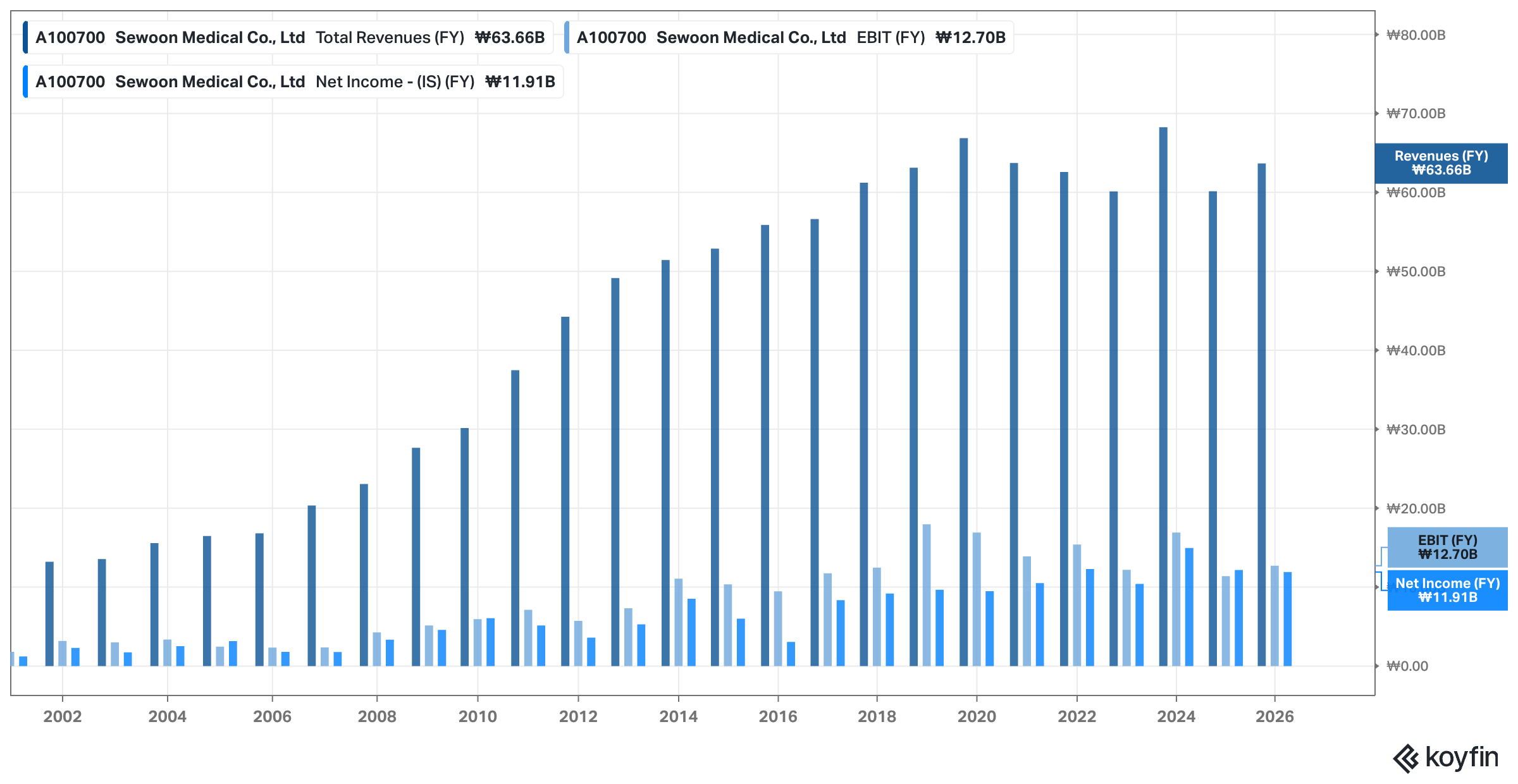
Each bar is plotted at the end of its fiscal year, so the bar above 2024 is FY2023.
The worst of those years on a sequential basis was FY24, when sales fell 12% and operating profit was down by 1/3. According to Sewoon, there was a major trainee doctors’ strike in February 2024, protesting against the government’s plan to expand medical school places. The number of surgeries reportedly dropped by 1/4 at the major Seoul hospitals, but even in that year, the operating margin was 19%.
It’s important to mention that Sewoon does not supply directly to hospitals but to regional dealers. The company says its main dealers are held as subsidiaries or affiliates, and the biggest of them is a company called Standard Sci-Tech. Sewoon owns 63.8% of the company, and the two share a CEO.
The government is a tough negotiator, specifically through the Korean health insurance system that sets what hospitals get paid. Hospitals then buy the cheapest product that does the job, and for the most basic disposables the price is set so low that Korean makers say they can’t make them at a profit. So this is an industry that competes on price, and I guess it’s probably one of the more commoditized parts of the medical value chain. The price of Sewoon’s main product, the wound drain, was about the same in 2025 as it was in 2020. Basically, the reason why margins have held up in the intervening period of inflation is that around 2016, Sewoon started moving production to Vietnam to create a cost base that could compete with the foreign contract plants.
Here’s Sewoon next to close Korean peers:

The first thing to stand out is that Korean small-cap medical device makers are generally priced low. A low P/E isn’t unique to Sewoon. This is an indication of the industry pressure I noted above.
But a P/E hides the most important difference, which is that Sewoon’s market cap is entirely covered by its cash.
M.I.Tech is the most direct peer, because it’s in the one category where Sewoon is growing the most, namely in stents. M.I.Tech is about the same size by revenue, has a 10ppt higher margin and Boston Scientific as its majority owner. It trades at >1x book, while Sewoon trades at 0.63x.
Over the last 12 months, Sewoon made KRW14.3bn of operating profit. After a ~20% tax rate, NOPAT is ~KRW11.5bn. That’s close to the average over the past five years too. Putting a 6x on that and adding cash would yield a ~KRW4,000 share price.
And like always, the thing standing between you and that value is the family.
The Lee family owns 52.8% of the shares. The founder, Lee Gil-hwan, is 84 and still owns 31.7%. The CEO, Lee Jae-hee, who I believe is his daughter, is 55 and owns 17.4%. The rest of the family owns 3.6%.
The payout ratio has been 18-25% every year since 2016, and that low payout has become more of an issue since FCF stepped up after the buildout of the Vietnam plant. Since 2020, FCF has averaged KRW15bn/year.
Part of the reason is the imminent succession. Lee Gil-hwan has got a big stake to pass on, so a low share price under the current inheritance tax regime is the main incentive at this moment. He’s already gifted and sold Lee Jae-hee 4mn shares since 2018.
I think it’s probable that Sewoon will bump the payout ratio for FY26 to qualify as a high-dividend company at the lower tax rate, but whether that will be at the expense of continued buybacks remains to be seen. The buybacks from last year, btw, haven’t been cancelled yet.
All in all, it looks like an okay Korean net net. You’re paying for the cash and getting a business that has earned ~20% margins for a decade, has no debt, and sells a product with constant demand. Provided that nothing changes, you collect a ~3% dividend and watch the cash pile grow, which is slow and might eat at your opportunity cost. Or you could wait for any news around the succession, after which the family would have less reason to want a low share price, and buy then. The risk is that by then the market has noticed too.
Pharmsville (318010.KQ)
Market cap KRW28bn (KRW3,560/share), 0.77x NCAV, 0.41x book, Value-up plan filed March 2026.
Pharmsville sells supplements under its own brands, mostly stuff like diet pills, vitamins, and collagen. It doesn’t make most of what it sells. ~87% of its products are made by contract manufacturers, and for most of the company’s 26-year life it didn’t sell these products itself either.
Home shopping, if you’re old enough to remember what that is (TV channels that sell stuff live all day, with a host demoing the product and a phone number on screen to call in your order), was a huge channel for Pharmsville back in the day. In 2020 alone, home shopping brought in nearly 3/4 of Pharmsville’s KRW39bn revs, at a time when Covid had everyone sitting at home shopping through their TVs. The company had listed on KOSDAQ the year before at KRW14,000/share. The share price has since drifted to KRW3,560 today.
From a returns perspective, a business like that is pretty good while it lasts. You don’t need a factory or salespeople, you just need the right TV slots.
However, your customers belong to the channel. And in Pharmsville’s case, the channels on which it aired had problems of their own. The cable companies that carry them now take a larger cut, so the networks started getting pickier about who gets airtime. By 2022, Pharmsville said it had lost its slots, blaming its plummeting sales on channels cutting its broadcasts.
So home-shopping sales went from KRW28.6bn in FY20 to KRW1.8bn last year. Total revenue is down to KRW12.7bn. The business now loses a little money, and one unnamed customer takes about half of the revs.
This is a broken business.
But the company did keep the money it made on the way up. Today there’s ~KRW48bn of cash, securities, and fund stakes, plus a building it rents out, against a KRW28bn market cap. There’s no debt.
That said, just ~KRW5bn of that figure above is cash. A full KRW30bn is structured notes whose principal is at risk, and the company doesn’t disclose what they’re linked to. Most of the rest is stakes in small private funds valued at those funds’ marks and bonds from unnamed issuers. Here’s my liquidation model, with all of that marked down:
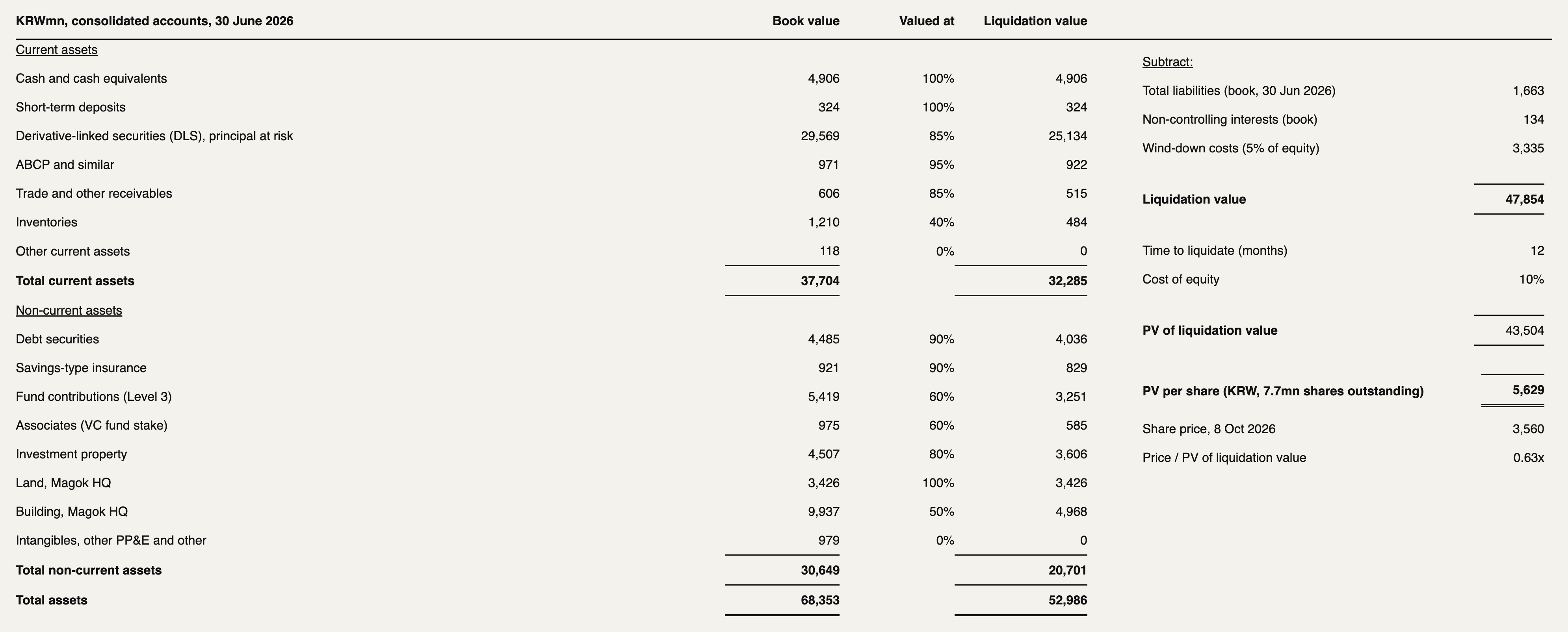
Given what we’re dealing with here, that gap to the share price isn’t nearly enough to make this worthwhile. There have been much better setups in this series. The founder owns over half of the company, and this is really illiquid, so we’re not gonna see an outside event.
Hyungji I&C (011080.KQ)
Market cap KRW5.2bn (KRW726/share), 0.33x NCAV, 0.15x book, no Value-up plan.
This is a clothing company that owns three old Korean brands called YEZAC (men’s shirts), BON (menswear), and Carries Note (womenswear). It’s all sold in department stores and outlets, almost all of it on consignment.
The stock is an easy pass for two reasons: 1) it’s way too tiny at a KRW5bn market cap (about $3.5mn), so it will probably be forced off the exchange soon (though delistings are on hold for now after a court ruling), and 2) if you owned 1% of the company in the summer of 2022 and sat out the rights issues since, you’d own 0.18% today. Adjusted for two reverse splits, the share count is 5.5x what it was 4 years ago. The company has raised ~KRW42bn from shareholders and bondholders through three rights issues, a convertible bond, and bonds with warrants. Those raises were done to keep the company’s shrinking clothing business open. And just a month after last year’s KRW12bn issue, the company started lending money to the unlisted parent, Fashion Group Hyungji.
This has trouble written all over it. The stock is down 93% this year.
Let’s now look at the best net net from this batch.