
A quick reminder that the Google Sheet tracking every stock in this series, with price and date at writeup, my rank, and the live return since, goes out to paid subscribers with each batch. Today’s 8 stocks get added when this is published. Premium subscribers will find the link at the end of this post behind the paywall.
I’m not kidding, my computer got stolen yesterday, which is why this batch comes out a day late. Somewhere in Copenhagen a thief is scrolling through 180 Korean net nets and wondering what he did to deserve it. (Now I’m kidding. Everything is in the cloud and the machine is locked, so the only thing he got is a nice keyboard.)
Batch three is the biggest yet, 8 stocks, and I’ve put the two stocks I like most behind the paywall.
In batch two I wrote that filings tell you what the controller did but never why. Going through this batch, I think the why for a lot of these insiders is the tax man.
Korea taxes inheritances and gifts at up to 50%. And the way the tax office values what’s being handed over is based on its average market price over the 4 months around the transfer. An unlisted company is valued off a formula, a blend of net assets and capitalized earnings. So for a family that controls a listed net net trading at a fraction of book, the low share price is a form of estate plan.
Once you see it, you see it everywhere: flat dividends that never grow, buybacks that don’t get cancelled, cash that goes into low-yielding assets, or a golf club bought from an uncle instead of back to shareholders. None of that is fraud, and most of it is defensible on its own, but it all keeps the price down.
Which means the question to ask of many Korean net nets is where the insiders are in the succession cycle. If the patriarch is old and the kids are already on the register, the discount has a reason to exist and to persist. If the handover happened last year and the estate has been valued, the incentive flips. Two of the stocks in this batch had an inheritance or a gift in the past 18 months. One of those, and a company with a 58-year-old founder with no heir on the register, are both behind the paywall.
Let’s get into it.
DRB Industrial (163560.KS)
Market cap KRW79bn (KRW5,660/share), 0.69x NCAV, 0.31x book, no Value-up plan.
DRB (Dongil Rubber Belt) makes the rubber tracks that go under compact track loaders and mini-excavators, and it sells them to Caterpillar, John Deere, Bobcat, and Volvo. The stock trades at 0.69x NCAV, and it’s paid a dividend every year since it was (re)listed in 2012. It also trades at 3.7x TTM operating income and <3x earnings.
While that sounds fine, out of the gate I’ll say this company is uninvestable. It sure looks like a net net. But 3/4 of the current assets are invoices owed by companies controlled by the parent (DRB Holding, also listed). The history is that in 2012, the old Dongil Rubber Belt split three ways. The holdco became DRB Holding and kept the plants outside Korea. The rubber business (this one) was relisted. And the family swapped its shares in the rubber business for shares in the holdco through a tender offer in 2013, so that DRB Holding ended up with 44% of DRB Industrial and the family with 70% of the votes.
So the group’s plants in Vietnam, Qingdao, and the US all belong to the parent. DRB Industrial holds the customer contracts and the factory in Busan. This means that the tracks sold to the likes of Caterpillar are made by a sisterco in Vietnam, bought by DRB Industrial, which sells them on to another sisterco in the US. In other words, every leg is a related-party transaction. Last year, DRB Industrial bought KRW212bn of goods from DRB Vietnam and DRB Qingdao, which amounts to 72% of COGS. It sold KRW188bn to DRB America and DRB Japan, which is 52% of sales.
The funds owed on those sales sit on the balance sheet, and they’re ageing. Of the KRW169bn of DRB Industrial’s trade receivables, KRW132bn is owed by sistercos, and DRB America alone owes the company KRW99bn. And it’s been going up:
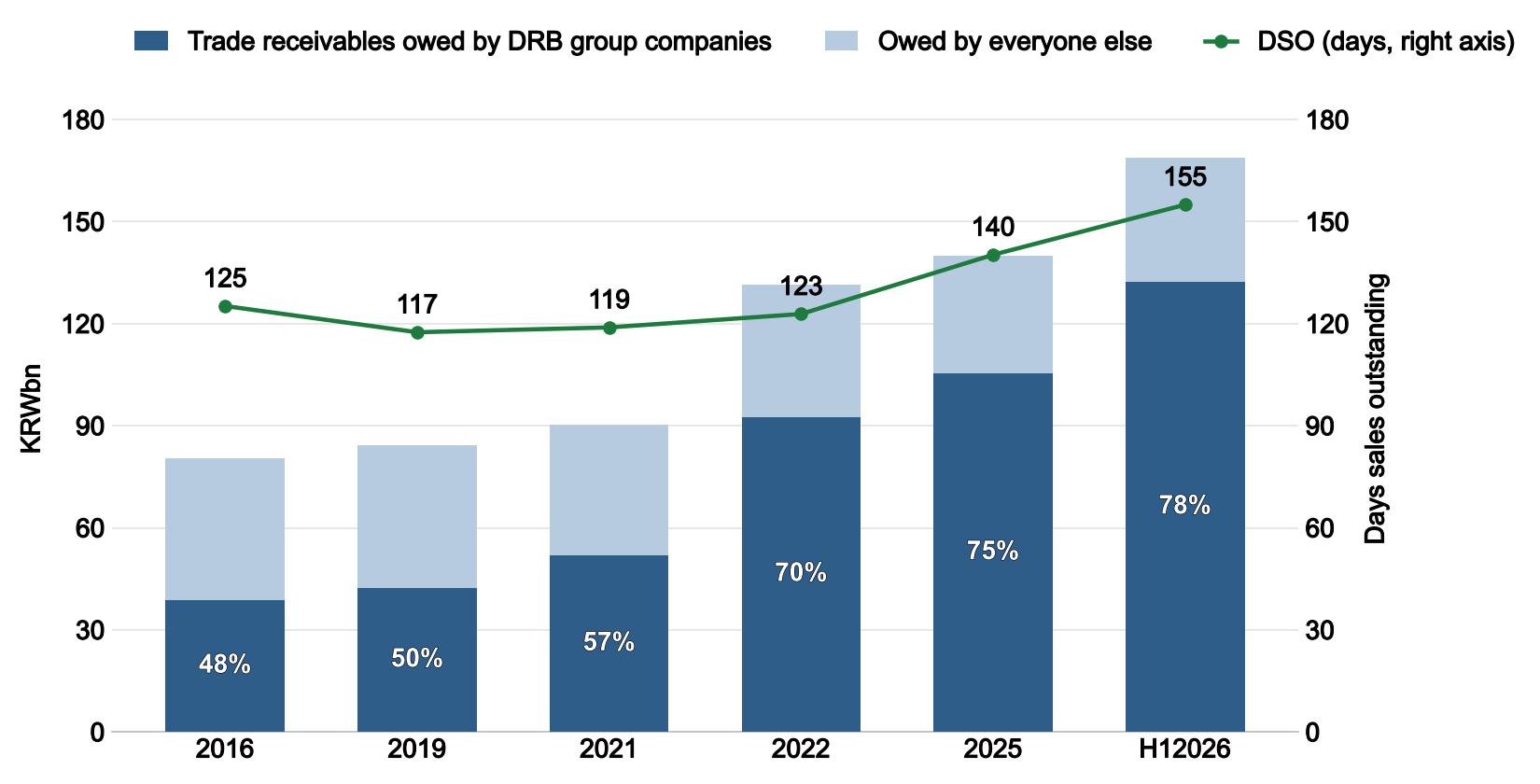
And not only do the receivables get older (DSO went from 119 days in FY21 to 155 by H12026), DRB Industrial also guarantees KRW40bn of DRB Vietnam’s bank loans out to 2028 and 2030. This “looks” like a consistently profitable company, but CFO has been negative in three recent years, FY21, FY22, and FY25, all because these receivables keep piling up and are almost entirely in the parent’s control. The earnings are a mirage.
So let’s not waste any more time.
Wiscom (024070.KS)
Market cap KRW29bn (KRW1,896/share), 0.62x NCAV, 0.32x book, Value-up plan filed March 2026.
Wiscom makes the plastic (PVC compound) that goes around a cable. It buys PVC resin, mixes in the plasticisers and pigments, and sells the pellets to cable makers who melt them onto copper. The company reckons it has 15% of the Korean market. It also does a side job coloring ABS plastic for LG Chem, where LG Chem owns the material and Wiscom gets a fee for stirring it. The company has 5 plants in Korea and 2 in China, and was founded in 1978 by a man named Koo Jo-woong, who’s 84 years old and still shows up as chairman. It’s a boring company.
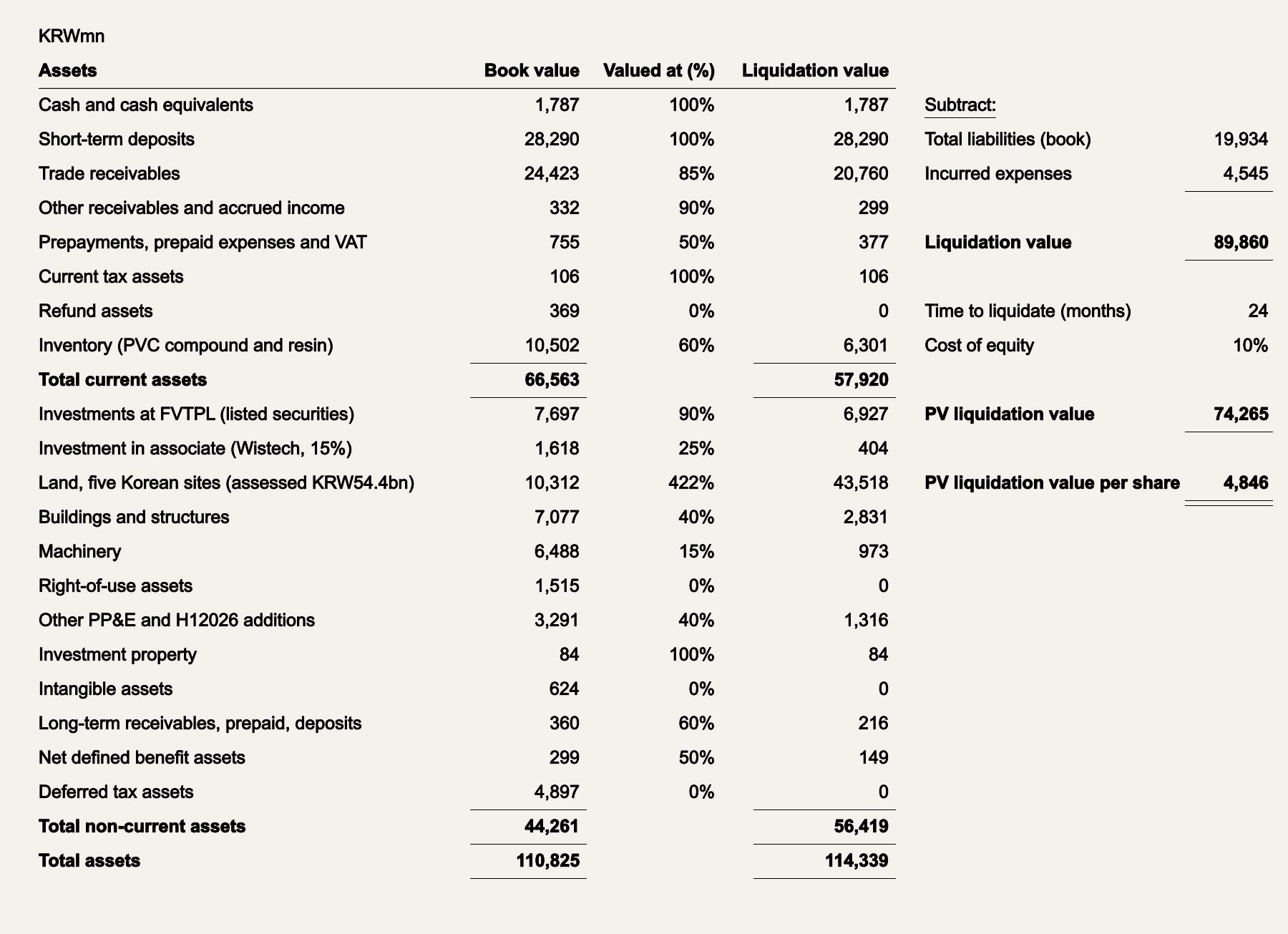
The stock trades at 85% of net cash, but the real value is in the land. The land under the 5 plants it has in Korea are carried at KRW10bn but date back to the 1980s and 90s. The government’s tax-purpose value is KRW54bn, and assessed values usually run below market. So the land alone is nearly 2x the market cap.
Liquidation model:
It’s cheap because the business sucks. Revenue was KRW151bn in FY13 and KRW103bn last year. Operating income has swung around zero since FY17 and was negative in most years since FY20.
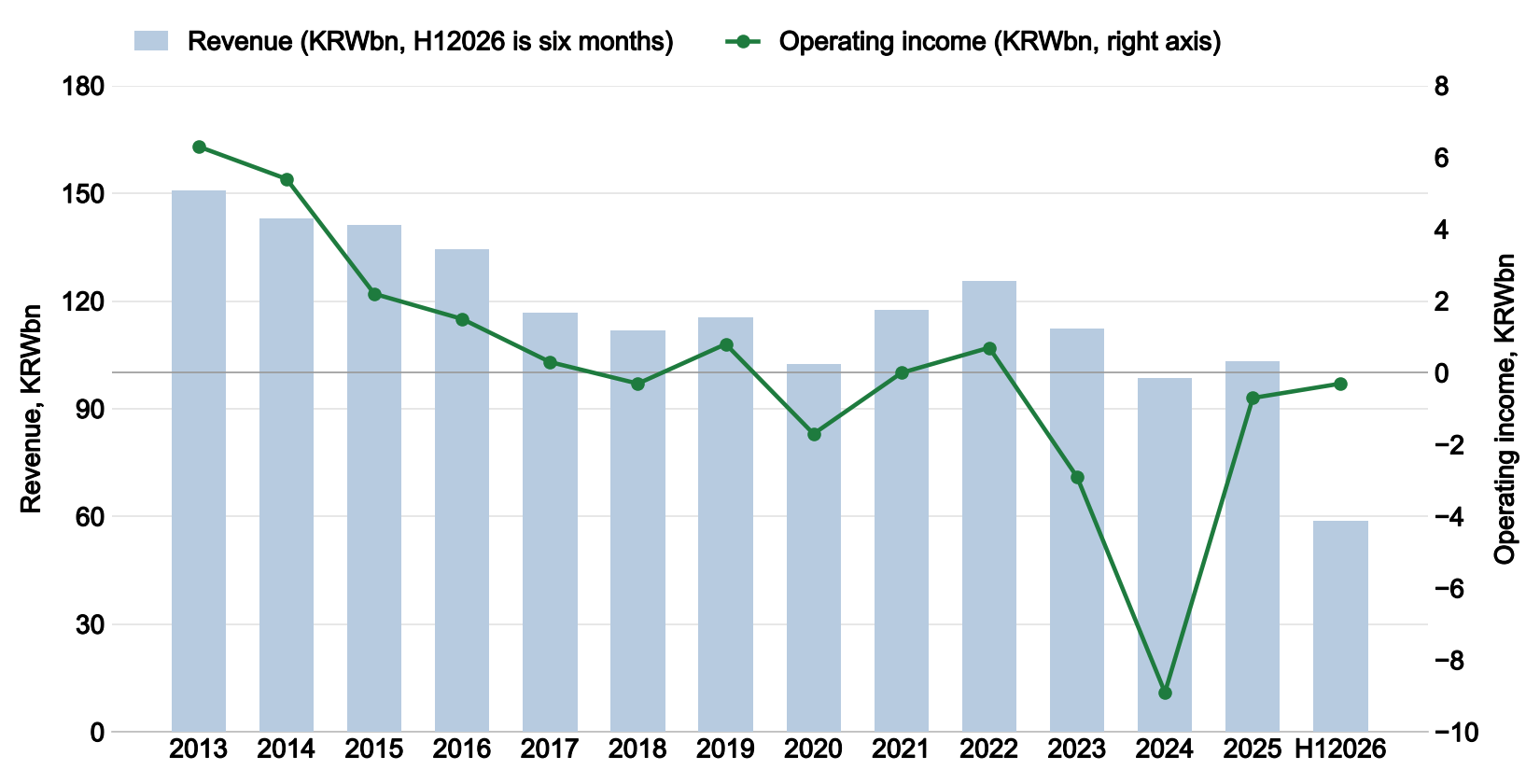
The company’s own explanation is weak demand, too many compounders chasing the same cable makers, the petrochemical downturn, and electricity bills. The Korean plants ran at 64% capacity last FY.
But if you dig one layer down, it looks pretty obvious. The PVC compound business made KRW6bn of gross profit in FY25, which is fine. The LG Chem coloring job, however, lost KRW5bn gross in FY24, KRW2bn in FY25, and another KRW3bn in H1 of this year. It’s 1/5 of revs, and it loses money every single period. I couldn’t find an explanation for why a company keeps doing a job that loses money for its biggest customer. My guess is you don’t fire LG Chem, but that’s a guess.
Also, Wiscom put ~KRW17bn into a new plant in Jiangmen, China, starting in FY17. It wrote off KRW7bn of the plant in FY22. It did KRW1.3bn of revs last year and runs at 21% capacity.
Koo Jo-woong ran the company for 47 years. In May 2025, he handed his entire 29% stake to his son, Koo Young-il, as a gift. The son is 52 years old, has been CEO since 2009, and now owns 40% of the company. The family owns 52% in total.
One thing I’ll mention is that the family owns 85% of another compounder (in the business sense, not the investment term) called Wistech, in the same business, down south in Yangsan. Wiscom owns the other 15%, which I don’t love.
Also, the son owes gift tax on KRW9bn of stock. That probably puts the tax bill at something like KRW5bn. His dividend from Wiscom is KRW300mn/year.
Wiscom is the third company in this series that has announced a Value-up plan (back in March), but it’s irrelevant. The plan is simply stating that Wiscom wants to create a foundation for sustainable growth and improve profitability. There are zero numeric targets. The company pays a dividend, though. It’s been KRW50/share since 2019. This is down from KRW200/share in 2014, after which insiders cut it and never put it back. Fwiw, two months ago, in July, it filed a KRW500mn buyback trust, which is ~1.8% of the shares. This is the first buyback plan in 48 years.
So the only thing I see here is the land. If the son sells one surplus plant, and there is at least one, the cash goes well above the market cap and perhaps something will give. But 47 years of family inertia say he probably won’t. It might be worth keeping an eye on, but I’ll likely forget about this one.
Sam Jung Pulp (009770.KS)
Market cap KRW70bn (KRW28,000/share), 0.49x NCAV, 0.25x book, no Value-up plan.
Sam Jung Pulp makes toilet paper. More precisely, it makes the jumbo rolls of base paper that other companies cut down into toilet paper rolls, and it’s done that since 1974 from three plants, two of them an hour or two south of Seoul and one down near Busan. The family that founded the company owns 74%.
On a net cash basis, if you count investments, the stock is incredibly cheap. The KRW70bn market cap buys you KRW34bn of cash and deposits, KRW101bn of an equity book, and KRW51bn of other investments. Total liabilities are KRW31bn, most of it deferred tax on equity gains. So net financial assets alone are KRW155bn. That’s 45 cents on the dollar, and you get a KRW64bn investment property and the toilet paper business for free on top.
I’ve been doing net nets for a while, and this is a really big gap.
Sam Jung Pulp IPO’ed in 2006 as the biggest base-paper maker in Korea. 20 years later the founder’s son runs the business, and this business is dying from cheap imports. Indonesian and Chinese mills reportedly make base paper 20% cheaper, and 9/10 of imported tons come from those two countries. Sam Jung’s revenues peaked at KRW178bn in FY23, did KRW149bn last FY, and fell 28% in H12026. The plants lost money in both periods.
So the company is shutting the plants down. Pyeongtaek, the head plant, was halted in December. Cheonan’s base-paper line gets halted at the end of this month. The filed reason both times, and I’m paraphrasing only slightly, is “imports are cheaper, there’s too much capacity, and it isn’t coming back.” The plan is to import the rolls they used to make and sell them under the same brand. So there’s basically one plant left, in Haman, running at 87% capacity. I guess it runs until the day it doesn’t cover its costs.
I like that. A family shutting losing factories is what you wanna see. The shutdowns leave two idle industrial sites owned outright. The Pyeongtaek plant is on the books at KRW9.3bn for the land (KRW3.5bn for the building), the Cheonan plant at KRW2.4bn, both bought decades ago. The filings don’t show an appraised value, but the Pyeongtaek site is in Haechang-ri, Godeok-myeon, and if that name means nothing to you, it’s the district where Samsung built its semiconductor campus and where a 13 sqkm new town has been going up since 2019. Part of Haechang-ri was redesignated as new-town land in 2021. I can’t tell you the plant’s acreage or what the land is worth. But I’d bet you it’s a multiple of KRW9bn.
But as you know, there’s always a catch.
What you really care about is what’s in the large equity book. That was disclosed until FY23. Back then, Alteogen, a KOSDAQ biotech, was a very large position with a market value of KRW18.8bn from a cost of KRW3.8bn.
Alteogen owns the tech that turns Merck’s Keytruda, the best-selling cancer drug in the world, from a hospital infusion into a shot you get in a clinic. Merck pays Alteogen royalties for that. In 2020, the stock was KRW15,000/share when Sam Jung bought its 248k shares, all of which it held at the year-end of FY23. By then, Alteogen was at KRW76,000/share, and by the end of F25, the stock was trading at KRW346,000/share. A complete home run.
Sam Jung stopped naming its holdings in the equity book from FY24. But I’m pretty sure Alteogen is still the main chunk. 248k shares at KRW346,000/share is KRW86bn, and the company’s whole equity book was KRW102bn at the end of FY25. The company reported KRW50bn of valuation gains in FY24 and KRW41bn in FY25, two big years for Alteogen. And when Alteogen fell 20% in H12026, Sam Jung reported a KRW22bn valuation loss.
I’m not here to argue about biotech valuations, but it’s worth noting that Alteogen trades at 127x earnings, 43x book, and 89x sales.
Then there’s another KRW51bn of other investments. Again according to the FY23 report, this portfolio is a bunch of private paper: bridge loans on officetels in Daejeon, Cheongdam-dong, and Haeundae, a project-finance bond for a site by Eonju station, private real estate funds, venture funds, a stake in 7-Eleven Korea, and 11 funds run by Alpenroute, the manager that froze redemptions in 2020 during the Lime scandal. Some of those Alpenroute funds are carried at 1/5 of cost, and it’s all valued by a third-party appraiser.
Lastly, the company owns an investment property booked at KRW64bn. In late 2024 it bought a small office building in Samseong-dong, Gangnam, from iCure, a listed drugmaker that needed the cash to pay down debt and stayed on as tenant. The stated purpose was “asset value and business objectives”, which is Korean for no reason at all. It earned KRW1.4bn of rent in FY25, a 2.1% yield, and Sam Jung borrowed KRW8.9bn from IBK to close it, the first debt on the balance sheet in years, since repaid.
So what you have here is not a toilet paper company, but a publicly traded family office that stopped disclosing what it owns two years ago. It made one of the great Korean stock picks of the decade, runs a bunch of private investments, owns an office building in Gangnam, and perhaps owns a bit of valuable idle plants too.
I can’t help but think that a family that wants the float (26%) on the cheap and the minorities bored would do exactly what Sam Jung does. It pays a flat dividend (3.5% yield), doesn’t do buybacks, has no Value-up plan, moves cash into a building that’s difficult to price, shuts plants, and stops disclosing its holdings. But it also fits a family that just doesn’t want questions about its specific investments.
The whole float costs ~KRW18bn at today’s price. At a 50% premium, it’s KRW27bn, and the company is sitting on KRW155bn of net financial assets. Taking this private through a tender offer would be the easiest thing in the world.
On the other hand, why would they? Korea taxes inheritances and gifts at up to 50%, and the taxable value of a listed share is the average market price over the 4 months around the transfer. For an unlisted company, the tax office uses a formula instead, a blend of NAV and capitalized earnings. Sam Jung’s book value is KRW113,000/share, and the stock trades at KRW28,000/share. Listed, the family’s 1.85mn shares are worth ~KRW52bn to the tax man. Unlisted, the same shares would be valued off KRW282bn of net assets, or ~KRW210bn for the family’s 74%. That’s a gap of KRW80-100bn in tax on the next handover.
The Chun family counts 13 relatives. The CEO is 65 years old and owns 24.5% of the shares. His two older brothers hold 25.6% between them, and his sons, at 29 and 33, have 16% and have had most of those shares since they were teenagers. So everything the family is doing to keep the share price down might as well be long-term estate planning, which is no good for you.
If they don’t take this private and you haircut both the Alteogen stake and private book by 50% each (receivables and inventory too), this is what you get for a discount to liquidation value:
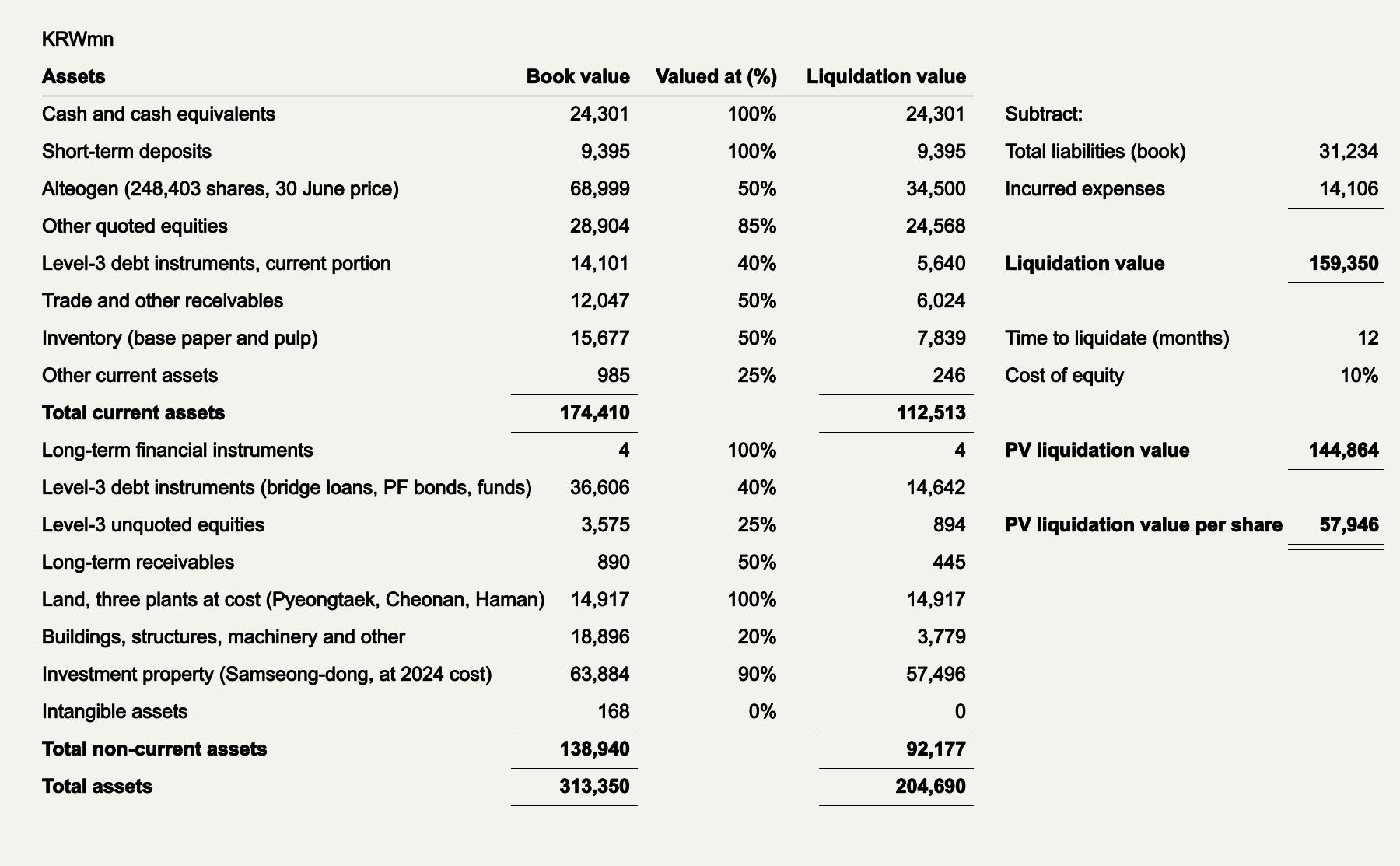
This is a massive discount (for a black box). It’s one of those stocks that you can end up regretting badly if you buy and badly if you don’t. The thing here is that no insider will probably want this gap closed, and they have a lot of tax reasons to keep the price where it is. They stopped telling minorities what they own, and the one time they spent from the cash pile it was on a building at a 2% yield. If they ever do buy out the float, it’ll be at a premium to KRW28,000 and a fraction of liquidation value and you’ll have done fine and been robbed at the same time. I suggest you keep an eye on this one.
TBC (033830.KQ)
Market cap KRW33bn (KRW1,738/share), 0.37x NCAV, 0.25x book, Value-up plan filed March 2026.
TBC is a broadcaster, founded in 1994 when Korea let a private broadcaster, SBS, compete with the state networks in Seoul. TBC is SBS’ affiliate for the Daegu region and carries ~70% of SBS’ programming. With cash and securities of ~KRW97bn, total liabilities of ~KRW6bn, a profitable TV station, a piece of land appraised at KRW30bn, and a market cap of just KRW32bn, this stock is probably the cheapest one on assets so far in this series. But it’s also an easy one to pass because foreigners can’t buy this stock. Korea’s Broadcasting Act (Article 14) bars terrestrial broadcasters from foreign investment. Since December 2023, no foreign ownership exists in the three main broadcasters, SBS, KNN, and TBC.
Aptocrom (109960.KQ)
Market cap KRW29bn (KRW1,903/share), 0.44x NCAV on paper, 0.08x book, no Value-up plan.
Aptocrom trades at 8% of book value. The market cap is KRW29bn. Net current assets are KRW66bn, and equity is a whopping KRW362bn.
I got excited for just a few minutes.
Here’s what the assets are: KRW141bn is convertible bonds issued by Aprogen, the parentco. KRW107bn is loans to Aprogen and two sistercos. KRW84bn is money Aptocrom paid toward the parent’s biosimilar R&D, booked as an “investment” and valued by DCF on products that have yet to sell. KRW16bn is lease receivables from a sisterco. That accounts for pretty much all assets. The rest is KRW4bn of cash, an office it rents to the family, and some cough syrup.
Aprogen, the parent, lost KRW141bn last year on KRW118bn of revs. It has KRW66bn of its own convertibles due within 12 months and KRW45bn of cash. It has issued 35 series of convertibles, and the market prices it at 9% of book. Aprogen Biologics, the sister that owes the most, lost KRW168bn and trades at 12% of book. The holdco above them all has negative equity.
How does a company end up like this? Aptocrom has had five different names since 2015, when a Chinese game developer bought 1/3 of it and the stock went up 600% in a month. A biotech group took control in 2017, and since then, its job has been to raise money from the public and lend it to the corporate group. The company has raised KRW160bn since 2023 alone, including a KRW43bn share offering sold to retail in 2024 at a 20% discount. Two reverse splits later, those buyers paid ~KRW10,000/share in today’s terms. The stock is at KRW1,900/share today.
I wouldn’t touch this in a million years.
Synapsoft (466410.KQ)
Market cap KRW42bn (KRW8,620/share), 0.93x NCAV, 0.58x book, no Value-up plan.
The short story is that Synapsoft went public in late 2024 and was marketed as a growth stock. The growth didn’t come, and the market cap fell to the company’s cash pile.
Synapsoft makes a document viewer that opens Word, Excel, PDF, and Hancom HWP files inside a browser without the native application. It lives inside other people’s software like groupware, email, document management, search, and the “view attachment” button on 70-80% of government and school websites in Korea. 49 of Korea’s 100 conglomerates use it, according to management, among a total of 7k companies and institutions. The CEO says 88% of central government agencies have Synapsoft integrated.
The prospectus says, translated to English, that users of digital document tools are “strongly locked in and find it very hard to change a tool once they’re used to it.” I’ve never heard of this company, I’ve most certainly never used the product, and I’m not sure I understand either the stickiness (~40%/revs is recurring revenue and 1/4 are maintenance contracts) or the AI threat to this business well enough, so I’ll pass on this one. But, worth knowing, it requires little capital and earned a 35% operating margin in FY25 (down from 51% in FY23) and has no debt. And the company has a growing AI segment (KRW0.9bn to KRW2.3bn in revs in the past two years) which partly explains the margin drop as it invests through SG&A. That segment sells the company’s 25 years of document-parsing know-how to companies building their own AI systems, providing a tool that turns HWP and PDF files into something an LLM can read, plus an on-premise chatbot package.
This stuff is outside my circle of competence, but if you’re reading this and thinking to yourself, “what a genius business,” you can take that bet cheaply. At this price, you’re paying roughly NCAV. Current assets are KRW47.1bn against total liabilities of KRW2.5bn. Pretty much all of those current assets are cash and corporate bonds, with just a couple of billion in receivables. If you add KRW7.7bn of non-current fund units, perpetual bonds, and fund commitments, the total financial assets come to KRW53.2bn. As non-operating assets, that puts the EV at negative KRW7bn.
Let’s now look at the two best net net from this batch.