I’m confident that Korea is the best pond to fish in right now.
This wasn’t always the case. Korea is a developed economy with a well-functioning court system, a sophisticated regulatory regime, and a stock market that has operated since 1956. Yet, for decades it’s been a notoriously difficult market to break into for foreign investors, the main reason being that regulators traditionally required foreigners to register through a cumbersome local representative system.
“Difficult”, though never impossible for a hungry enough value investor. In 2004 somebody sent Warren Buffett a Citigroup guide to the Korean market, a book with a single page on each listed company. He spent a Saturday going through it and put $100mn of his own money into about 20 Korean names, personally rather than through Berkshire.
So nah, the real reason Korea has never been a value investor’s paradise (until today?), despite low prices on book and earnings, has less to do with access than with something more structural and cultural. There’s a term thrown around called “The Korean discount” (meaning you’d want to pay less for a Korean company than you’d pay for the same business anywhere else) for a reason, but it’s actually a hodgepodge of reasons.
The overarching one is that the country’s economy has been dominated for decades by “chaebols,” or large family-owned conglomerates that have never had much regard for shareholder returns. Chaebols themselves are old (Samsung dates to 1938 and both Hyundai and LG go back to 1947) but the system that made them what they are was built in the 1960s and 70s. Park Chung-hee took power in a coup in 1961, and after he gained power, he put the commercial banks under government control and decided to point cheap credit at a handful of families he’d picked to industrialize the country. If these families hit their export target, well then more loans would follow at rates that were negative in real terms. The money that built corporate Korea came from the state and then from the banks, never really from shareholders, so the shareholder was never the constituency that mattered. That conflict between controllers and minority holders has been running ever since, and it’s been incredibly difficult to resolve.
Each one of the companies under a chaebol, some listed and some not, is called an “affiliate.” Samsung, Hyundai, and LG each run dozens of affiliates, and the largest 81 chaebols in the country count >3k affiliates under their umbrella. Why this is an issue when it comes to governance is that the families keep a tight grip on their affiliates through a spaghetti-fashion of cross-holdings between them. It’s not abnormal for a family to own, say, just 3.7% of a company but control 62.4% of the votes through a block of affiliates, meaning you could buy as much of the company as you’d like and still be the minority next to a family that owns <4% of it. If you wonder why I picked such odd percentages for illustration, you’ve probably already guessed that those aren’t illustrative but are the real numbers. 3.7% ownership vs 62.4% control represents the average across the country’s chaebol affiliates. Korea’s competition regulator publishes these figures every year here.
And that 3.7% average ownership figure isn’t random either. Korea caps the controlling shareholder’s votes at 3% (the “3% rule”) when a company elects its auditor and audit committee members, whose entire job is to watch management. And while that rule exists precisely to give minorities a meaningful chance to install independent oversight, the second-order effect is that it pushes chaebols to hold as little as possible in their own names and as much as possible through separate entities, further worsening the cross-holding problem.
There’s a book by a local investor named Nam-gil Park titled “A Country Without Shareholder Rights,” which puts Korean governance where the US stood in the 1970s and compares the market to Taiwan. It’s a fair comparison since they both face permanent political risks from their neighbor. But as of today, Taiwanese stocks trade at a median 1.9x book with a median 61% payout ratio. Korea trades at 1x book and a measly 23% payout ratio. The second ratio goes a long way toward explaining the gap between the two countries in the first ratio, and underlying that issue is a bunch of things that have traditionally been wrong with the machinery and have caused the chaebols to not only treat minorities unfairly but also hoard cash and create a jumble of corporate pyramids. Even worse, this machinery incentivized the controllers to in fact keep their own share prices down, and there have been at least four moving parts to it:
- Dividend taxation. In Korea, once an individual’s financial income passes KRW20mn/year, dividends get folded into progressive rates that approach 50%, so the rational move for controllers has been to hoard the cash and pile it into low-return assets and further cross-holdings.
- Inheritance taxation. Korea taxes inheritance at up to 50%, with a surcharge on controlling stakes that takes the bill toward 60%. And because the taxable value of listed shares is the average market price over the four months around the transfer, a family planning succession has a large and entirely legal incentive to keep their share price down for years.
- Merger rules. A Korean merger ratio is typically set by averaging recent market prices rather than by any fair-value opinion. If the merger ratio is decided by the marginal buyer in the market rather than negotiated in the boardrooms, then that’s been good enough for the regulators. In 2015, the Samsung chairman was dying and his son, Lee Jae-yong, needed to end up controlling Samsung Electronics, which he barely owned any of, without triggering the inheritance bill. What he did own was a large slice of Cheil Industries, a small company in the group. Samsung C&T, a separate one, held a block of Samsung Electronics shares. So Samsung decided to merge C&T into Cheil right when C&T was trading at historic lows and Cheil at historic highs. The national pension fund, C&T’s biggest shareholder, swung the vote. People went to prison over that vote (including Lee Jae-yong, but he was later acquitted of all charges related to the merger), and the deal stood anyway.
- Misuse of treasury shares. Because treasury shares haven’t traditionally been cancelled in Korea, in many cases they’ve been used to abuse shareholder value. There have been numerous cases of controllers swapping treasury shares with friendly parties, which is precisely what happened last year when Muhak, a local brewer, executed two treasury stock cross-swaps with its main glass bottle supplier and Samsung Gongjo, an auto parts company in the same region. This has meant that a Korean buyback is less a return of capital than a block of dormant votes bought with shareholders’ money and parked until the controller needs them.
You’re probably thinking why on earth I’d want to touch a market like this.
The reason is that from February 2024, the government has been trying to dismantle all of it, starting with the Value-up program that was modeled openly on reforms that partly ended Japan’s deep-value era. In the Value-up program, public companies disclose plans for their own valuation, stating where the company stands on things that matter to shareholders, ROE and P/B among them, what it intends to do about them, and how it plans to get there. The plans go up on the exchange’s disclosure system where you can read them, and as a carrot to do this (because it’s entirely voluntary), companies with published Value-up plans stand to receive a bunch of goodies such as exchange fee exemptions, government-endorsed recognition, and priority for tax credits.
Just like in Japan, the market gets a reboot from a very, very low point. However, the difference between these reforms and what happened in Japan in 2023 is that in Japan, the main voice for change was the exchange, but in Korea, this is a two-front effort by both the KRX and the government. The KRX has launched a Value-up index that includes the 100 best-scoring publishers. If you go to the KRX website right now, you’ll find the Value-up index before the KOSPI index listed on the front page. The Value-up index comprises 100 companies, 67 picked from KOSPI and 33 from KOSDAQ, and it’s up >2x over the past year.
Now you’re probably thinking, “What is a stack of PDFs on an exchange website gonna do about incentives that run this deep? Won’t these companies just file the paperwork, tick the box, and go on with their day?”
That’s a fair objection. But the government is taking much deeper stabs at it from multiple fronts:
- In July 2025, amendments to the Commercial Act were approved to require directors to balance corporate and shareholder interests. This is similar to what Japan enacted in its Stewardship Code around 2014. Before this amendment, a director’s duty ran to the company, which in a family-controlled company meant the family. This amendment is likely to mean more fairness in mergers, spins, splits, delistings, and other corporate transactions going forward.
- Then in December 2025, the National Assembly approved a massive reduction in the dividend tax rate to a range of 14-30% for “high-dividend payers.” A “high-dividend payer” is one that has a payout ratio of >40% or has a payout ratio of >25% and increases it by 10% from the prior year. Crucially, to qualify, the company must also have a Value-up plan disclosed on the KRX. This is the first reform that really rewires the incentives for return of capital.
- Finally, in February this year, the National Assembly passed another amendment requiring mandatory cancellation of treasury shares. Companies must now cancel newly acquired treasury shares within one year, and existing treasury stock got an 18-month grace period. This is a big deal.
In addition to the natural pressure Korean companies will get from being excluded from the “Value-up club” and all that entails (such as institutional flow from indices and the National Pension Service, the largest pool of capital in the country, which has become more willing to vote against managements that ignore their own valuation), all of these recent reforms make it likely that more activist funds will put a spotlight on public companies to invoke change. My good friend Ryan of Terton Capital is currently and openly pounding the table over the tender offer at Golfzon Holdings where the controller is trying to take the company private at a ridiculous price.
It certainly helps that Korea is also dissolving the old registration regime for foreign investors. Since last year, foreign investors have been able to trade Korean stocks directly through overseas brokerages (myself included). Omnibus accounts have been introduced too, so a fund no longer opens a separate Korean account for every vehicle it runs. Reporting is opening up as well, with every KOSPI company above KRW2tn required to publish in English since May, and all of them from March 2027.
It’s important to mention that regulators have also decided that Korea has too many listed zombiecos, and so the exchange has started clearing out from the bottom. The minimum market cap for staying on KOSDAQ went to KRW20bn in July and will reach KRW30bn in January 2027. 30 trading days under the line brings a warning, then 90 more days to climb back above it, or the company gets delisted. The first company went out in June, another 36 were flagged just a week ago on August 12, and something like 1/10 of KOSDAQ could be gone by the end of the year. This process works against me as much as for me. A market with fewer zombies is a better one to fish in, and real companies that are up for a potential delisting have a corporate governance clock over their heads, but this essentially indiscriminately targets all stocks too small, cheap, and barely traded, and those are a fair description of most of what I’m looking for!
All in, I think all these factors mean the Korean stock market is due for quite a rerating. It’s already rerating now. But, as a stock picker, I won’t bet on the index. The total market is as concentrated as you’ve ever seen, with Samsung and SK Hynix taking up pretty much half of the KOSPI.
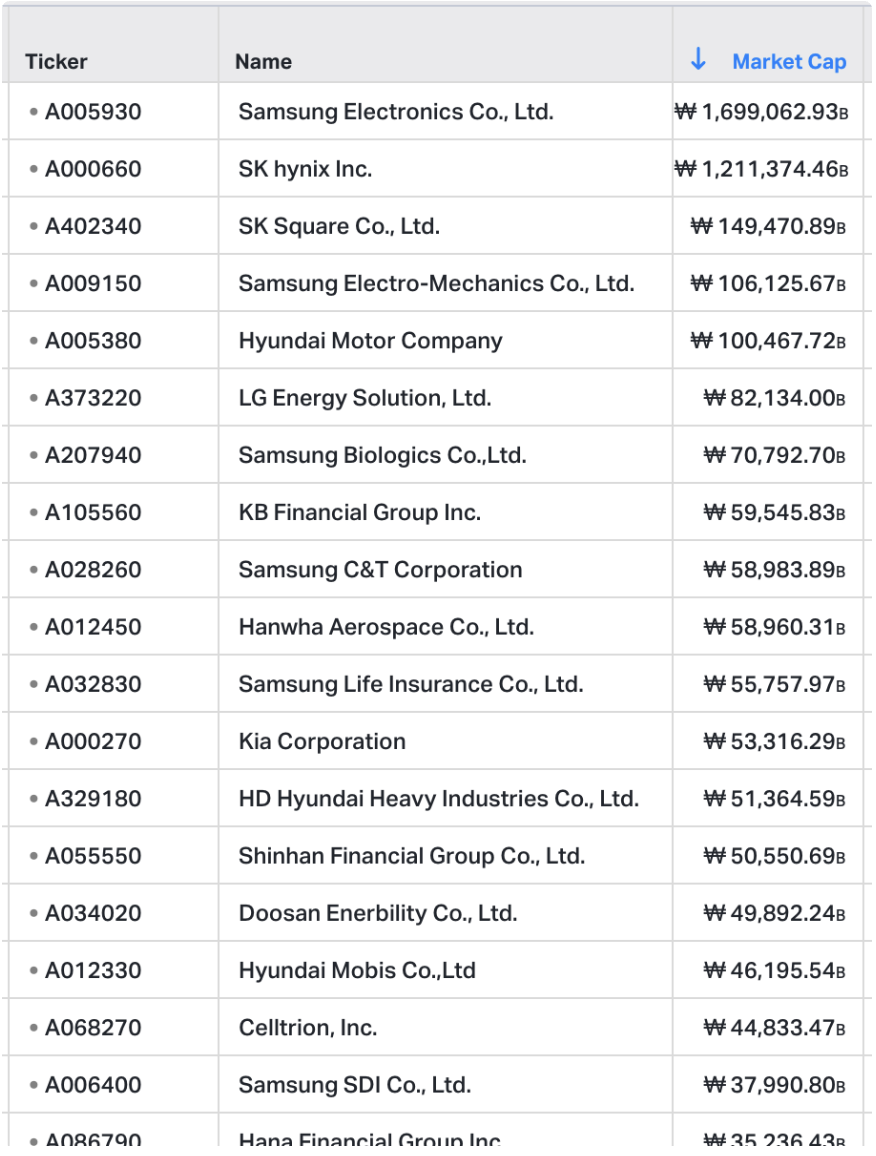
So buying the Korean stock market means betting hugely on memory and getting a couple of thousand other companies thrown in. Korea’s recent market rally has been narrow as well. The KOSPI was up 71% last year while just 140 of its 948 companies beat the index. For various economic (meaning inequality) and cultural reasons, Koreans tend to treat their stock market as a leveraged trading venue rather than a place to own businesses. When Situational Awareness collapsed in the midst of the brief AI trade dip recently, a whopping 1.2mn retail traders received forced margin calls on hugely levered positions. That is despite the fact that Korea has experienced some of the biggest financial shocks in modern history, including the 1997 Asian Financial Crisis. I don’t expect rapid boom-and-bust cycles to go away from Korean markets anytime soon and those cycles will be reflected in the index.
That said, both boom-and-bust cycles coupled with the structural reforms create what I think is the perfect cocktail and tide for value stock pickers. Which answers the question that out of all 2.7k publicly listed Korean stocks, we’ll focus on the absolute lowest-priced of the lot: net nets.
(If you’re new to this newsletter and don’t know what a net net is, I’ve written a guide here.)
I’ve gathered that there are ~180 of them in Korea right now, quite an oddball bunch all trading below NCAV.
Here’s a little overview of what they consist of:
- No single industry dominates the list. The net nets comprise 15 industries and no single one is >13% of the list. (The two most common on the list are electronics/components and auto parts). Just one name on the list is a diversified holding company. The rest do one thing, usually, for domestic customers.
- The median market cap translated to USD for reference is $32mn, and the average is $55mn, with 115 of them <$50mn. 2/3rds trade on KOSDAQ rather than the main board.
- The average P/NCAV is 0.68x. 30 names trade below half of NCAV. Obviously, every one of them trades well below tangible book value.
As of last month, a total of 747 public companies have disclosed Value-up plans out of a total of 2.7k companies listed on the Korean exchange. (You can find recently announced plans on this page.) Those 747 companies account for ~85% of the total domestic stock market capitalization, so there’s obviously a long, long tail of nano-, micro-, and small caps left to join the train. Out of our net net list, just ~1/3rd have filed a Value-up plan so far. I won’t pretend that you can trade around a Value-up announcement pop — maybe you can, I don’t know — and it won’t be my focus in this series. If a company already has a Value-up plan disclosed, that’s great for me as an analyst doing my best to gauge management incentives, but if not, well then you’ve got a potential catalyst in that every Korean public company will probably join the train at some point.
I think what’s happening in Korea is the perfect tide for value stock pickers, and in this series, I’ll write up every single one of Korea’s net nets.
And I’ll do so in batches. Each post in the series will have a batch of net nets, and how many in each post will depend on how much work each name requires. Some will be quick throwaways, some will require a little digging, and some will take up more space. Perhaps I’ll do deeper single deep dives too. But expect something like 10 stocks +/- 5 for each post, and for each post, I’ll paywall a couple of the ones I like the most while keeping the rest open for everyone.
I reckon this series will last 3-4 months, but don’t worry, this newsletter will not turn into a Korean net net herald (even though my name Sung might indicate so). I have other interesting stuff in the pipeline and will continue writing as usual, only I will be much busier writing more. I truly believe Korean net nets are an opportunity one shouldn’t pass up, so now is the time for sprinting!
Hopefully, which is the purpose of this exercise, what we’ll end up with is a basket of the best opportunities right now in Korea, and I emphasize basket for these reasons:
- Buying net nets in baskets is generally a good idea, for reasons I cover in my guide. What’s usual with net nets is that some will go nowhere for months or years on end and then rerate 2x in a single quarter, either due to something external or out of nowhere. You cannot predict which name will be which, and you don’t need to.
- Even as Korea is opening up, it’s still a foreign market with a different culture and different set of rules. I’m not gonna pretend that sitting in Scandi and looking to place bets in Korean names is not a risky pursuit in itself. Downside protection is absolutely imperative. That’s why we focus on net nets in the first place, due to their wide margin of safety.
- These stocks will be dry of two things which are very important to a lot of investors and a little less important to me: liquidity and information access. You cannot carry out an in-depth qualitative assessment of these companies as you’d do in other markets. You look for crumbs of information and try to assemble a picture which isn’t always possible or complete. It will require a lot of manual translation. This is again why we focus on net nets. They’re already by definition so cheap that the numbers carry a lot of the weight. We want to find stuff where we don’t have to predict much and the risk/reward still looks attractive.
- This last point is only somewhat related to why you should take a basket approach, but I just want to note that if you’re investing in Korea through Interactive Brokers, jumping into stocks about to delist (either through the market cap rule or a controller take-private) is a dangerous pursuit. You can risk IBKR liquidating your position. So unless you got a local broker, try to stay away from potential “forced” delistings.
I’ll emphasize once again that I don’t think this window of opportunity will stay open forever. The “Korean trade” as it sits today is quite similar to where Japan was in 2019. And as always, value investing is about fishing where the fish are. I’m pretty excited about the fishing conditions in Korea.
The first batch of the series will hit your inbox early next week (or perhaps by the weekend, if I can keep my momentum), so make sure you’re on the list.
If you’re not on the premium newsletter and want access to every name I write up (as well as the full archive), it works with a simple annual tier at $500 or a monthly tier at $100. You can subscribe here.
Buckle up, and let’s hunt some Korean net nets!
Cordially,
Oliver Sung