I try to stay out of the big headlines. My focus is small, ignored, and obscure stocks, and the loudest blowup in finance/AI is about as far from my typical position as you can get. But every few years the market runs a live experiment that re-teaches something basic, in public and at scale. The GameStop craze was one. The Bitcoin treasuries trading at nosebleed valuations, which I called out last year, were another. The implosion of Situational Awareness is the latest in line, and it teaches the two lessons every investor gets taught sooner or later. This latest one cost ~$35bn of other people’s money.
Here’s the story if you miraculously haven’t seen the news. In June 2024, a 22-year-old former OpenAI researcher named Leopold Aschenbrenner published a 165-page essay called “Situational Awareness: The Decade Ahead.” The argument was that almost nobody understood what was coming in AI, and that he did. A month later he was running a hedge fund named after the essay, seeded by the Collison brothers and Nat Friedman among others. It’s hard to think of any manifesto that has raised more capital per page. His resume up to that point was OpenAI, which had fired him, and FTX, which had imploded. But I’ll be fair to him, since the thesis itself seemed about right. The fund started out nailing the AI infrastructure trade, and by the end of June 2026 it was up 439% after fees for the half year, with assets peaking at $45bn and leverage on the public book reported at up to 4x.
Then, last month, the AI trade rolled over, and the fund’s four biggest public positions in Nebius, SanDisk, Micron, and CoreWeave each fell >35% for the month. The fund’s three prime brokers started calling. And on July 30, the whole public book was sold to Citadel in one block, at a discount, the way you sell a couch that has to be out of the apartment by Friday. $35bn of positions in public AI stocks were offloaded at a total loss (i.e. handed to Citadel in full to settle the margin debt, so that part of the fund is a zero).
After losing its entire public book, the fund reportedly claims to be up 80% since inception. That works because a good chunk of the assets weren’t public stocks at all, but a private stake in Anthropic, which was marked up +620% on paper (private marks are whatever the last funding round says). Blend that mark (~1/4 of assets) with a -100% on the public book (3/4) and you land at +80%. If you allocated on July 1, you caught a zero in a month’s time.
Now, the other side of a forced sale is usually making a good deal. Ken Griffin, the “king of Wall Street”, got to buy a fund’s entire book at a discount, from a seller who had to sell that day. The stocks jumped as soon as the block cleared and the forced selling stopped, the Fed had held rates steady the day before when parts of the market feared a hike, and Big Tech’s earnings landed a day later, with Amazon raising its AI capex yet again. What Citadel paid was never disclosed, but the next day’s jump says enough. And it got the deal by having cash and patience at the moment someone else had neither, a classic Wall Street tale.
Without its excessive leverage, Leopold’s book would’ve had a rough July and lived to see another day.
Now, why do I care and feel the need to write up yet another post on this situation? I’m old enough to have lived through the global financial crisis. And I know what you’re thinking: “Hold on. Weren’t you about 12 years old in 2007?” Yes, I was a kid. But that age was also when I first touched the stock market, with the worst timing imaginable, right before the whole thing came down. I was a squirrel back then, saving every penny from a little business I ran at the time. My parents even offered me a deal to skip my Confirmation party (the Danish coming-of-age ritual where a 13-year-old confirms his baptism, and, more important to the 13-year-old, gets a large party and collects cash gifts from the whole family) and keep the money. I took the offer and threw everything into the stock market. And, naive as I was, basing my investment decisions on tips from strangers online, I bought the worst of the worst, banks and biotechs. By the time the dust settled I’d lost probably 80% of everything I’d saved, which was quite a bit of money for any 12-13-year-old. Yet it still made me fall in love with the stock market and I’ve been hooked on this game ever since. And I feel blessed that I got those lessons so early, at a price a kid could afford.
Had I been born a few years later, the only “crash” of my formative years would’ve been a little taste of the European debt crisis and then the Covid dip, which barely counts. Gen Z has lived their whole investing lives inside one long bull market, with all the craze that’s come with it, and that includes Leopold. The market has rewarded them for every escalation they’ve ever made. Many have been conditioned to YOLO into stocks balls to the wall and gamble their way to the promised nirvana, because every dip they’ve ever met was an opportunity. In many cases, as reported in the media, they’ve been right. For one of these gamblers, the bill for all this conditioning came due in four weeks.
There are two important lessons to this whole situation, and both of them are timeless.
1) Leverage
Everyone knows leverage was the bullet here, but not everyone understands leverage itself. Frequently, people synonymize the word “leverage” with the word “amplify”, which makes it sound like it works the same way in both directions. That’s very dangerous thinking. I’ve explained this before in my post on the Kelly criterion.
Returns compound, and compounding never forgets your worst month. Say you got $100 in one stock at 4x leverage for a $400 exposure. The stock doubles, and the $400 of gains are all yours, so your $100 is now $500. You keep the leverage on, which means $2,000 of exposure. Now the stock drops 25%, and that’s $500 gone, all of it yours too. The stock ends up 50% higher than where you started, and you end up at zero.
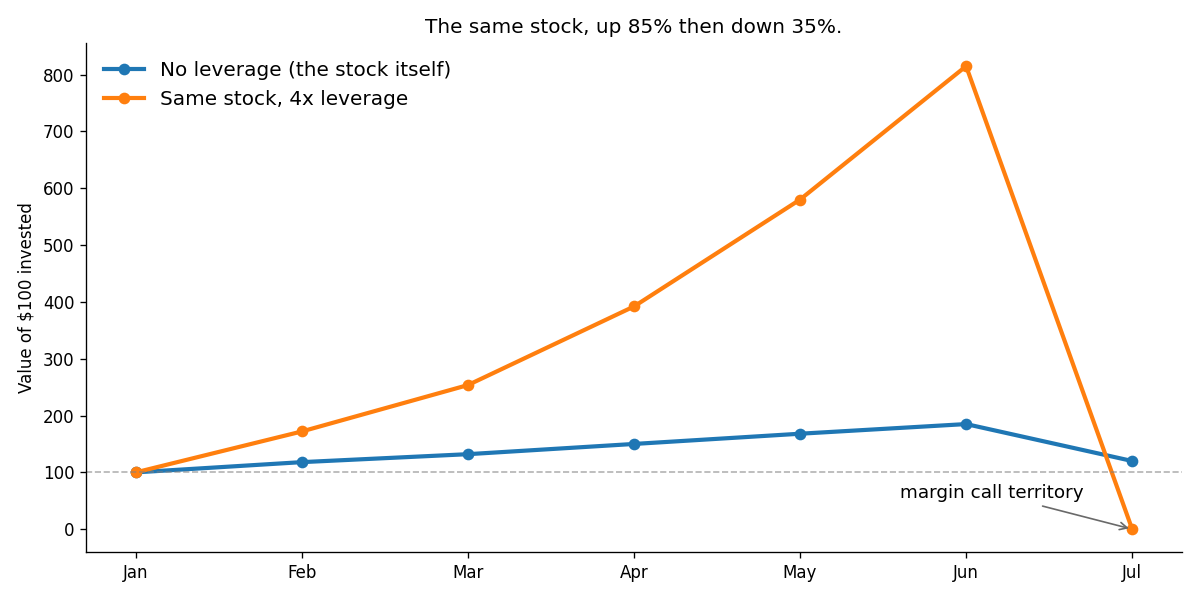
In the illustration above, the investor without leverage ends the seven months up 20% and mildly annoyed. The one with leverage is gone. When a stock falls in price, an investor without debt has one question to answer: did the thesis break? And he got time to answer it. An investor on margin has a second question: am I allowed to keep holding, and will my broker answer that question for me? Aschenbrenner saw the opportunity, to his credit. His July 24 letter called the selloff one of the best buying opportunities since early 2025 and invited fresh capital for August 1, adding: “At times we call out opportunities that seem like a particularly good time to add funds, if you have been waiting for one.” But six days later, Goldman, JPMorgan, and Bank of America forced the liquidation. He may even have been right about the buying opportunity, but it wasn’t his call anymore.
There are only three ways a smart person can go broke: liquor, ladies, and leverage. —Charlie Munger
Regular readers know I make less than a handful of important investment decisions per year. I’ve written before about why, and I call it the sit-on-your-ass philosophy. Sitting on your ass only works if nobody can make you stand up. I’ve had many positions sitting in my portfolio through stretches where the market called me an idiot, no matter how ridiculously mispriced the stock was. I’m sitting on one right now. A margin loan takes that power away on day one. Borrowing money to buy liquid assets that have rapidly changing values is simply a recipe for disaster. And you can have “indirect” leverage in your individual positions as well without your investors knowing it (assuming you run OPM) if the companies you invest in have balance sheets that are levered to the hilt. That’s why I usually prefer stocks with large cash piles and very little debt. Pretty much all my investing mistakes have involved too much debt at the company level.
Underneath all of this is a simple question. How much should you bet when you think the odds are on your side? That’s what the Kelly criterion answers. But if you take away only one thing about Kelly, let it be this. It’s far worse to overbet than to underbet. If you underbet, you make less money than you could have, but your risk is reduced by more than the optimal profit you give up. Overbetting is the other way around. If you overbet enough, you’re guaranteed to make no money at all over time, on the very same winning bets. And that’s what Leopold was running, a concentrated book of AI stocks that were tightly correlated, levered by a reported 4x. It may have been a bold bet with an edge, but at the same time, it was several times past the size where the edge stops mattering. At that size, ruin is just a matter of time.
My partnership’s portfolio is concentrated, sometimes very concentrated. But there’s no leverage and no shorts, and my estimates of edge are guesses like everyone else’s. So when I’m unsure about size, I go smaller. I’d take making less in the good years and still be around for the bad ones any day.
2) Reflexivity
The second lesson is more interesting to me, because funds have blown up on leverage since the beginning of margin lending. Value and price are two different things. The value of a business comes from the cash it makes, how fast it grows, and how risky it is. The price of the stock is just what people will pay today, and that runs on mood and momentum. Nothing forces the two to agree. My investment partnership is built on that fact, as is any other value fund.
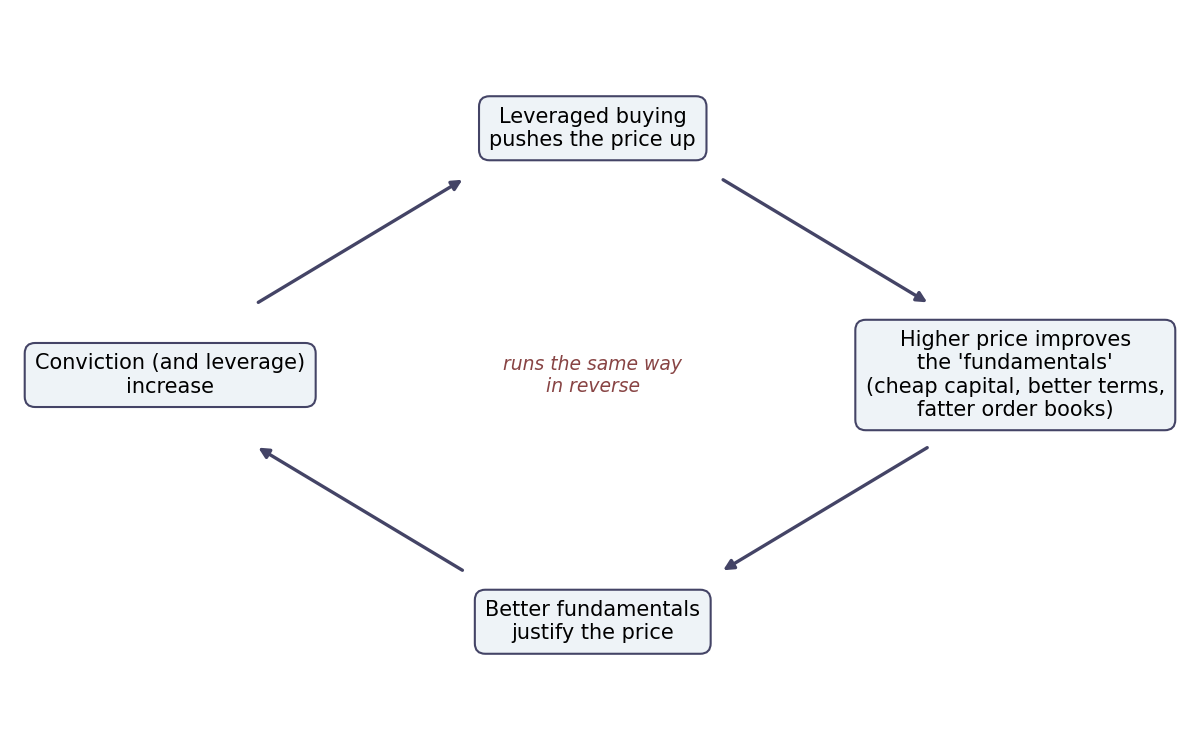
Most of the time, the gap between the two is harmless. The business grinds on, the price wanders, and sooner or later they find each other. But sometimes a price runs way ahead of the value and stays there. And then something funny happens, the high price starts fixing the company’s problems. Lenders get friendlier, since the collateral behind their loans looks better. Employees stick around, since their options are worth something again. And best of all, the company can sell new shares at the crazy price and put the money in the bank. None of this creates anything new, the money just moves from the people buying the overpriced shares into the company. But it’s real money, and if this goes on for a while, the fundamentals will slowly edge toward the price that created them in the first place. This is just how momentum works. A rising price pulls in buyers, the buying makes the story look better, and the better story pulls in more buyers.
AMC was days from bankruptcy in January 2021. Then the squeeze converted $600mn of its convertible debt into equity, and the company sold ~$1.25bn of new stock into the frenzy. GameStop sold ~$1.7bn of new shares by June. In effect, a crowd that gathered to bankrupt Wall Street ended up transferring its own savings onto the balance sheets of two of the most distressed companies in America (AMC is still alive today because of it). The prices were nonsense, but the cash they left behind was crystallized.
By May 2026, Situational Awareness had ~40% of its (again, levered) public book in one stock, Nebius (a stake so big it required a 13G filing). And since filings are public, every pod shop and retail trader could copy the position, and many did. So did Situational’s buying inflate these stocks? Partly, probably. A 40% position on leverage is big enough to move a price, and the copycats added more. But how much of the run-up was the fund and how much was real demand, nobody can measure. The companies can’t measure it either, but they act on the price anyway. Nebius raised $4bn in March, near the top because it needs to. A hyped share price is god’s gift if you keep raising money. The AI startups and data center operators raised money at the same prices and spent it on the orders that every earnings call cites as proof of demand.
So when Leopold’s July letter said the fundamentals were accelerating, he probably meant every word. The fundamentals were accelerating. From inside a loop, the loop looks like being right. But his buying and the hype around what he was doing were part of inflating the bubble.
Reflexivity works both ways. Falling prices forced margin calls (a Goldman note counted ~1.2mn of them in Korea alone in July due to the AI trade dipping), the margin calls forced more selling, and once the market smelled a leveraged seller like Leopold, traders did what they always do and shorted the very names he’d be forced to dump, so the rumor of the liquidation accelerated the liquidation.
Will the AI buildout’s demand survive its own financing? The next few years will answer that, and I don’t know. Hyperscalers’ cash flows are real but free cash flows are decelerating at a rapid clip toward zero.
Anyways, neither lesson requires the answer. Here are some takeaways.
1. Never let anyone else hold a timer on your positions. A falling stock asks whether your thesis broke. Borrowed money adds a second question, whether you may keep holding, and someone else answers it. No expected return is worth handing over that answer.
2. When unsure about betting size, err small. Underbetting means making less money. Overbetting past a point means making none at all. Since your edge is always a guess, stay on the left side of the Kelly curve.
3. Reflexivity can keep a run going for far longer than the fundamentals justify, especially when those fundamentals hinge on cash flows far into the future. The loop can feed itself for years. Michael Saylor at Strategy knows this better than anyone. No reason to bet against it, but to lever into something where small variables can shift the momentum or intrinsic value is insane.
Oliver Sung is the founder of Sung Capital. Sung Capital picks underpriced stocks, usually in pockets of the market where large pools of capital (funds and institutions) can’t or won’t invest. Sung Capital picks stocks only, uses no leverage, and requires a significant margin of safety in every investment. Oliver can be reached at oliver@sungcap.com.