
Today’s batch got another 5 Korean net nets. I spent more time than usual on the one behind the paywall.
I continue to believe that the regulatory and sentimental tide in Korea is an opportunity that doesn’t come around often. A lot of this stuff is simply dirt-cheap, and rarely have I seen a market this lopsided, meaning how many cheap stocks there are that need to go through change and how few are actually looking at them.
I’ve now written up 25 stocks on the Korean net net list. I’ve given them all a rank in the Google Sheet tracker available to premium subscribers. 6 of the 25 have received a rank of 1 (out of 5, with 1 being the most attractive), and they’re pretty much all something that could fit in a net net basket. Just to be clear, a “1” on my list simply means it’s a potential basket candidate. You still gotta stack them against each other, think of their correlation, and a rank is not my way of recommending a buy as nothing here is investment advice. As always, I’ve added a link to the tracker at the end of the post.
Enjoy this batch.
SJM (123700.KS)
Market cap KRW54bn (KRW3,430/share), 0.30x NCAV, 0.21x book, Value-up plan filed March 2026.
SJM trades at a KRW54bn market cap, has KRW109bn of cash, deposits, and short-term bonds with just KRW10bn of debt and leases against it, and a profitable business. The business has existed since 1975, earned KRW11bn last year and something like that on average for a decade, owns its main plants outright, carries land under the Korean plants at cost spanning back to the 1980s, and pays you 6%/year in dividends. FCF has averaged ~KRW20bn over FY23-25, so the whole company trades at ~2.7x trailing FCF with the cash thrown in for nothing.
That’s a cheap stock.
Liquidation model:
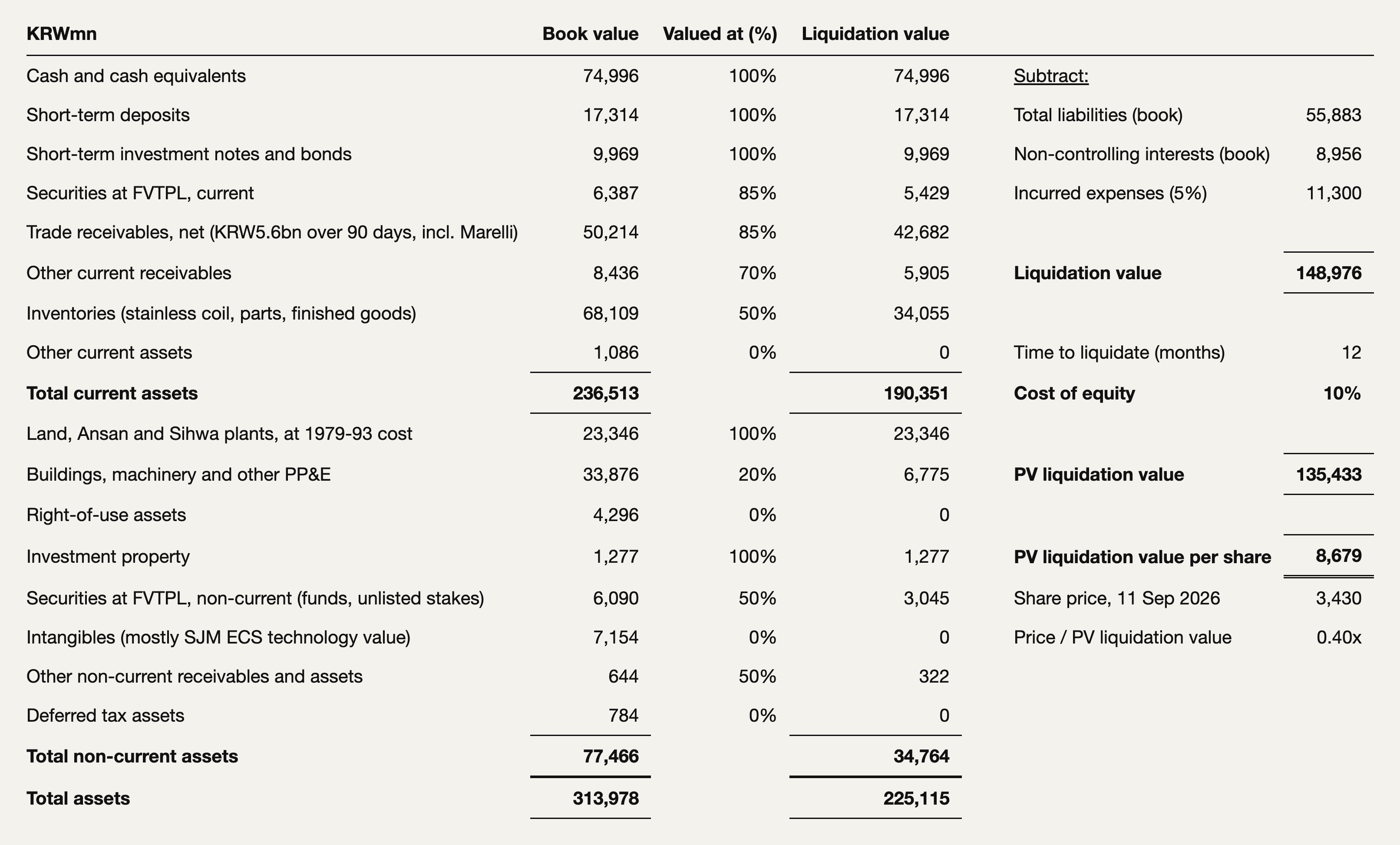
SJM makes the bit of a car’s exhaust pipe that flexes. It’s a corrugated stainless tube wrapped in wire braid, welded between the engine and the rest of the pipe, so the engine can shake without cracking anything. It’s called a flexible coupling. SJM made Korea’s first one in 1975. It now makes 16mn of them per year in Korea, China, South Africa, Mexico, Morocco, and Malaysia, and it opened an Indian plant last year. The customers are the companies that build exhaust systems, like Tenneco, Forvia, or Marelli. That’s 87%/revs, and then there’s a second, smaller business making the same kind of bellows in big sizes for ships, power plants, and pipework. That business has grown from KRW20bn to KRW28bn in two years and earns a 15% margin. The car business, which doesn’t grow, earns a 5% margin.
Now, this stock is cheap for three main reasons:
- The product is an internal-combustion part. It has no place in an EV. Hybrids still need them, though. 7/10 of Hyundai’s electrified cars last year were hybrids. Call it 80mn cars per year that still need the part, shrinking by some 3mn/year. It shrinks the fastest in China, where SJM’s best plant is based and where its profit halved in H12026. So this company has quite a secular wave against it. SJM bought an EV cooling-parts company in 2021 to do something about that. That company did KRW83mn of revs in H12026, lost money, and had its goodwill written down to zero last FY. The company put out a PR in August 2024 saying the cooling tube would be supplied to Hyundai and BMW, but it’s not a viable business yet.
- The Korean parent loses money at the operating line, and the group’s profit comes from the overseas plants, above all Yantai in China, whose profit, again, just halved.
- SJM is controlled by a holdco, SJM Holdings, which owns 40.6%. The founder is 89 years old and still chairman, but his son already owns 51% of the holdco and took over the business in 2013, so the succession is already done. The holdco also owns a steel importer, TNN, which sells SJM about half of its stainless coil (40% of SJM’s raw materials purchases), so the family takes a margin on SJM’s raw materials one layer above the minorities.
Against those realities are two options for the value here:
- Option one is the land beneath the plants. The Ansan and Sihwa sites are on the books at KRW23bn, both purchased between 1979 and 1993. There’s no appraisal in the filings. Whatever they’re worth today is upside value.
- Option two is the plant business. It earns 15% operating margins, is the one growing segment, and sells into LNG carriers and nuclear plants. It’s a nice little business hiding behind the crappy auto parts business.
This is, of course, another case where the family likely does nothing and neither might the price. But at 0.3x NCAV with a 6% dividend, a profitable business, and a few optionalities, it’s still cheap enough to consider.
Fashion Platform (225590.KQ)
Market cap KRW17bn (KRW3,265/share), 0.20x book, 0.44x NCAV, no Value-up plan.
Fashion Platform, a women’s clothing company founded in 2009, trades at:
- 1.5x TTM earnings
- 1.9x FCF, a 54% yield
- 0.2x book
- 0.44x NCAV
- 0.5x EBIT
The market cap is KRW17bn. Cash and securities are KRW21bn against KRW11bn of bank debt. You have investment property too, booked at KRW18.5bn, with an appraised value of ~KRW25.4bn.
The company generates a significant amount of cash. Operating cash flows were KRW10.9bn over the TTM period against KRW1.9bn of capex, most of it office equipment, because the company owns no factories. The apparel is cut and sewn by outside workshops. That’s ~a normal capex rate, running below D&A. The exception was FY22, when it spent KRW18.3bn on the investment property and borrowed KRW12.9bn to do it, and FY23, when it added KRW5bn of own-use land and buildings. Revenue has been KRW104-110bn for 4 years, and the company has been profitable in each of them.
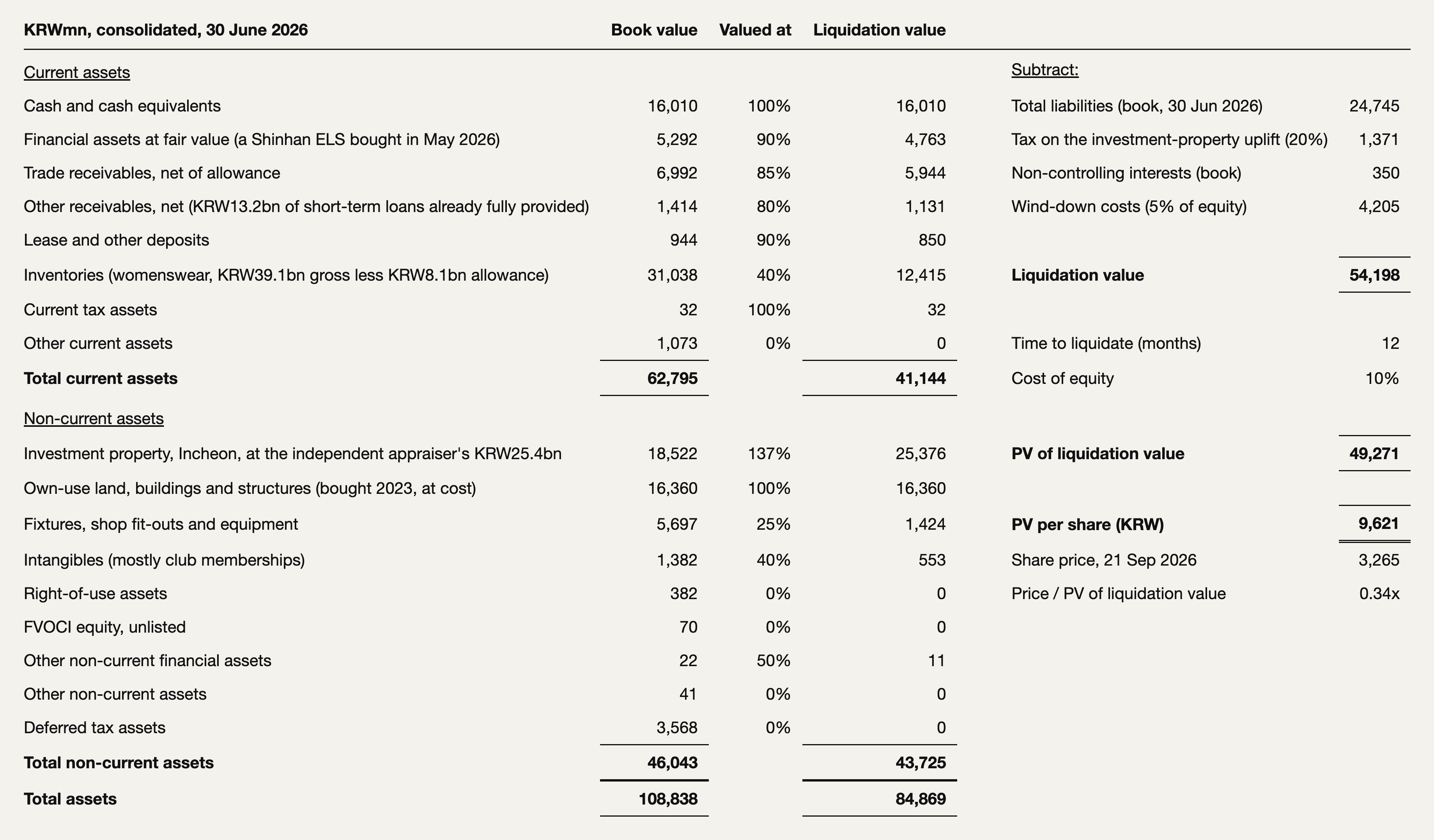
According to my liquidation model, you’re paying ~1/3 of what an orderly wind-up would hand back.
So why is this thing priced like a liquidation?
- Well, it’s tiny. Park Won-hee owns 39.7% of the company through his own clothing firm, Maven FC, so the float is KRW10bn.
- The exchange has designated it a “management stock” on August 13 after spending 30 trading days below the KRW20bn market cap line. This could turn into a delisting or a move to KONEX.
- Earnings numbers are not all clean. The company’s own disclosure credits last year’s operating profit jump to write-backs on multi-year-old inventory. H12026 took another KRW1.7bn. That said, if you strip the write-backs, this is an ~KRW6-7bn normalized operating profit business, which still puts the EV at about 1x.
- It’s a “levered” net net. Total liabilities account for more than half of haircut current assets. The investment property sits as collateral for the company’s KRW11.4bn bank loan.
Also, Fashion Platform sells five apparel brands. The Renoma is the big one, and it’s licensed from its French owner, with expiration in 2029. The other four are owned: Bonnie Spark, Le Shop Blanc (bought in 2021), Liete (launched in 2023), and DECO (bought out of bankruptcy in 2021). These are all mid-market brands, pretty much all go through department store concessions and outlet malls, and the company holds ~a year of inventory. This is why the mid-60s gross margin looks good but isn’t.
In its entire listed life, Fashion Platform has never paid a dividend. But back in March, the board went ahead and cancelled all >1mn treasury shares (3.9% of the issue), then ran a 5:1 reverse split in May, and in June promised to return at least 10% of adjusted net profit for 3 years. On last year’s number that’s ~KRW600mn, which is a 3.6% yield.
That payout policy announcement, however, did nothing to lift the share price above the market cap threshold, and in the fortnight after the stock was designated a “management stock”, one of Park’s relatives sold her entire 1.27% holding into the market. It’s small money but surely worth flagging.
I haven’t spent too much time on this stock. It’s dirt cheap, but the market cap threshold and the owner’s intentions for the listing scare me. On September 4, the authorities pushed the step-up in the KOSDAQ floor from KRW20bn to KRW30bn back by six months to July 2027. They also allowed profitable companies (positive operating profit in two of the last three years, or one of three with equity >KRW20bn) that fail to clear the market cap threshold to move to KONEX without the liquidation trading period. Fashion Platform would be included here, but if you trade with the likes of Interactive Brokers, you might get forcibly liquidated. If you do decide to buy this, size cautiously.
Hwacheon Machine Tool (000850.KS)
Market cap KRW82.5bn (KRW37,500/share), 1.0x NCAV, 0.24x book, Value-up plan filed March 2026.
This company calls itself Korea’s oldest machine-tool maker. It’s been making lathes in Gwangju since 1952. A lathe is the machine that makes round metal parts. It spins a bar of steel and holds a cutting tool against it (like the way a potter shapes clay on a wheel) until the bar is a shaft, a bolt, a bearing housing, or a car axle. The product’s cousin, the machining centre (think CNC milling machines), holds the metal still and spins the tool instead, for anything that isn’t round. Every factory that makes anything out of metal owns a few of each of these.
Hwacheon sells these machines through a listed distributor (Hwacheon Machinery) it owns 40% of, and exports the rest. Revenue has swung around KRW220bn for the past decade, and operating profit swings between nothing and a decent year depending on the capex cycle. H1 2026 was good, but through the cycle, returns on the business are abysmal.
So the stock is priced at 24% of book value, and there are several different assets here. As for non-operating assets, the company has KRW109bn in cash and securities, some listed affiliates, and some unlisted holdings. I’ve marked the listed holdings to market and find that the stock is priced at 64% of its net financial assets.
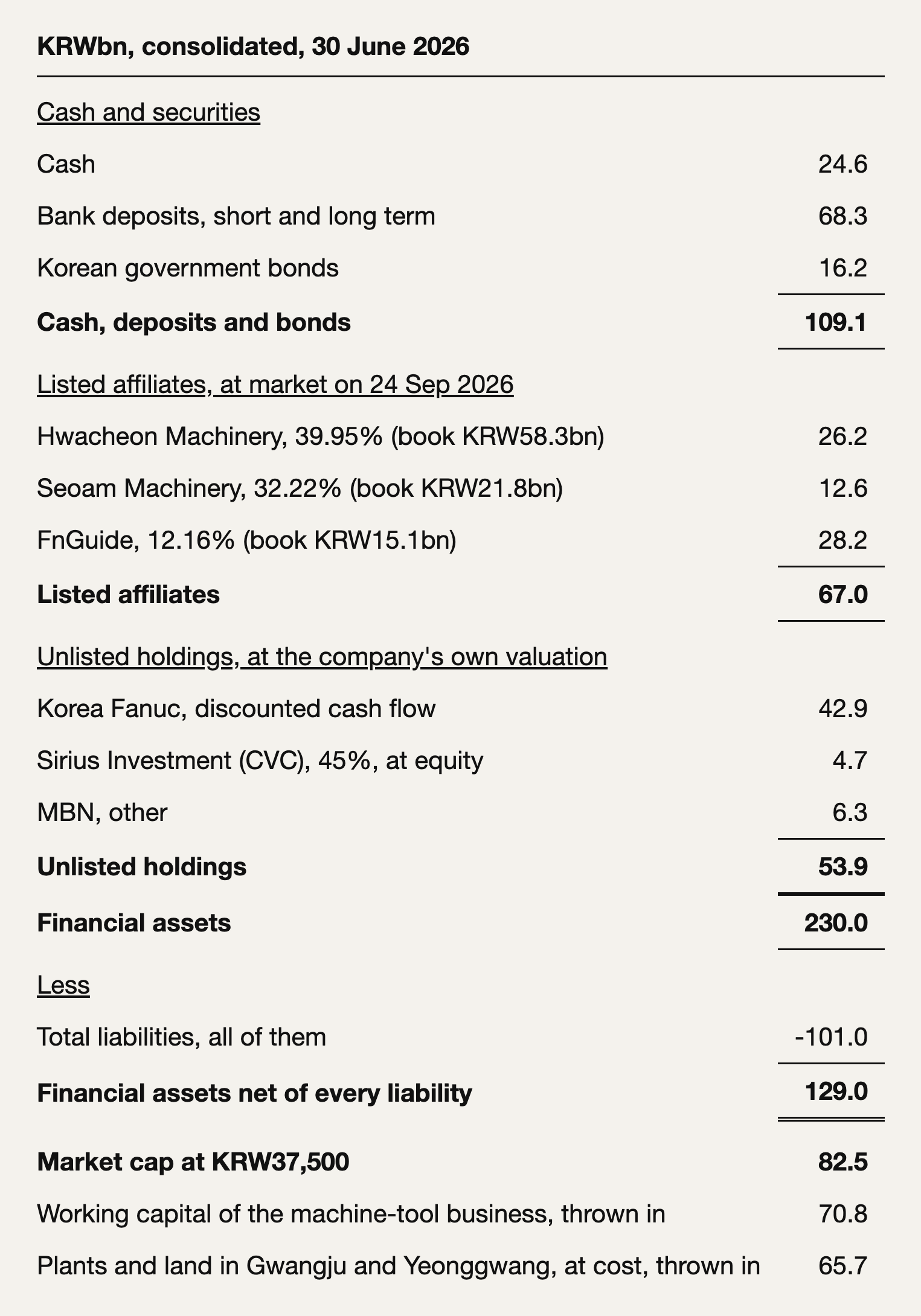
The issue here is that two of the three holdings above are family companies. Hwacheon Machinery is the distributor and sells Hwacheon’s lathes in Korea. Seoam Machinery makes gears. The family won’t sell either.
The third listed stake is 12% ownership of FnGuide, which is a financial data firm. In 2005, the Kwon family, which owns 49% of Hwacheon, put KRW1bn into a data startup run by a former Samsung analyst. That small investment turned into quite a homerun, and today, the whole company has a market cap of KRW230bn on KOSDAQ. The Kwons control 48% of it. 12% is held through Hwacheon, 10% by the distribution arm, and 26% is held by the Kwons directly. Through 2023 and 2024, two third-generation family members went on the board and the chairman’s brother-in-law took the CEO position. Hwacheon’s 12% stake is an anchor of that control block, so this is not a liquid equity stake either.
Although it’s not a dealbreaker in this case, the Korea Fanuc unlisted stake is interesting. In 1977, when Hwacheon built Korea’s first NC lathe, Fanuc, the Japanese company that makes the brains inside most of the world’s machine tools, wanted a way into the country. In 1978 the two set up Korea Fanuc as a 50/50 JV. Five years later, Hwacheon sold most of its half to Kolon, a Korean conglomerate, and kept a sliver. Kolon sold out to Fanuc in 1998. Today, Hwacheon owns 5.3% of the company, and it’s a great asset. Korea Fanuc sells the controller inside almost every machine tool built in Korea, Hwacheon’s included, and earns ~KRW37bn/year doing it.
Hwacheon carries the stake at KRW43bn, so ~22x earnings. The dividends Hwacheon receives from Korea Fanuc are about equal to the amount of dividends it pays to its own shareholders. To you as a shareholder, the stake is worth its dividend and nothing more, since there’s only one buyer on earth for 5% of a Fanuc subsidiary and that’s Fanuc.
As I said, the Kwon family and their foundation own 49% of Hwacheon. Kwon Young-yeol turns 80 this year and holds 18%. His son Kwon Hyung-seok is in his 50s, became co-CEO in March 2024, and holds 15.5%. Four Kwons sit on the board.
In FY25, the four Kwons on the board paid themselves — hold onto your coffee — KRW3.8bn. The company’s entire operating profit that year was KRW4.2bn. Three of those same men drew a second salary at the distribution arm of KRW2.3bn in FY25, from a business with almost no operating income. The honorary chairman collected KRW2.1bn between the two companies. The family takes 4x more through the payroll than through the dividend. This is excessive.
Meanwhile, the ageing chairman still holds 18% of the shares after passing 5.5% to his son, so they, for now, have a clear interest in keeping the share price down, at least until one of the bills aimed at exactly this becomes law. Until then, a low price is the cheapest way to move the remaining 18%.
I don’t know why I spent so much time writing this stock up, because it still looks like a value trap from the outside. I guess what got me interested was the Value-up plan announced back in March that aims to double the P/B and “amend the articles on dividends,” whatever that means. Keep an eye on any news about dividends for this one.
Jindo (088790.KS)
Market cap KRW30.2bn (KRW2,430/share), 0.60x NCAV, 0.27x book, Value-up plan filed April 2026.
Jindo sells fur coats. It was the fur name in Korea in the 1980s, when imports were banned and the coats went over the counter hand over fist. The company went through a workout after 1997, was bought by a conglomerate called C&Group for KRW174bn in 2004, and when C&Group collapsed, the fur company was bought out of the wreckage in 2009 for a minuscule KRW4.5bn by a Namdaemun trader named Lim Oh-sik. Revenue was KRW128bn in FY17 and KRW48bn last FY. Fur is, of course, a shrinking category sold through department stores. It still makes money, ~KRW4bn of operating profit in FY25, hinging on the fur coats’ 50% gross margins.
Liquidation model:
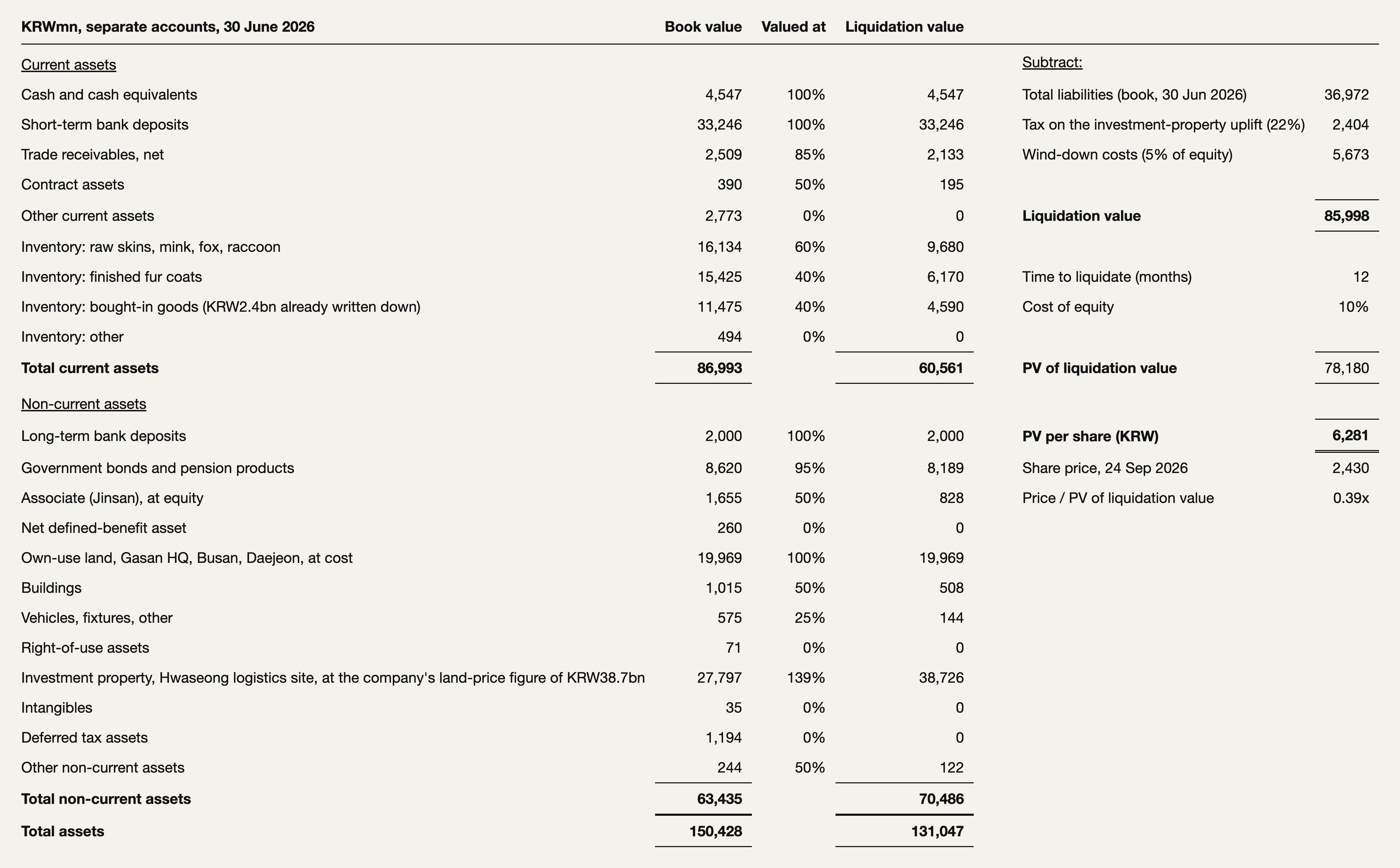
I’ve taken the fur inventory at 40-60% of book, the land at the company’s own land-price figure, and everything else at book. Price-to-liquidation value is 0.39x.
It’s worth noting that this is a “levered” net net. Jindo has bank debt of KRW31bn. It finances its skins with import credit, the same way every fur house does it, and rolls it every year. Net cash is ~KRW17bn.
Lim Oh-sik is 77 years old by now and still the chairman, though he doesn’t sit on the board. (In Korea, “chairman” is a job title, not a board position per se.) He’s the company’s only unregistered executive, which means shareholders have never voted on his pay, and it shows. Last year, he was paid KRW900mn, almost 2x the whole registered board. This is down from KRW1.8bn in 2018.
In 2015, prosecutors charged him with embezzling about KRW13bn from his other companies, by leaving shop takings off the books and paying salaries to relatives who never worked there. In 2017, a court found part of it proven and gave him two years suspended for four.
Jindo was left out of it, to be fair, but this is still who you’re rolling with.
In October 2025, he handed the company to his son, not as a gift, but as a swap, which the tax code doesn’t treat as a gift. His holdco traded its 40.7% ownership of Jindo to Lim Byung-nam in exchange for shares in three private family companies.
In June, a shareholder named Kwon Pan-seok wrote to the board. He’s a lawyer and owns ~1% of the shares. He asked for a shareholder meeting and was ignored. He wrote again and was ignored.
So he went to court, and while he waited, he started publishing open letters on the Naver message board (Korea’s main retail investing forum). He proposed six sensible things: interim dividends, a mandatory annual value plan written into the articles, executive severance tied to the share price, a KRW5bn buyback, a KRW10bn reserve reduction so dividends come tax-free to small holders, and himself as a second auditor.
Sixty-three days after his first letter, and six days before the court hearing, the company called a meeting with all six of his items on the agenda.
But the board added two of its own. One of them wrote a KRW2bn director pay cap into the articles, so it never has to be voted on again. The other one, which was clever, is a pre-vote on whether the company needs a second auditor at all.
That matters a whole lot, because Korea has a 3% rule: in an auditor election, no shareholder gets to vote more than 3%. It’s the one vote a controlling family can lose. So what the board did was put a question in front of shareholders that isn’t an auditor election, and where its 50.6% ownership counts in full.
Kwon knows he loses at the October 8 meeting.
There’s a whole lot to dislike here, so it’s a clear pass. What I also need to mention is that for KOSPI-listed stocks, the market cap threshold goes to KRW50bn in July 2027. This stock is at risk of delisting or a move to KONEX if it doesn’t clear it.
Let’s now look at the best net net from this batch.