In the US, ~12k stocks trade over the counter rather than on an exchange. They include the whole palette of market misfits like community banks in Pennsylvania, family-controlled insurers, German and Japanese companies whose home listing is the primary listing and whose US quote is a convenience for American holders, a long tail of shells and delinquent filers, and a decent number of profitable little businesses that never saw the point of paying an exchange for the public trading of its shares.
This corner of the stock market, the OTC market, has a reputation, most of it earned by the worst quartile of it. The OTC market has corners that most people would rather not be seen in, so lots of market participants stay away with a ten-foot pole. This is the kind of market where I like to fish the most.
Someone has to run the plumbing for the OTC universe, and not everyone knows that the one doing it is a public company listed on its own market. The venues where those quotes get published, where broker-dealers negotiate and match, and where the price data comes out and travels on to Bloomberg terminals and brokerage apps, belong to OTC Markets Group, ticker OTCM. Cromwell Coulson bought the business in 1997, when it was the old Pink Sheets and the quotes were still printed on pink paper, and he has run it every day since. The stock is quoted on OTCQX, which is one of OTC’s markets.
Standing between every buyer and seller in a monopolistic or oligopolistic market is obviously a great business. Exchange operators (OTC Markets is not an exchange, which I’ll return to, but it can still be counted here) have always been excellent long-term investments. Look up any exchange operator and take a long-term chart. It’s hard to find total shareholder returns <13%/year over the long term.
For an exchange or stock market operator, tolls rise with activity, the assets are a pile of servers, and the customers have nowhere else to go. The market knows it too, which is why the chance to buy an operator cheap rarely comes around.
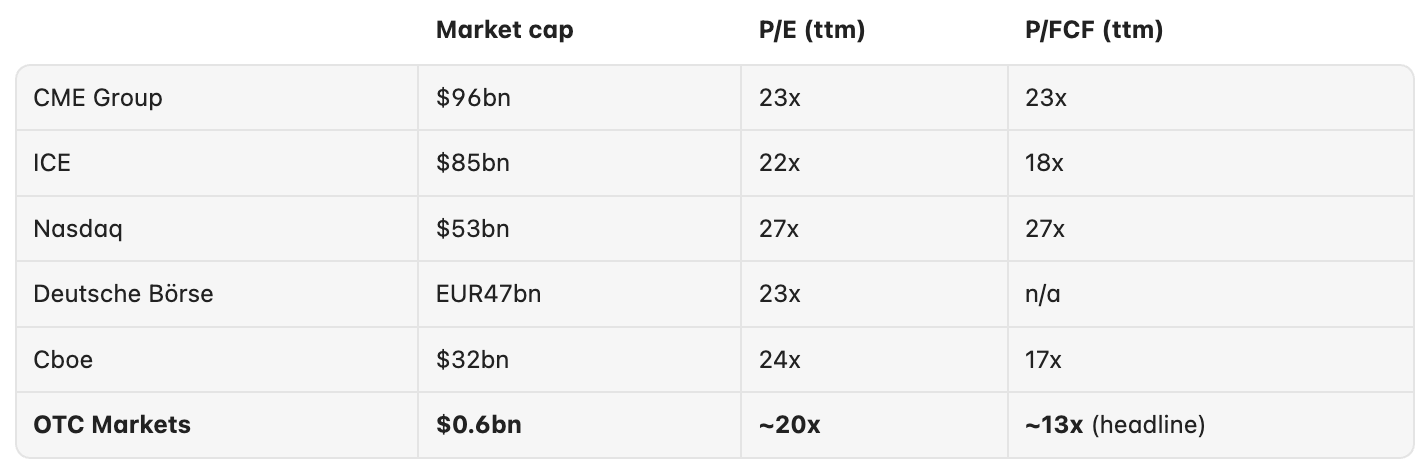
I’m zeroing in on OTC Markets today because 2025 was the best year in the company’s history and the stock has stagnated for more than four years. The company now has a ~$625mn of market cap against almost >$40mn of FCF (ex stock comp), or ~15x (headline is 13x). Measured on my stricter owner earnings number, it’s still under 16x. Whenever you get the chance to buy a market operator of the largest game in the world, the stock market, at <16x, that’s probably a nice decision because the cash flows are durable as hell. And OTC Markets runs the market the exchanges aren’t allowed to compete in.
That’s because, legally, OTC Markets is no exchange operator, but a broker-dealer (a distinction the company is probably happy about). It runs four trading systems and the SEC regulates all of them.
Picture a market square in a town where the supermarkets aren’t allowed to trade. OTC Markets owns the square and nothing else. It doesn’t own the stalls, nor the goods. It never takes the other side of a trade. What it does is decide who may set up, check that the sellers are who they say they are, and take money from three different market participants.
Let’s start with the stallholders. >3k companies pay for a pitch, somewhere between $6k and $25k a year depending which one they take, so ~$15k each. A company on the top tier pays less in a year than it would spend on one round of legal fees getting ready for a Nasdaq listing. These stallholders brought in $48.7mn of revenue last fiscal year for OTC Markets.
Then there’s the dealers at the pitch. They pay for connection to the venue where all of their OTC business happens, and they brought in $26.3mn of revenue last fiscal year. Across 145 broker-dealers, that’s ~$181k each, which is less than one trader’s pay.
And then there’s the price list, meaning the record of what everything in the square sold for. For OTC Markets, selling the price list itself is the biggest earner of the three revenue streams, bringing in $50.4mn last fiscal year. ~28k professionals and 10k retail investors pay a monthly fee to access that list. A couple of dozen trading firms pay a bigger fee that covers their whole firm. And Bloomberg, Fidelity, and Yahoo Finance pay to show it to their own users.
Add the three tolls together and you’ve got a market square bringing in $125.3mn in a year, with 80% of it billed twelve months in advance. For an operation that stands between every buyer and seller in ~12k securities, that’s quite a small operation.
Here’s how a trade works:
Say I want to buy shares in some Ohio bank holding company with a few branches, founded in the 1800s, profitable every year I can find a record for, and never written up by anybody.
The first thing to understand is that nobody ever listed this bank. On an exchange, a company applies for a listing, signs an agreement, and pays for it. In the OTC market there is no application because the market runs on the dealers. A company that wants a US quote can engage a dealer to set one up, and plenty do. But a dealer can also do it entirely on its own, whether the company asked or not. That has happened before. When a rule change made it easier in 2008, US depositary banks created more than a thousand OTC-traded ADR programs in foreign companies within three months, many without the companies’ consent, and some of those companies complained loudly.
Now why would a dealer choose a sleepy Ohio bank to trade OTC? Because market making is a business. A dealer earns the gap between the price it buys at and the price it sells at, and this bank has shareholders who die, divorce and retire, and heirs who want to sell. At some point a dealer decided there was enough of that trade to live off, and asked to post its prices OTC.
Asking is required, because posting prices in unknown companies is how stock scams start. The law says current information about a company must be publicly available before its stock may be quoted, and somebody has to check that it is. These days that checking is mostly done by OTC Markets’ own compliance team. And that check never goes away. If the bank’s information dries up, the quote dies for every dealer at once, and the stock gets banished to the Expert Market, a shadow corner where only professionals may see a price.
So what this means is that OTC Markets runs the square and it runs the gate into the square, and the gate is written into federal law rather than into a contract.
Now, the bank we’re trying to trade did make one choice of its own, which is what kind of pitch it wants to trade in. It could stand at the back for free. Plenty of companies do that, and they’re quoted and tradeable like everyone else. But instead this bank has decided to pay ~$25k a year for OTCQX. Trading on OTCQX means an adviser has been through the filings, the share price clears a minimum, and somebody has confirmed the company is neither a shell nor bust.
Why pay at all when you can be listed for free? Because the paid tiers work like the hygiene rating in a restaurant window. You pay to be inspected and to display the result, and the rating decides who’s willing to buy from you. Some buyers won’t deal with a stall nobody has checked. Others can’t, because their own rules forbid it.
And then there’s the usual American issue that every state has its own regulation on top of the federal, so whether a broker may recommend a stock to a client depends on the state the client lives in. A stock listed on an exchange gets a federal pass across all fifty. An OTC stock doesn’t, and nobody registers a small bank’s shares state by state, so for years a broker in, say, Texas simply wouldn’t be able to pitch our bank to anyone. These state laws are called Blue Sky laws, and OTC Markets has worked at dissolving the problem on its issuers’ behalf. 40 states now waive the requirement for any stock on OTCQX or OTCQB, up from under 30 a few years ago. Every state added means more brokers who may actually sell stock of an issuer, which is a decent return on a $25k subscription.
At OTC Markets, there are four tiers of pitches, and each step down checks less. To trade on OTCQX, the highest tier, a company has to put up $25k a year. Then there’s the “venture” tier, OTCQB, at ~$15k. Then OTCID at ~$6k since it launched in July 2025, and the infamous Pink Sheets at the back which is free.
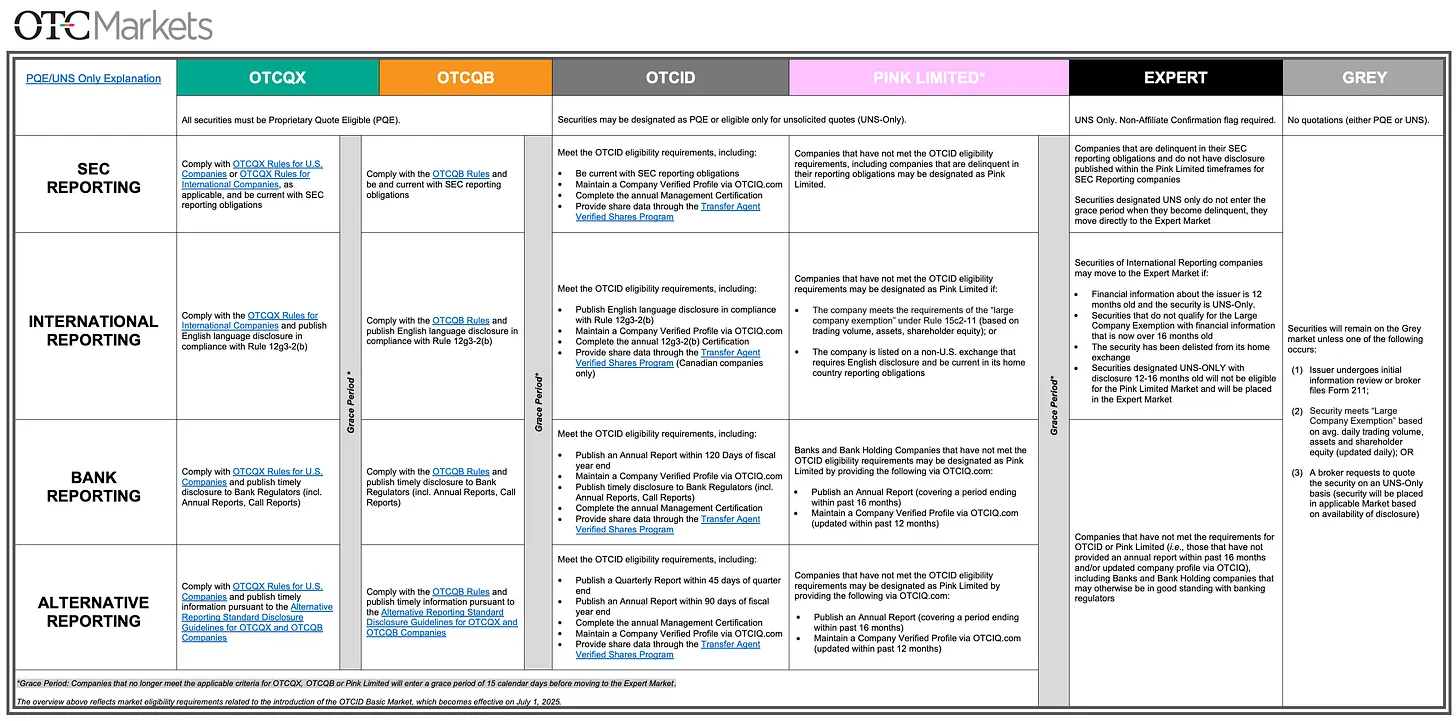
The fee paid is flat whatever the size of the company. In contrast, an exchange charges by size. At OTC Markets, Siemens Energy, which joined OTCQX this July at a ~EUR70bn market cap, pays the same $25k for its US quote as our small bank, against the six-figure and scaling bill it would face on the NYSE. That’s most of why ~70% of the top two tiers on OTC Markets consist of foreign companies. At the same time, this means OTC Markets earns nothing extra when one of its issuers grows tenfold.
So the bank pays its $25k, making me more comfortable to trade the stock, and now my order goes in. But as we established, instead of the order routing to an exchange, it goes to OTC Link. Those 145 dealers post the prices they’ll buy and sell at, under their own names. They pay a monthly fee to be connected and more per security to publish their quotes. That dealer takes the other side of my trade, we agree a price in a few seconds, and the trade is done.
But then it prints, and that record belongs to OTC Markets. It’s now the only thing telling anybody what this bank is trading at and has traded at in the past. I’ll check the position tonight on Yahoo Finance, a fund’s compliance desk looks up whether it may own the thing, and somebody in Singapore pulls the quote on a Bloomberg terminal. All three are buying the same price list, and selling it is the largest revenue generator for OTC Markets. A retail Level 2 license (Level 2 shows every dealer’s bids and asks with sizes, where Level 1 shows only the best of each) runs $20/month, a professional one $100/month, and a broker-dealer taking the same feed across its whole firm $30k/month. Most of the data revenue arrives through the redistributors, meaning Bloomberg, Fidelity, and the like, who pay OTC Markets for the feed and resell it inside their own products. The three largest of them alone account for 13% of group revenue. Coulson calls the data licensing part of the business a cornered resource. OTC Link is where the price gets set in these securities, so nobody else has the quote and trade history and nobody can buy twenty years of it.
But this business has a moat around it that counts more than data licensing. US law stops a national exchange from trading securities that aren’t registered with the SEC, and plenty of OTC issuers aren’t. Nasdaq and the NYSE fight over the companies that grow up and leave. Everything underneath is off limits to them. Meanwhile, anybody else can open a rival square, and it still wouldn’t work due to entrenched network effects. Registering a trading system is cheap and no statute stands in the way. NYSE Group has run one called Global OTC for years with nothing to show for it. Instead, every dealer is on OTC Link because every other dealer is on OTC Link, and to move you’d need all of them to move on the same morning.
But isn’t the moat just a statute then, you ask? I stopped worrying about that when I read the history. The lineage runs back to the National Quotation Bureau, which started printing dealer quotes on pink paper in 1913. Coulson bought control in 1997, when the business was a printing operation with a fax machine. Then Nasdaq’s OTC Bulletin Board, the incumbent quotation system for these securities, went away. On the Q32025 call, an analyst put that to Coulson as luck and got corrected.
“We didn’t just benefit from the OTC Bulletin Board. We competed it out of existence. We better serve the broker-dealer communities.”
A competitor wouldn’t need much capital to go after OTC Markets either, because this business requires none. Issuers and data subscribers both pay their annual fee up front, so OTC Markets was sitting on >$30mn of deferred revenue at the end of March. Strip out the cash and the goodwill and ~$34mn of operating assets stand against $50mn of liabilities. The business runs on roughly negative $16mn of capital.
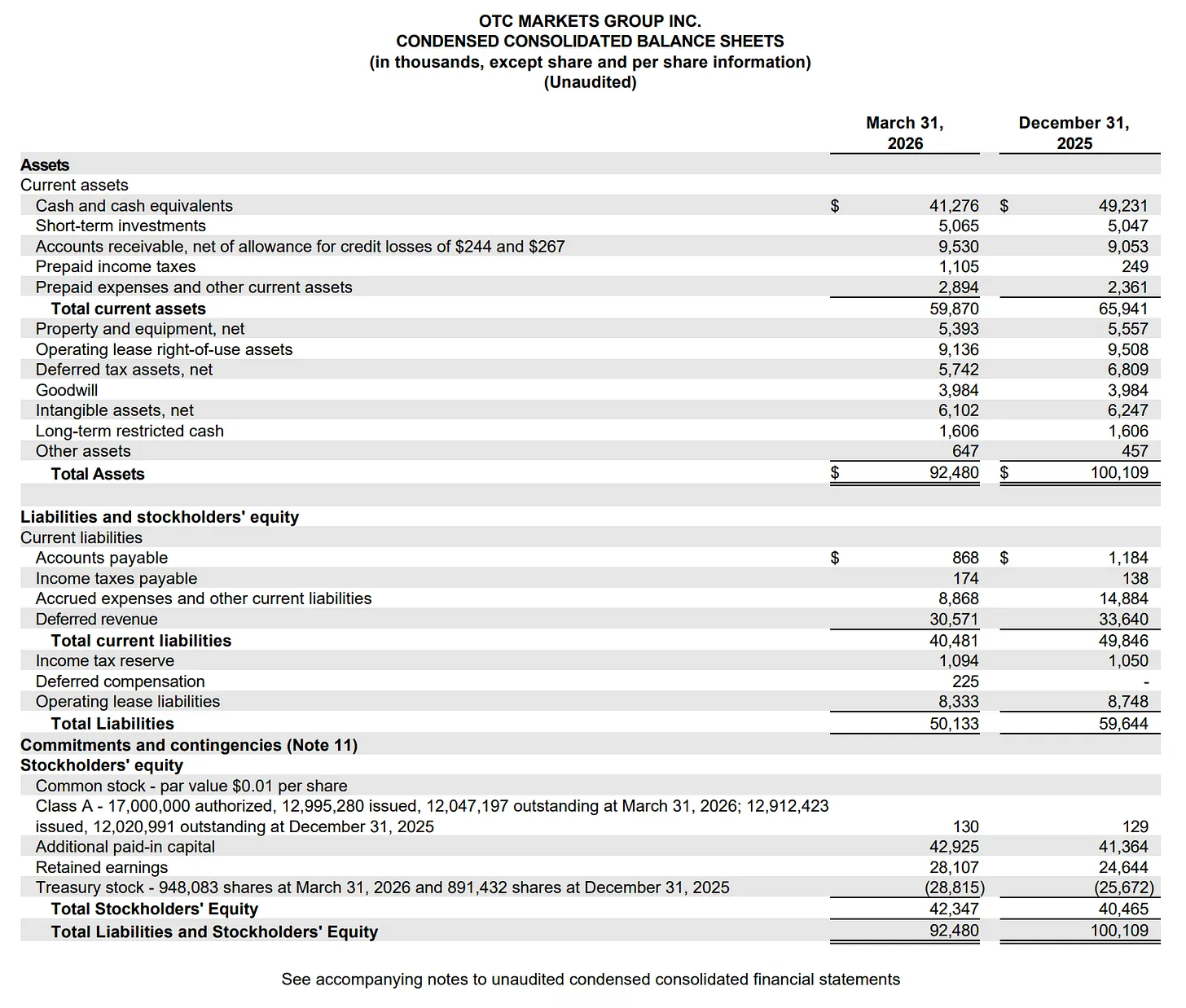
OTC Markets’ capex was $220k last year against $2.6mn of depreciation, and the entire physical plant behind the main US venue for >12k securities is $5.6mn of property and equipment, less than the company spends in a year on professional fees. That makes the return on capital infinite, or, in other words, growth free for shareholders. This is a wonderful business.
So why has it derated? Because for four years, operating income has gone nowhere, even on $22mn more revenue.
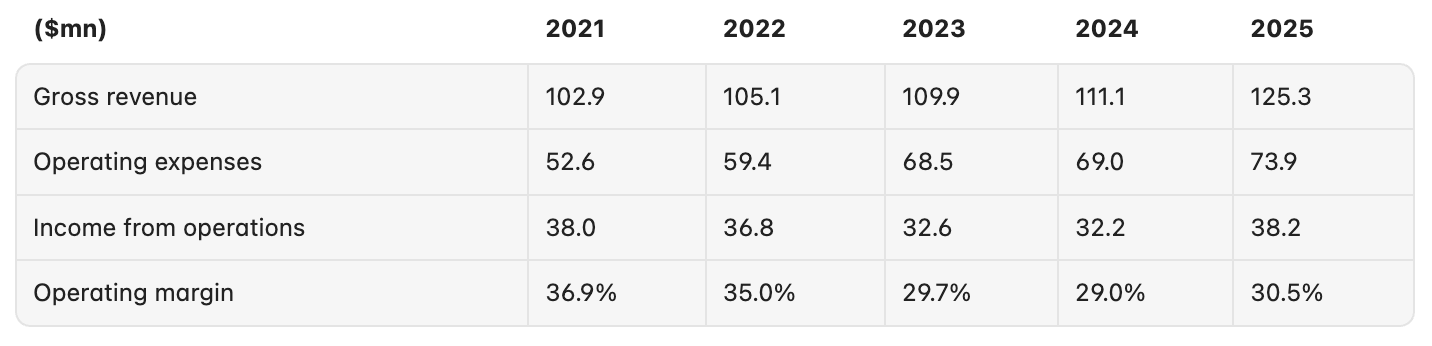
EPS has gone backwards, $2.52 in 2021, $2.53 in 2022, $2.28 in 2023, $2.26 in 2024. And that is for a company calling itself a growth business. What happened is that the money went into people, which is the only way this company can invest. Here’s the income statement, 2021 vs 2025:
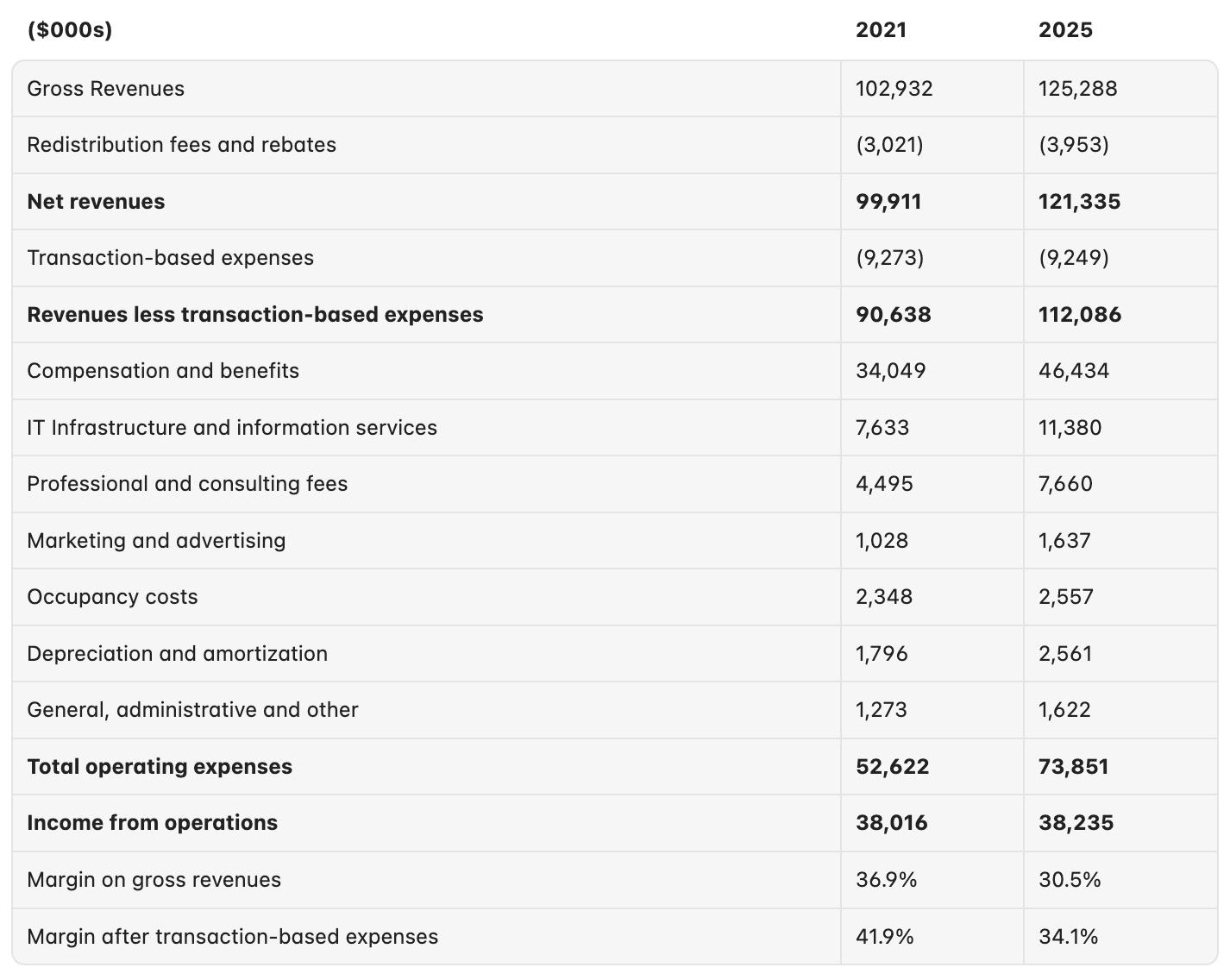
Compensation has gone from $34.0mn to $46.4mn, IT infrastructure has added $3.7mn, and professional fees $3.2mn. That’s because, as Coulson puts it, “our IT spending, it’s people.” So the years it spends hardest are the years the margin looks worst.
Was the spending a build or a leak? The headcount gives half the answer. Employees went 107, 131, 134, 133, 130 across those years, meaning all of the hiring happened in 2022, 24 people in one year, seven of them arriving with two small acquisitions. Since then the company has hired nobody on net, so this was a one-time expansion rather than a cost base drifting away.
What did the expansion buy? Mostly it bought the compliance machine. Those hires are the team that now runs the 15c2-11 information reviews in-house, which is what lets OTC Markets man the gate itself instead of waiting for a dealer to sponsor each stock, and what made joining much simpler for foreign companies. The two small acquisitions became the Blue Sky and compliance data products it now sells. And the same stretch paid for the plumbing behind OTCID and overnight trading, the two newest revenue lines which I’ll return to behind the paywall. In other words, the money bought capacity that’s becoming visible in the topline. Also, the margin has slowly edged back up on cue, 29% in 2024, then 30.5% in 2025, and 25.5% in Q12026 (up 80bps yoy).
Which brings me to the man, because this is an owner-operator story and his temperament is important. Coulson has owned and run the place for nearly three decades now. He holds 27.1% of the shares outright, a family trust holds another 7.4%, and the stock is most of his personal wealth.
What I like most about Coulson is what he refuses to do, which is charge what he could. That’s because this company earns 30% operating margins where CME earns ~65% and Nasdaq ~48%, and the gap is deliberate. A shareholder asked him on the Q22025 call whether the spending was now done and margins could head for exchange levels. His reply:
“Why not go for 90%? I actually, the exchanges have a model which I think is probably best exemplified by Larry Ellison at Oracle. And whenever Oracle buys a technology we use, we plan on how are we getting rid of it in the next three years. Then you’ve got other businesses like Costco, and they provide consistently competitive prices. We need a margin because we need to be open every day. I am not margin obsessed. I am margin of safety obsessed. So when things have generally gone up, our margin has gone up, it’s because we’ve had a good run, and then we have to grind back in. Our goal is to be the kind of company that Charlie Munger would want to own.”
He put a number on it a quarter later, and it’s hard to miss:
“I get grumpy when it starts going below 30%. Otherwise we get spendy above 30%.”
I like it. A man who owns a third of the company and caps its margin on purpose to keep his dealers loyal is behaving like an owner. He’s leaving money on the table to widen the moat. You’re buying his discipline and patience as much as the business.
Pull back further, though, and those four flat years look different again:

Revenue has compounded at ~10%/year for eleven years and net income at ~13%, with no capital consumed and nearly all of it paid out along the way. In other words, those were four bad years inside two good decades. So the central question was never whether this is a good business, but whether the growth is durable, because at this share price, you’re still paying for some.
Let’s now get to the bottom of how attractive OTC Markets is as a stock…