
Software is eating the world, and AI is eating software. The further that goes, the more I find myself looking for assets that live in the physical world and can’t be copied by anyone with a keyboard. Today’s company owns that kind of asset.
The company is SUTL Enterprise (SGX: BHU), owner of ONE°15 Marina Sentosa Cove and the only listed marina operator in Singapore. On paper, it’s one of the cheaper asset plays I’ve come across in a while:
- ~1.1x book, and the book is mostly cash and property.
- ~SGD69mn of liquid assets against an SGD81mn market cap. No bank debt. ~2x EV/EBIT.
- 25% pre-tax margins, financed partly by long-standing customer prepayments.
- A 5% dividend.
- A pending SGD40mn acquisition that doubles the berth pipeline and lifts EPS 14%.
- A rebuild would cost several times the EV, if anyone were allowed to try.
It reads like the kind of setup that attracted me to Karelia: a cash pile nearly the size of the market cap, a controlling family, and no analyst coverage. But the two are not the same, and the difference is the point of this writeup. Karelia’s pile is free cash. The tobacco business needs none of it, so you can count it as value on top, and then you got the exchange-driven catalyst as a cherry on top. SUTL’s pile only looks like free cash. SGD40mn is earmarked for an acquisition (which isn’t a bad thing), but I’ll argue the rest is being saved for the biggest issue hanging over the company: the marina that generates effectively all the profit sits on a single leasehold expiring in 2034. In April, management confirmed it’s in talks with its government landlord about renewing it, eight years early. It’s for those two reasons I’m writing up SUTL now. What happens at lease expiration is what makes the investment case path dependent. And there’s a third reason: SUTL has circulated in deep-value circles for a couple of years, and every writeup I’ve found on it is extremely bullish, mostly resting on the cash pile. I looked, and the pile isn’t what they say it is. My bullishness is more tempered.
Add to that a 53% family owner under a takeover code that has let controlling shareholders take out minorities cheaply, a stock where on some days barely any shares trade, three years of flat revenue, and reported earnings that overstate the cash the business makes today, and you can see why the market wants a discount. This one is for small accounts.
The Tay story starts in 1968, when Tay Choon Hye set up SUTL as a ship-chandelling business supplying merchant vessels in Singapore’s harbour. Two generations later it’s a private consumer-goods and lifestyle group operating in 18 markets with a reported ~SGD800mn in annual turnover, and the family ranks #35 on Forbes’ Singapore’s 50 Richest with an estimated net worth of $1.6bn.
Arthur Tay, the founder’s son, runs the group, and boats are his thing. He built ONE°15 at Sentosa Cove in the mid-2000s, opened it in 2007, and made it the first marina in Southeast Asia to earn the Platinum Gold Anchor award from the Marina Industries Association. He chairs the Singapore Boating Industry Association, sits on the board of the international marine-industry council, and reportedly keeps a yacht or two of his own.
The listing of SUTL came later, and in an unusual way. In August 2014 the family sold the marina club and a small yacht-chartering outfit into Achieva Limited, a computer-parts distributor that had lost SGD8mn the year prior, for SGD21mn paid entirely in new shares (a reverse merger). SUTL Global, the family’s holding company, went from 25.3% of the shell to 54.8%, got a waiver so it didn’t have to make a general offer, sold off the IT business, and renamed the company SUTL Enterprise. So the marina has effectively only been public since 2015, and the family took control of a listed company by selling its own assets to it. That sounds worse than it turned out. The deal went through a minority vote, and related-party dealings since have been minimal. Minorities have been treated fair so far.
ONE°15 has ~270 wet berths, 33 of them for superyachts up to 200 feet. Around the berths sit a members’ club with restaurants and bars, a small hotel, a spa and gym, and a service operation that fuels and maintains the boats. A wholly owned subsidiary charters out a fleet of >50 luxury yachts it mostly doesn’t own, so that part is asset-light. The company also manages other operators’ marinas for a base fee plus an incentive fee, and consults on marina development. Revenue splits into 3/4 goods and services and 1/4 membership and management fees.
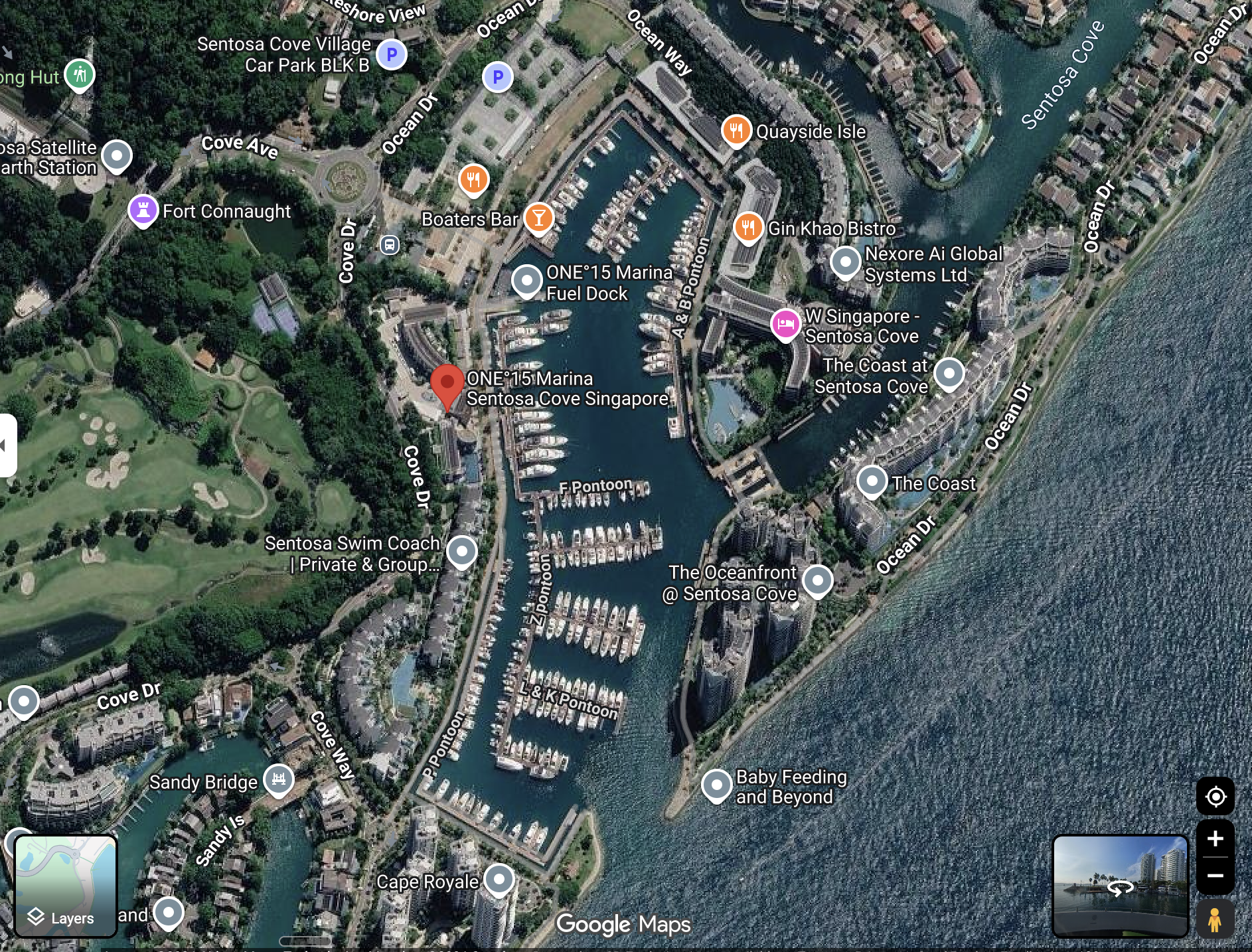
It’s easy to see why demand is strong. Imagine you own a yacht that cost some million and burns a big chunk of that every year just sitting in the water. You need somewhere to keep it, and in Singapore there isn’t much suitable waterfront, marina permits are hard to get, and ONE°15 is the best address in the country. The berth costs nothing next to the boat, the boat has to live somewhere, and while it lives there you buy fuel, servicing, dinners, parties, and the odd charter when guests are in town. And Asia keeps producing more of these customers: the region’s large-yacht fleet is up ~1/3 in five years according to the industry estimates I’ve seen, and the marina hosted a record Singapore Yachting Festival in April of last year, with 70 yachts on display and 12k visitors.
So far, so good. Now let me show you why the earnings aren’t exactly what they look like, what the cash pile is really for, and what I think the whole thing is worth.